
Forty-third in a series
If you are engaged in conversation with a Muslim about religion, there are two areas where you will likely be asked questions. The first concerns God’s nature; the second is Jesus. The answers aren’t necessarily quick, but they can be done. The inconsistencies within the Qur’an offer a starting point. This includes the dilemma mentioned in the last article whereby the Bible and Torah are both recognized as coming from God, but they will likely believe (or at least say) they’ve been corrupted. This, too, can be addressed. Also, remember you, too, should ask similar questions along the same line to the person you are talking with.
Even if you never speak about religion with a Muslim, you will likely speak with someone who attended an inter-faith event in the past, or watched programming on television about Islam. These sources also spout the same standard Islam narrative, and are therefore in the same need of correction. Even books are often based on the standard Islamic narrative. It’s always best to begin with the original source material, before listening to another. That’s what I’ve attempted to do in this series.
The Trinity Versus Tawhid
The early Church Father’s writings responded to Platonic philosophical thought. Two concepts needed to be understood and laid out when discussing the divine during this period. First, what is meant by the terms “the one” and “the many”. The second concept concerns divine immanence versus transcendence. Christianity and Islam express very different ideas, but let’s start by explaining these two concepts first.
The One and the Many[1]
What is meant when we say a thing “is one”? Is it a simple unity from which nothing can be made from the things that are left, or is it a complex whole of many parts? A simple unity can only be defined in negative terms—what it is not. The hypothesis for a simple unity is “if the One is to be One, it will neither be a whole nor have parts.” Further properties of a simple unity include:
- Have neither a beginning, middle, nor end,
- Is without shape,
- Not anywhere, neither in itself nor in another,
- Neither at rest nor in motion,
- Can’t be different from another or the same as itself,
- Neither like nor unlike, and neither equal nor unequal, to another or itself,
- It has no share of time, nor is it in any time,
- Therefore, it is not named or spoken of, nor is it the object of opinion or knowledge, nor does anything that is perceive it.
A complex unity, on the other hand, can be described in positive terms—in terms of what it is. The hypothesis for a complex unity is, “If One is … the one that is, must it not itself, since it is one being, be a whole, and the parts of this whole be oneness and being.” A complex unity therefore has both unity and being. An example of a complex unity is you. Other properties are the negations of those listed above, such as having a shape, and being like and unlike others.
These two hypotheses “present us with a pattern of two unities—a unity which is simple, bare, one and nothing but one, and a unity which is infinitely complex, one and many.”
Immanence and Transcendence
In regard to God, transcendence meant being remote from the world and beyond the reach of human knowledge. Immanence, on the other hand, meant God being present in, and perhaps identical with, the world.
Clement of Alexandria is one of the earliest Church Fathers for whom we have some writing. He lived in the second and early third century. Within Middle Platonic thought, to which Clement was responding, these two issues were blended, with the simple unity being transcendent and the complex unity being immanent. However, the blending of the two concepts varied for each philosopher.
The Trinity
The term Trinity does not appear in the Bible. It is a Church construct intended to help us from straying further from an idea of who God is. It is not complete, but a description to aid us in our understanding. A definition is, “the union of three persons in one Godhead, the Father, the Son, and the Holy Spirit.”[2] This idea can be diagrammed as follows.
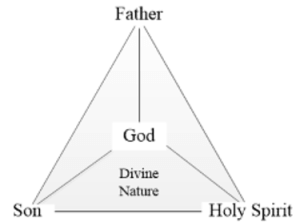
Each of the persons named at the three corners is not the other, but each is God as shown by the lines connecting them to the divine nature in the center.
Clement laid out his argument this way. The Creator is God. He is transcendent and therefore One, and cannot be known by us through human wisdom. He is outside of time and space, a simple unity. It is God’s power which is immanent, and it appears to be a complex unity as there are different positive attributes associated with that power. Clement lays out his arguments regarding the Father and the Son. He only makes a couple of references to the Holy Spirit within his writings.
Clement presents two different themes of the Father and Son. One theme places emphasis on their unity, such as, “The Son in the Father, and the Father in the Son.” The second theme indicates some of the distinctions between the Father and the Son. One example, “And as the unoriginated Being is one, the Omnipotent God; one, too, is the First-begotten ‘by whom all things were made, and without whom not one thing ever was made.’”[3] Clement says the Father and Son are first principle and creator in different senses of the word.
Trinity References in the Bible
While the word Trinity is not mentioned in the Bible, references to it exist in many places. We can begin in Genesis 1, with the first two verses. These are shown below in Hebrew and their literal English translation. The passage is read from right to left.
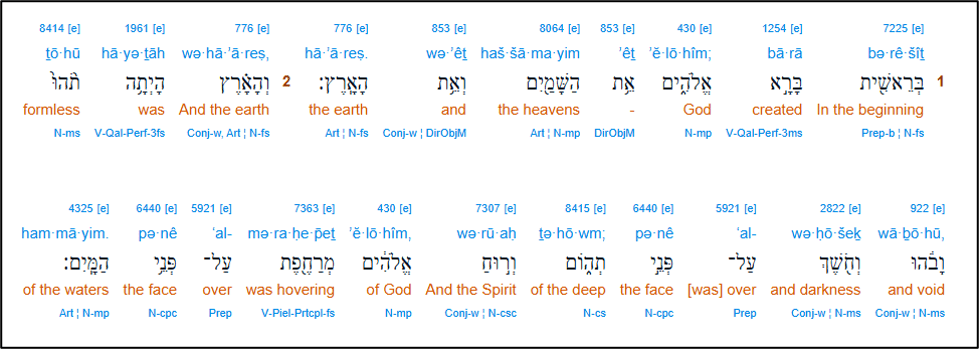
God is referred to as Elohim. Grammatically, it is used in the singular—one God. However, the word itself is plural, Gods, and at least three. The second verse, in line two, refers to the Spirit of God. For another example, we can go a few verses later to where God created man.
“And God said, Let us make man in our image, after our likeness: and let them have dominion over the fish of the sea, and over the birds of the heavens, and over the cattle, and over all the earth, and over every creeping thing that creepeth upon the earth. And God created man in his own image; in the image of God created he him; male and female created he them.” (Gen. 1:26-7)
The word Elohim for God comes the closest to the Islamic idea of Allah, but again, the underpinnings are very different. A list of additional verses regarding the Trinity is presented at the end of this article. It is not complete. When you read your Bible, you will find similar references throughout it. The listed references come from a Pfander Center presentation on this same subject, as does much of the next section’s content.[4]
Tawhid
Tawhid is that within Islam which is essential for belief (iman). It is the first principle upon which Islam’s worldview is based. It is what philosophers called first cause, and within Islam carries with it a singularity and oneness, resulting in the act of uniformity or declaring oneness. Tawhid’s negation is shirk. It is the one unforgivable sin, unless one repents prior to death.
Relation to Islam
Allah is:
- One,
- Unique in his essence, attributes, and actions,
- Without partner, associate, or peer, and
- Absolutely and indivisibly one.
A transcendent simple unity, eternal, self-subsistent, and without need. Remember from above, a transcendent first cause is beyond human knowledge, and one that is a simple unity can only be expressed in terms of what it is not. Such an entity is beyond all being, and cannot enter into time or space, or have positive attributes associated with it. Allah is pure will, beyond all being, nature, and essence.
Man’s idea of God impacts human society. God preceded man, therefore “theology always precedes anthropology.” Within Christianity, there is a balance between the one and the many, both within God and human society. The Godhead presents God as a “continuous and indivisible community” or “Three persons who are eternally in relation.” As man is created in God’s image, we are also to be persons in community.[5] There is balance between the individual and the community. Islam’s view of Allah does not have this same balance. Instead, Islam’s idea of tawhid philosophically binds the individual to be swallowed up by the community (ummah).
However, the Qur’an describes Allah in terms of his attributes and what Allah causes. There are also a few occasions where the Qur’an indicates Allah enters time and space. These conflict with Islam’s notion of first cause as a transcendent simple unity. We’ll cover a few of those inconsistencies next.
Some Islamic Inconsistencies[6]
- There is inconsistency in Allah’s attributes. Allah is the owner, sovereign and possessor, of all things (S 67.1, 5.26), and also the inheritor of all things (S 15.23, 19.40). How can Allah be both? Allah is eternal. Who predates Allah for him to inherit from?
- One of Allah’s names is the merciful. However, mercy requires a second party. There is a giver and a receiver, a relationship. If Allah is all-sufficient, therefore without any needs, then how can he be merciful, as that implies he is dependent on another for his mercy? Other names of Allah pose a similar question. These include; just, compassionate, provider, forgiving, and guide.
- If Allah is not like anything he created, then how can man use anything he created to describe him? Therefore, how can we know anything at all about him?
- The Qur’an is Allah’s word, and separate from him (S 56.77-80, 85.21-2). This is a positive attribute, and inconsistent with Islam’s view of Allah. Further, it is the very argument used within Christianity for the Word— See John 1:1-14. In one case, the argument is accepted, in the other it is denied. Islam’s concept of Allah leaves no room for such a notion.
- The Qur’an will come as a man on the day of judgment (Sunan Ibn Majah 3781, Book of Etiquette). How can an inanimate object appear as a man, one which enters time and space?
- Allah will be seen as a shape (al-Bukhari 6573, Book 81, Hadith 37) and a ‘shin’ (sunnah.com) on the day of judgment. He also enters time and space in two other places. The first is when he cast Adam and Eve down from the Garden (S 7.20-5), and the second when Allah spoke to Moses from the burning bush (S 20.9-24, 27.7-14, 28.29-35).
Common Islamic Arguments and Responses
Jay Smith outlines eight arguments Islam often presents to Christians in discussing both religions and their differences. This is not an exhaustive list. Additional inconsistencies and their implications can be found in A War for God.[7]
How can God be 1, yet 3 simultaneously?
This is only a problem for Islam, as its concept of Allah as a monad without relationships. This goes back to the earlier discussion of Allah’s names, and that some of these require a relationship where one cannot exist. See the list of Bible verses and the Trinity at the end of this article for some useful references. Some verses in the Qur’an related to the Creator (S 13.16), Spirit (S 15.29, 38.72, and 17.85), and the eternal Word (S 4.171, 56.77-80, and 85.21-2) can also be useful.
The Trinity is God the Father, Jesus the Son, and Mary the Mother
This comes from S 5.116, and is not found in the Bible. It is believed much of what became the Qur’an came from Zoroastrian, Christian heresy, Jewish apocalyptic, and pagan sources.[8] This idea could have been borrowed from the fourth century Collyridions. This was an Arabian female sect who offered cakes of bread to Mary, and earlier offered these cakes to the pagan earth mother.
Where did Jesus say, “I am God, worship me”?
He didn’t. Instead, Jesus used Hebrew divine titles four times, which Jews understood as meaning God. In Matt. 26: 62-6, Caiaphas asked Jesus if he was “the Messiah”, “the Son of God”, and “the Son of Man”. Not a Messiah, son of God, or son of Man. Jesus accepted all three divine titles, and Caiaphas tore his robe. In John 8:58, Jesus told the Jews in the temple that, “Before Abraham was, I AM”, using the name Yahweh. The same name God used for himself when speaking to Moses from the burning bush.
How could God have a biological son?
As Allah is a transcendent simple unity, it cannot enter time and space, but we’ve already seen a few examples where even the Qur’an is inconsistent on this point. Is anything impossible for God?
Part of this problem is in the Qur’an itself. It states: God has no son (S 4.171), God cannot be the Messiah (S 5.17), God can have no partner (S 72), God cannot eat (S 5.75), the verse above with Mary being part of the Trinity (S 5.116), and God has no wife (S 6.101). None of these are found in the Bible. In fact, the Bible says God ate with Abraham in Gen. 18:1-8. Further, in Arabic, the word ibn means ‘son of’ in a relational sense. S 39.4 intimates that Allah could have had a son—ibn Allah, literally “son of God”. How do Muslims explain that?
How can God enter time and space?
Islam professes Allah is the greater. Logically, if Allah cannot have a son or come to the earth, then who is greater? We’ve already shown several instances from the Qur’an where it says Allah took physical form and had a relationship with man (both with Adam and Eve in the Garden, where God cast them down to the earth), and Allah coming to the earth in the burning bush and speaking with Moses.
The Bible says God walked in the garden in the evening (Gen. 3:8-9), and spoke with man (Gen. 3). But it doesn’t end there. God led the Israelites out of Egypt as a cloud by day and pillar of fire by night, parted the Red Sea, wrestled with Jacob, and sent His Son to the earth to restore the relationship man broke with Him through man’s disobedience. If Allah can do none of these things, then Islam needs a greater God. We have him, his name is Jesus.
Isn’t Jesus as a man inferior to God?
In Matt. 24 and Matt. 28, along with John 14, Jesus states that the Father is greater than he. Jesus prays to the Father in Gethsemane, and only God the Father knows when the end of time will come. This suggests Jesus is inferior to God. However, Phil. 2:6-9 says that Jesus was equal with God, but chose to limit himself by becoming a man. While on the earth, Jesus was 100% man and 100% God.
This is a difference between quantity and quality. Quantitatively, Jesus, while on earth, limited himself, and was therefore less than God in that sense. But qualitatively he was still fully God while here. An example. Each of us is by function inferior to the President. However, each of us, including the President, are fully man. Jesus limited himself in form while on the earth, without diminishing his divinity. Be in awe that God chose to come to earth to provide the opportunity for our salvation.
When Jesus was on the earth, who controlled the universe?
Muslims are attempting to impose their monad view of Allah onto the God of the Bible. Don’t let them. God’s Spirit controls the universe. See Gen. 1:2; from the very beginning. Jesus sent the Comforter, the Holy Spirit, to us after His resurrection to guide us in the last days (Acts 2:17-21). We will prophesy, have visions and dreams, and work miracles. Also see John 14:12.
You can ask the question in reverse, using the instance where Moses was asked to remove his sandals when before the burning bush. Can any ground be holy if God is not there? If God was there, as the Qur’an says, who was running the universe then?
Didn’t Paul create the idea of the Trinity?
See what Jesus said in Matt. 28:19-20, John 17, and Peter in Acts 2:33. Also, the divine titles given to Jesus by Luke. These include Messiah (Luke 2:11, 26 and 4:41), Servant of God (Acts 3:13, 26, 4:27, 30), the promised prophet (Acts 3:22, 7:37), and Prince of Life (Acts 3:15, 5:31). Paul’s function was to give voice to what Jesus said and did.
The next time we will look at Jesus and Muhammad.
Footnotes:
[1] Wolf, Dan, pp.50-9, The Light & The Rod: Why Biblical Governance Works, Living Rightly Publications, 2020. The quotes within this section come from Plato’s Parmenides.
[2] Webster, Noah, American Dictionary of the English Language, Foundation for American Christian Education 1828.
[3] Wolf, Dan, pp.50-9, The Light & The Rod: Why Biblical Governance Works, Living Rightly Publications, 2020.
[4] Smith, Jay, Trinity vs Tawhid, Pfander Center for Apologetics & Polemics, https://www.youtube.com/watch?v=lOqddw0dvEk&t=4957s , June 19, 2026. Accessed August, 2026.
[5] From the work of Dr. Colin Gunton, within the preceding citation.
[6] Smith, Jay, Trinity vs Tawhid, Pfander Center for Apologetics & Polemics, https://www.youtube.com/watch?v=lOqddw0dvEk&t=4957s , June 19, 2026. Accessed August, 2026.
[7] Wolf, Dan, pp. 132-150, A War for God, Living Rightly Publications, 2017.
[8] Wolf, Dan, Historical Critique, Part III, Virginia Christian Alliance, https://vachristian.org/historical-critique-part-iii/ , July 15, 2026.