

Part 13 in a series
A previous article, discussed some events from the Abbasid dynasty’s end. These included the; Mongol invasion, rise of the Mamluks, and Seljuk Turk kingdom’s eventual development into the Ottoman Empire. This article looks closer into each of these events. The next picks up briefly looking at its governance issues and dhimmitude. Ottoman rule is largely referred to as one of Islam’s more tolerant periods. That article closes with some words from our fifth president—John Quincy Adams—on differences, as he saw them, between Christianity and Islam and implications arising from those differences.
But first the timeline below presents the timing of some significant events occurring during the Ottoman’s expansion period. Note this Empire existed until the early 20th century, about 300 years beyond the time presented below.
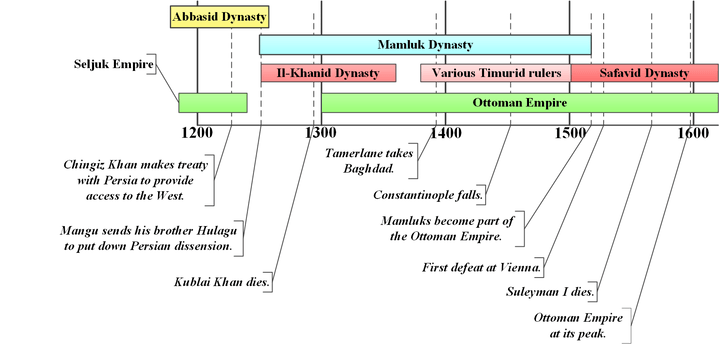
Figure 1: Events Related to the Ottoman Empire
History
The Abbasid decline didn’t directly result in the Ottoman Empire’s rise. Instead, it created a vacuum in which several powers rose. There were also many smaller areas exercising significant degrees of autonomy, and to some degree this continued throughout the Ottoman Empire’s existence. We’ll look at the three largest domains arising from the former Abbasid Dynasty: (1) the Mamluks (Egypt and Syria), (2) the Il-Khanid (Persia), and (3) the Ottoman Empire (Anatolia). Part of this discussion also outlines some of the events setting in place Islam’s division between East and West.
The Il-Khanid
Early in the thirteenth century Chingiz Khan (Genghis Khan) created an empire stretching from a significant part of China in the east, toward the Dnieper River in the west. In 1222 he made a treaty with the Shah of Persia allowing his people access to the west. A short time later, one of the Shah’s governors murdered a party of Mongol merchants and confiscated their goods. The Khan sent an envoy to obtain reparations for the act. His envoy was tortured and killed. Chingiz Khan and his four sons led a Mongol army west in retaliation. The Mongols met an Islamic army in modern Kazakhstan, where the Mongols reportedly slew 160,000 of the 400,000 man army sent to meet them. They also invaded Georgia in 1222, defeating the Russian army. Chingiz Khan died in 1227.[1]
He was succeeded by one of his sons, Ogdai, who pushed further into China in the east and by 1241 destroyed Moscow and Kiev in Russia. He reached as far west as Poland and Hungary. In addition to the Mongols traveling west, Nestorian monks travelled east and began evangelizing. By the time Ogdai’s successor, his eldest son Kuyuk, became Khan in about 1243 Christianity had made significant inroads into the Mongol nation. Kuyuk’s physicians and chief officials were reportedly Christian, and a church-tent sat close to the royal pavilion.[2] One byproduct of these, and earlier, Mongol expansions forced large numbers of Seljuk Turks into Anatolia and Syria. They settled there after decisively defeating the Byzantines at Manzikert in 1071. (More on the Seljuk Dynasty in The Abbasid Dynasty – Part I.)
Hulagu Sent West
Mangu, a nephew of Ogdai, succeeded Kuyuk in 1251. He had two brothers, Hulagu and Kublai. While Mangu and Kublai focused their conquest efforts in the east, Mangu sent Hulagu west. Mangu made no distinction between Christians, Jews, Muslims, Buddhists, or believers in Lamaism. However, Hulagu was a Christian and a fanatical adversary of Islam. In 1256 he invaded the Kohistan district within Pakistan massacring 800,000 subjects and killing their king. He took control of Persia and reached Baghdad in 1258. He besieged the city and when it fell he spared the Christians, but massacred thousands of others.
Hulagu’s goal was to “gain possession of Jerusalem because they [the Mongols] wanted to destroy the Arabs who were in Syria and in Palestine, and to massacre their Saljuk supporters.”[3] He sacked Aleppo, and Damascus surrendered to him in 1260. But while preparing to take Jerusalem, he learned of Mangu’s death and returned to Mongolia. He was empowered to take control over all the lands he’d conquered, but instead declared himself an independent king, an Il-Khan.[4] A Mamluk army defeated him in 1260, and he reigned until 1265.
Initially the Mongols tried forming treaties and alliances with the European Christian kings and Rome’s Pope. However, these rulers didn’t understand Hulagu’s goal was simply destroying Islam’s followers; no agreements were ever reached. When the Mongols saw “that there was no military assistance to be gained from Europe, their Christian zeal began to abate, and Western Mongols began to fraternize with Syrian and Egyptian Muslims, and Islam began to make progress among them.”[5]
The Western Mongol Conversion
Islam displayed a larger degree of tolerance towards Christians at this time. Not only did Hulagu support Christianity, but his brother Kublai did as well—despite the latter’s personal belief in Lamaism. Kublai did much supporting Christianity’s development within his kingdom, which by this time stretched from the Yellow Sea in the east to the Black Sea in the west, and from Mongolia in the north to Tonquin in the south. Islam made no overt effort against other religions so long as Kublai Khan lived. He died in 1294.
With Kublai Khan’s death, Islam’s followers began rebelling against the Mongols and rose up against Christians. “The Arabs hated the Mongols both as men and as Christians, and their memories of the atrocities committed at Baghdad by Hulagu, nerved them to fight to the death, sparing no one.”[6] Hulagu’s son Abga, reigning from 1265 – 1281, and continued corresponding with the Pope and European kings. During his reign Marco Polo travelled to the east.
After Abga’s reign, his successors initially vacillated between Christianity and Islam, becoming too weak to prevent attacks by local Islamic forces. By the fourteenth century, “the Nestorians were cruelly persecuted; the goods of their merchants were confiscated, their churches were destroyed, and those who refused to accept Islam and could not escape were slain. It is probable that large numbers became Muslims and excused themselves for so doing by saying that it was better to accept a religion which proclaimed God and His Unity, than to revert to paganism and idolatry.”[7]
Results
By the fourteenth century’s end, Nestorianism practically ceased to exist in Persia, Central Asia, or China. The last Il-Khans continued ruling until 1335. The Monks of Kublai Khan Emperor of China chronicles the persecution and massacres of Christians in the villages of Maraghah near Azerbaijan and Arbil northwest of Baghdad in Kurdish Iraq late in the thirteenth century. Other works chronicle similar events around Mosul,[8] Baghdad,[9] the Mardin region in Turkey, and a Nestorian village along the Tigris during this same period.[10]
The Mamluks
As noted previously, the Mamluks defeated the Mongols in 1260. This is the first documented defeat of the Mongol army in open combat. The word mamluk literally means slave, and the Mamluks were a slave army of Seljuk Turks and Circassians, created and employed by the Islamic rulers during the Abbasid dynasty. They frequently used their military power in overthrowing local political authority. These power usurpations often didn’t last long, but in Egypt they became the power behind a caliph—one maintained as a symbol legitimizing their authority. Any caliph not acquiescing to their demands soon found themselves dispatched by the Mamluk generals. By the middle of the thirteenth century, they established dynasties in both Egypt and India.
“Historians have traditionally broken the era of Mamluk rule into two periods—one covering 1250-1382, the other, 1382-1517. Western historians call the former the ‘Bahr’I’ period and the latter the ‘Burji,’ because of the political dominance of the regiments known by these names during the respective times. Contemporary Muslim historians refer to the same divisions as the “Turkish” and “Circassian” periods, in order to call attention to the change in ethnic origin of the majority of Mamluks, which occurred and persisted after the accession of Barquq in 1382.”[11]
The following map shows the Mamluk Dynasty at its peak.
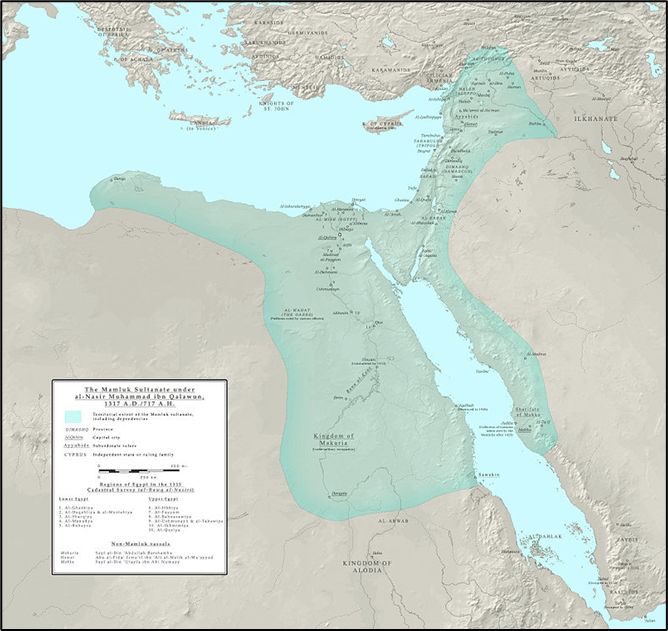
Figure 2: Mamluk Dynasty at its peak – 1317[12]
The Turkish and Circassian Periods
There is general agreement the Mamluks declined during their Circassian period. They drove the last of the Crusaders out of the Holy Lands and turned back the Mongols—both of which occurred during the Turkish period. The Turkish period based advancement upon ability. Under the Circassians, advancement became based upon race (i.e., Circassian). Other factors weakened the Mamluks, including the inability to defeat Bedouin raiding parties. This resulted in trade disruptions, agricultural losses, and economic disorder. Further compounding the situation were several plagues occurring within Egypt and the East. These events left the Mamluks unable to prevent Tamerlane from temporarily taking Baghdad in 1395. The final economic blow came with the Portuguese discovery of a sea route to the East early in the sixteenth century.
The Mamluk Become Part of the Ottoman Empire
The declining economy resulted in less tax revenue, weakening the Mamluk army. The Ottoman defeated them in both Syria and Egypt. One reason for their defeat was the Ottoman adoption of field artillery, while the Mamluks still used artillery only when laying siege. Mamluk territory became part of the Ottoman Empire in 1517; with the general population rising up against the Mamluks and corruption they represented.
The Mamluks continued as a presence within the Ottoman Empire. They became part of the Ottoman army, and over time again achieved positions of significant power and influence over the Ottoman. The Ottomans removed the Mamluk requirement of excluding their sons from serving only in non-slave regiments. This resulted in changing loyalty dynamics from one based upon their regiment to one based upon family ties, creating additional factions making it difficult to hold the Empire together. As we will see shortly, by the end of the seventeenth century Mamluks once again controlled the armies, tax revenue and government. Napoleon faced a Mamluk army when entering Egypt in 1798, but Muhammad Ali Pasha ended Mamluk power by massacring them in 1811.[13]
The Ottomans
As noted above, the Mongol advance drove the Turks into Anatolia and Syria. During Hulagu’s reign, Mongols took portions of eastern Anatolia from the Turks, but their primary objectives were Syria and the city of Jerusalem. It was from northwestern Anatolia the Ottoman Empire rose. Osman was from the Kayi tribe, and the prince of a territory on the Byzantine border frontier. After the last Mongol defeat of the Seljuk Turks in 1293, Osman took additional territory from the Byzantines, who were in a state of decline. He ruled until 1324, and it is during his reign the Ottoman Empire began.
Orhan succeeded his father Osman, passing rule to his son Murad I. These rulers continued taking territory from the Byzantines, eventually moving into southeastern Europe, but bypassing major cities like Constantinople and Belgrade as they didn’t have the means for conquering these more heavily fortified cities. They continued the Abbasid tactic of destroying food sources, thereby reducing tax revenue and weakening their adversaries.
The attraction of Byzantine wealth attracted many nomads to fight for the Ottoman, but Orhan began a tradition of employing Christian mercenaries to lessen the young Empire’s nomad reliance. Orhan’s annexation of Karasi (in southern Anatolia) also made the Ottoman Empire the Byzantine’s primary ally. This alliance provided the Ottoman access to gaining direct knowledge of Byzantine territory and its weaknesses. Early Ottoman rulers also strengthened their alliances by marriage, to both Christian courts and Islamic principalities. Orhan ruled until 1360. A map of the Ottoman and Byzantine Empires around 1350 is shown below.
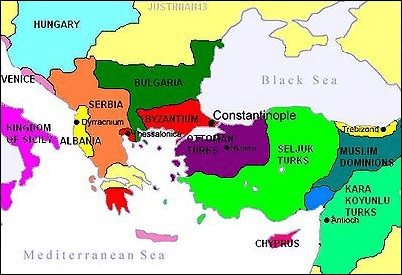
Figure 3: Byzantine and Ottoman Empires about 1350[14]
Power Consolidation
Bayezid I succeeded his father Murad I, after the latter’s death in one of the Battles of Kosovo. Bayezid turned his attention to Anatolia, eliminating a threat from one of the remaining Turkish territories (Karaman) to the east. Bayezid’s accomplishments were so significant that “he was given the title of sultan by the shadow Abbasid caliph of Cairo, despite the opposition of the caliph’s Mamluk masters.”[15] Tamerlane attacked the Seljuk Turks in 1397, to protect his flank while driving into India and Persia. Bayezid’s followers deserted him—all except his Christian mercenaries—and he was captured at the battle of Ankara. He died a short time later. Tamerlane broke up the Ottoman territory removing the threat they posed to his ambitions.
Turkish notables made Murad II ruler in 1421, and he ruled until 1451. Murad began resenting the power gained by the notables, creating the devsirme system as a counter-balance. This system formalized the practice begun by Orhan of levying, as tribute, one fifth of the Christian children from the Balkan region.[16] Non-Muslim children were viewed as fay, state property, and Murad began collecting the levies annually.
Youngsters were generally 14-20 years of age when drafted, and taken from the aristocracy and priest families in contingents of a thousand at a time. They converted to Islam and served the sultan for life in his janissary corps; an infantry used against Christian kingdoms in the Ottoman wars. A parallel system of ichoghlani was also created taking children six to ten years of age into the sultan’s service as Ottoman administrators, after a fourteen year training period.[17]
Reinforcing Sunni Islam
Murad enlarged the concept of using a military slave force for the Empire’s benefit (kapikulu), including Turkish nobility as well and increasing the sultan’s power further. With this last change only persons accepting slave status, whether Muslim or not, held positions in the Ottoman army or government.[18] Anyone could achieve this status as long as they accepted “absolute obedience to their master [the sultan] and the devotion of their lives, properties, and families to his service.”[19]
Later sultans continued playing notables against janissaries to retain power and control over the Empire. With Constantinople’s fall in 1453, Turkish notable’s power significantly decreased. The Ottoman executed many notables or exiled them to Anatolia. However, janissary and notable power continued fluctuating within the Empire. The Ottoman’s continued fighting against the European kingdoms, the Mamluks in Syria and Egypt, and the Safavids in Persia.
The Safavids were Turkish tribes emigrating from eastern Anatolia into Persia in reaction to the Ottoman return to a strictly orthodox form of Sunni Islam. The Safavid embraced Shia and Sufi doctrines, and spread dissension leading to several revolts within Ottoman provinces. The Ottomans were unable to conquer the Safavids, as the latter generally chose not to engage in direct conflict. Their dynasty lasted from about 1501 through the early part of the 18th century. This rift left the Islamic world divided as we see it today. As mentioned earlier, the Ottoman defeated the Mamluk Dynasty; the latter becoming part of the Empire in 1517. Finally, the European kingdoms defeated the Ottoman a second time at Vienna in 1683.
The map below shows the Ottoman Empire’s expansion from its inception to its peak in about 1599.
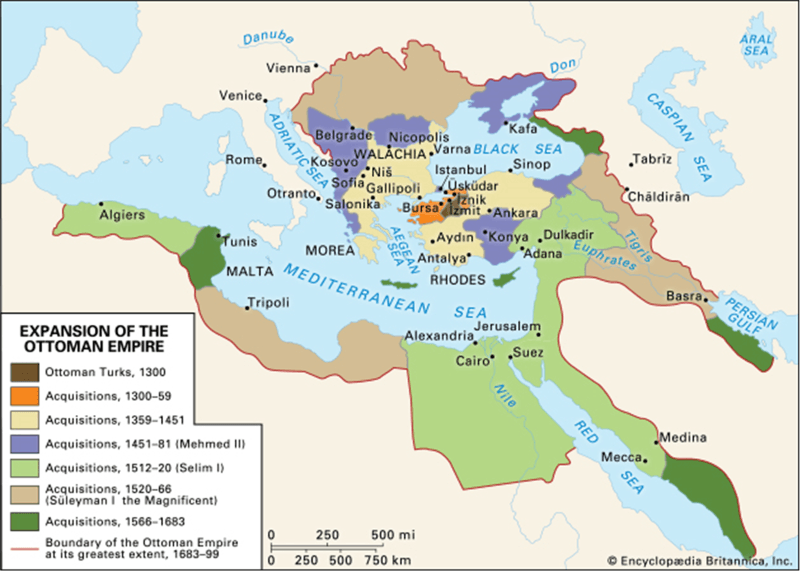
Figure 4: Rise of the Ottoman Empire 1300 – 1599[20]
Footnotes:
[1] Budge, Sir E. A. Wallace, The Monks of Kublai Khan Emperor of China, 1928, Assyrian International News Agency, http://www.aina.org/books/mokk/mokk.pdf. This is a translation of the original Syriac text. This quote comes from the Introduction to this work.
[2] Ibid.
[3] Ibid.
[4] Ibid.
[5] Ibid.
[6] Ibid.
[7] Ibid.
[8] Ye’or, Bat, The Decline of Eastern Christianity under Islam, From Jihad to Dhimmitude, pp. 346-7, Fairleigh Dickinson University Press, 2002. An extract from the chronicle of Bar Hebraeus is reproduced.
[9] Ibid, pp. 356-9. An extract from the chronicle of Bar Hebraeus is reproduced
[10] Ibid, pp. 350-6. An extract from the chronicle of Bar Hebraeus is reproduced.
[11] Britannica Online Encyclopedia, Mamluk dynasty, http://www.britannica.com/topic/Mamluk accessed January, 2016.
[12] By Ro4444 – Own work, CC BY-SA 4.0, https://commons.wikimedia.org/w/index.php?curid=46642565.
[13] Britannica Online Encyclopedia, Mamluk dynasty, http://www.britannica.com/topic/Mamluk, accessed January, 2016.
[14] Wikipedia, The rise and fall of Kantakouzenos, https://en.wikipedia.org/wiki/Byzantine_Empire_under_the_Palaiologos_dynasty#The_rise_and_fall_of_Kantakouzenos.2C_1341.E2.80.931357, accessed February, 2016.
[15] Britannica Online Encyclopedia, Ottoman Empire, http://www.britannica.com/place/Ottoman-Empire, accessed January, 2016.
[16] Ye’or, Bat, The Decline of Eastern Christianity under Islam, From Jihad to Dhimmitude, pp. 113, Fairleigh Dickinson University Press, 2002.
[17] Ibid, p. 115.
[18] Britannica Online Encyclopedia, Ottoman Empire, http://www.britannica.com/place/Ottoman-Empire, accessed January, 2016.
[19] Ibid.
[20] Ibid.