
Forty-second in a series
As Christians, we should reach out to others in truth and love. This final set of articles is written with that in mind. It also returns to the foundational idea behind this series: ideas have consequences.
The Problem
Islam is an ideology, as discussed earlier. One cannot have a relationship with Allah; they can only obey. Islam strictly concerns how one is to order their life, the actions they are to perform, and their relationship with others. Historically, it has had a difficult time maintaining relevance. Consider its principles on slavery, women’s status, child marriage, and endless war. The last comes from its governance model. What Augustine labeled the city of man. In this city, war is man’s natural state, interrupted by periods of peace after conflict temporarily ends. Compare this to Augustine’s City of God, where man’s natural state is peace, interrupted by periods of war. Does man wage peace to make war, or war to make peace? Below is a table of collectivism principles and their Islamic counterparts.[1]
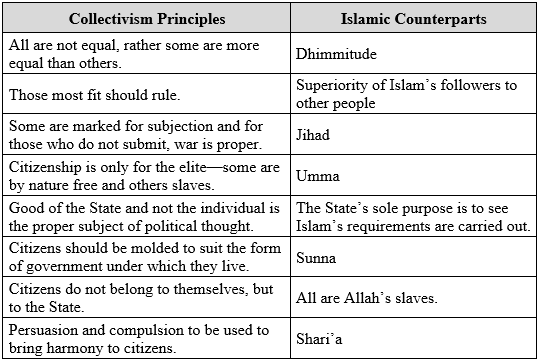
Within this ideology, whatever the situation, the answer is always more Islam. Regardless of whether one fails or succeeds. Can peace be achieved when the basis is conflict? Can anyone ever follow all of Islam’s directives, totally and completely? Islam changes over time in an attempt to maintain its societal relevance. Consider Islam’s prohibition on wine. Applying cleric consensus and reasoning over several centuries resulted in effectively removing the prohibition of its use.
The modern left of fascists, socialists, and communists represent today’s notables.[2] These are the individuals who worked with Islam during the caliphate’s early expansion. When the notables were no longer useful, they faced three choices of either; joining Islam, becoming a slave (dhimmi), or death. If Islam were to ever gain complete control, they would face these same three choices.
Compatibility
Islam’s ideology is incompatible with America, whose values are based upon Judeo-Christian principles. Take something as simple as truth. A Christian principle is we should always tell the truth, even if it costs us because we’ve done something wrong. Within Islam, it is okay to lie if it furthers Islam. This idea is called taqiyya. There are many other areas which are entirely different. These include; God, Jesus, the relationship we are to have with Him, the crucifixion, sin, atonement, man’s nature, governance, and freedom. This is unfortunate because we are all created by God, and we all share the same God-given nature.
However, the ideology one adopts defines our thoughts, choices, and actions. It defines who we choose to become. Thankfully, we are always able each day to make a better choice, to be better today than we were yesterday.
Who Are They?
When one thinks of Islam, one usually makes a connection to the Middle East. But is that true today? We mentioned before that the countries containing the largest Muslim populations are; Indonesia, Pakistan, India, Bangladesh, and Nigeria. The total number of Islam’s followers within these five countries accounts for about 60% of the world’s Muslim population. None of them are in the Middle East. None of them speak Arabic, and three are members of the British Commonwealth – those in the list’s middle.
Only about 15% of the world’s Muslim population lives in the Middle East, and you can push this up to about 20% if you include the North African countries. This is important because Islam teaches the Qur’an can only be understood in Arabic. But can one truly understand what they cannot read? Is this any different from when the Bible was maintained by the church only in Latin? It wasn’t until the Bible was translated into other languages that people could internalize what it teaches. We also have the Hebrew and Greek manuscripts to refer to for understanding.
Except for the terrorist groups maintained by Iran, these groups have largely left the Middle East. And even there, progress is being made with Hamas in Gaza, and against Hezbollah in Lebanon and the Houthi in Yemen. Some of these groups have migrated to Africa. Other new groups have formed within the Indian subcontinent. Why? Because there are almost no followers of other religions in any of the Middle Eastern countries anymore. They are all gone.
Why Do They Come?
This brings us to an interesting question. If the Middle Eastern countries almost exclusively follow Islam, then why do its people migrate to other countries? Wouldn’t they want to stay where they are, as Islam has achieved its goal in those areas?
There are at least four groups who migrate to countries not following Islam. First, are those who’ve seen what Islam has done to their country and wish to leave. If they leave, aren’t they looking for something better? The second group are those looking for education. Same question here, if Islam is all, then shouldn’t they be able to find the education they need within the Islamic countries? The third group is those looking for employment. Again, the same question. If Islam creates a successful society, then shouldn’t there be economic opportunities in their home countries?
Much like Imperial Rome, Islam has a caste system. One sanctioned by Islam itself. Another borrowing from the surrounding cultures it absorbed its principles from.[3] I would suggest the above are indications of Islam’s failure, rather than its success. It has achieved everything, but has it gained anything?
The fourth group are those committing themselves to dawah. Dawah is an invitation to others to learn and join Islam. Jihad is the method used in its advance. Remember, only one form of jihad—jihad of the sword—uses violence in advancing Islam.[4] Also, taqiyya’s use is acceptable in advancing Islam. Aren’t those coming to America, or other countries, within this group arriving under false pretenses? Shouldn’t they be returned to their country of origin?
How Do We Reach Them?
Churches and church-related organizations largely teach irenics. This is the promotion of peace through friendship in order to change people’s hearts and minds. I have used this method previously when working with Muslims. It is intuitive and non-confrontational. While I made friends, I didn’t move the needle in bringing them home to Christ. I failed. Another approach is appeasement, such as Chrislam. That also fails. Islam doesn’t conform to other things; other things conform to it.
Irenics is not enough. Did Paul use irenics when he went on his journeys? No, anything but. He went into the synagogues, challenging the Pharisees’ and Sadducees’ thinking. He confronted them and argued with them about their own ideas. He followed Jesus’ instructions when he sent out his disciples. (Matt. 10:5-39) It was only after Paul failed to move those in the synagogue that he went to the Gentiles.
We have two other methods available; apologetics and polemics. Apologetics is simply a defense of one’s faith. However, can one win if they are solely on defense? It’s possible, but not likely. This defense generally focuses on Christ and God’s Word—the Bible. Polemics is using words to wage war. This is the primary tool Paul used. Jesus also used it with the religious leaders he encountered in his day. It won’t be for everyone, but there is no reason why one cannot switch back and forth between these two methods when it makes sense to do so.
We can use a form of tough love to reach people. Understanding their questions and arguments, then making those ideas obedient to Jesus’ teachings using the Bible. To use this approach, we must know and understand the Bible, have some understanding of the Qur’an’s contents, and develop the ability to ask questions.
Some Approaches
A few things helping our effort. First, there are many inconsistencies within Islam. Also, if someone asks us questions about our faith, shouldn’t we also ask them questions about their faith? After all, we are not conversing with someone who has no faith, but rather with someone who does. It also helps if you genuinely care about the other person. We can all spot someone who talks to us without caring, when their heart is not there. When someone does engage us in conversation, but they are not serious about learning, then it is okay to end the conversation. They are not ready to hear.
A couple of ideas. These come from individuals and organizations doing outreach to Islam’s followers for years, such as Jay Smith and the Pfander Center. The first is very simple. You can tell someone you believe Jesus is God, and the Bible is the Word of God. Do you have an opinion? This can open a door to a long conversation. In my conversations, I’ve found we are much more alike than different. We want the same things for our life, work, family, and society. What differs is our ideas in how we go about it.
The second is to start with a passage from the Qur’an and ask them about what it means. This is where Islam’s inconsistencies come into play. There will be some places where we actually come to some kind of agreement, but that will generally be incomplete. Other areas will not agree at all. That is the point where we can ask them questions, one coming from the same basis, but leading to a fuller answer referencing the Bible.
Islam’s Dilemma
Within the Qur’an, the Bible and Torah are God’s word to different peoples. They are God’s truths, and the people they were given to are to each follow the instructions God gave them. Starting with the Qur’an begins from a place they know, or at least believe. As many of Islam’s followers do not speak Arabic, they likely have not read the Qur’an, or even own one. Using a Qur’an where one page is in Arabic and the other in your language will only help.
A typical response when referencing the Bible is, “It is corrupted.” If so, how and when? If the Qur’an says the Bible and Torah are God’s word, then they cannot be corrupted. The Bible today is the same as it was in the seventh century. So, which is it? We have the manuscripts and church father’s writings supporting that claim. Was the revelation wrong? Or, is the Qur’an wrong about the Bible and Torah? For more, see S 5:44-9, and the list at this article’s end.
This line of questioning puts those following Islam in a dilemma. They are left with two unworkable choices. Deny what is in the Bible, indicating the Qur’an is incorrect about God’s word. Or, accepting the Bible, indicating the Qur’an itself is incomplete. But one cannot have it both ways. The next article looks at some areas where significant theological differences exist, where this approach can be useful. You might put tabs on your Bible for certain passages, and if you have a copy of a Qur’an – know where the key passages are located.
Before closing, a few words about John of Damascus. He was the last of the church fathers and first apologist to those who would become Islam’s followers. Yes, become.
John of Damascus
John was born about 675 and lived until about 749.[5] His family were notables.[6] His grandfather was the Financial Governor of Damascus, responsible for tax collection for the city, and allowed to retain his position when the Arabs conquered Damascus in 635. This position was later inherited first by his father, and then himself when his father died in 695. John’s father was a friend of Abd al-Malik. John was also the chief tax collector for Abd al-Malik, and had access to the inner circle of power during Islam’s development. John was an eyewitness to that development.
Initially, the tax records were kept in Greek, which the Arabs did not understand, nor did they yet understand the tax collection process within the city. The next caliph, Al-Walid I (705-715) was not as open to notables being in positions of power within the caliphate. John left and entered the monastery at St. Sabbas, near Jerusalem, by 715. It is after entering the monastery that John began to write. His The Fount of Knowledge, contains three sections. The first summarizes Christian theology to the eighth century. The second, a list of 103 heresies. The first 100 came from other sources, but the last three John wrote. Number 101 concerns the “superstition of the Ishmaelites.” The third and final section covers the Orthodox faith.
Some of John’s Observations
The People and Prophet
When Damascus fell in 635, the Arabs called themselves Ishmaelites, Agarenes, and Saracens (destitute of Sara). “These used to be idolaters and worshiped the morning star and Aphrodite whom in their own language they called Khabár, which means great. And so down to the time of Heraclius they were very great idolaters.”[7] Heraclius ruled the Byzantine Empire from 610 to 641.
Concerning the prophet, there is a mistranslation from the Greek manuscript in some writings. The word translated as “Muhammad” is the word “mamed”, a title meaning ‘praised one’ or ‘blessed one’ as discussed in previous articles. It is preceded by a word meaning ‘so-called’ or ‘presumed’. Per Dr. Janosik, the correct translation of this part of the manuscript is, “[F]rom that time until now, a false prophet, called Mamed, sprung up among them; who, after conversing with an Arian monk concerning the Old and New Testament, fabricated his own heresy.”[8] John questioned those believing this prophet’s revelations while serving as chief tax collector for Damascus.
Some Beliefs and Practices
Beliefs expressed by those following these writings include:
- There is one God, creator of all things, who has neither been begotten nor has begotten.
- Christ is the Word of God and His Spirit, but a creature and a servant,
- That Jesus was begotten, without seed, of Mary the sister of Moses and Aaron,
- The Word and God and the Spirit entered into Mary and she brought forth Jesus, who was a prophet and servant of God,
- The Jews wanted to crucify Him in violation of the law, and that they seized His shadow and crucified this, but Christ himself was not crucified, nor did He die, and
- That God out of His love for Jesus took Him to Himself into heaven, where Jesus told God He did not say, “I am the Son of God and God.”[9]
Some practices include:
- Circumcising men and women,
- Not keeping the Sabbath nor being baptized,
- Ordering the eating of some things forbidden by the Law, and abstaining from others, and
- Absolutely forbidding the drinking of wine.[10]
Writings
John writes about four separate books this prophet’s followers related to him, that many such books were written, and each one given a title. John includes some of the contents from the four books revealed to him. These include: On Women (S4), The Camel of God (not in the Qur’an), The Table (S5), and The Heifer (S2).[11] At this time, these writings had not yet been assembled into a single book, nor do they appear to be in their final form. John’s witness contradicts the standard Islamic narrative, that the Qur’an was fully written and assembled by 652.
Footnotes:
[1] Wolf, Dan, p. 240, A War for God, Living Rightly Publications, 2017.
[2] Wolf, Dan, The Abbasid Dynasty – Part III, Dhimmitude, Virginia Christian Alliance, https://vachristian.org/the-abbasid-dynasty-part-iii-dhimmitude-2/ , April 10, 2026.
[3] Wolf, Dan, Islamic Borrowings and the Arabic People, Virginia Christian Alliance, https://vachristian.org/?s=islamic+borrowings , March 12, 2026.
[4] Wolf, Dan, The New Jihad, Virginia Christian Alliance, https://vachristian.org/?s=The+new+jihad , July 29, 2026.
[5] Much of this section comes from the following.
- Chase, Frederic H., Jr., Translator, Saint John of Damascus: Writings, Ex Fontibus Company, 1958, and
- Janosik, Daniel J., John of Damascus, First Apologist to the Muslims: The Trinity and Christian Apologetics in the Early Islamic Period, Pickwick Publications, 2016.
[6] Wolf, Dan, The Abbasid Dynasty – Part III, Dhimmitude, Virginia Christian Alliance, https://vachristian.org/the-abbasid-dynasty-part-iii-dhimmitude-2/ , April 10, 2026.
[7] Chase, Frederic H., Jr., Translator, p. 153, Saint John of Damascus: Writings, Ex Fontibus Company, 1958.
[8] Janosik, Daniel, John of Damascus: The First Apologist to Muslims, Pfander Center for Apologetics and Polemics, https://www.youtube.com/watch?v=Xic5VWdD4gI&t=2s , June, 2026. Accessed, August, 2026.
[9] Chase, Frederic H., Jr., Translator, pp. 153-4, Saint John of Damascus: Writings, Ex Fontibus Company, 1958.
[10] Ibid, pp. 159-60.
[11] Ibid, pp. 157-9.
[12] Pfander Center for Apologetics & Polemics, The Islamic Dilemma – How to Use it With Muslims, https://www.youtube.com/watch?v=LpyqnYz2GBg&t=1439s , May 21, 2026. Accessed, August, 2026.