Today’s companion: This post pairs with today’s About Islam analysis, “A Pattern? What America’s 2026 Midterms and Britain’s 2024 Election Have in Common, and What They Don’t.” That piece ended in Jerusalem. This one starts there.
Our About Islam piece closed with a prayer: “Pray for the peace of Jerusalem! ‘May they be secure who love you!'” (Psalm 122:6). So today, let’s go to Jerusalem and look at the ground itself. Specifically, let’s look at what Temple Mount archaeology shows about the city’s Jewish past.
Some leaders today say no Jewish temple ever stood on the Temple Mount. That claim has a name: Temple denial. We want to weigh it the way we’d weigh any claim, by the evidence. We’ll measure the claim, not the people who make it.
Read along with us. If you know a find we missed, or think we got one wrong, tell us in the comments.
The Claim: “There Is Nothing There”
Temple denial is not a fringe idea. It has come from the top. At the Camp David summit in 2000, Yasser Arafat told the Americans the temple was not in Jerusalem at all, but in Nablus. That account comes from two very different sources: U.S. negotiator Dennis Ross, and journalist Clayton Swisher, whose book drew on President Clinton’s chief Arabic interpreter.
The claim has continued. In 2001, Jerusalem’s grand mufti, Ikrima Sabri, told the German paper Die Welt there was not the slightest sign that a Jewish temple had ever stood on the site. And on May 15, 2023, Palestinian Authority President Mahmoud Abbas told a United Nations gathering, “They [Israel] dug under al-Aqsa… they dug everywhere, and they could not find anything.”
That is a clear claim. So what does the ground say?
What the Supreme Moslem Council Wrote in 1925
Before we pick up a single shovel, consider a pamphlet. In 1925, the Supreme Moslem Council, the body that oversaw Jerusalem’s Islamic holy places, published an English guide for visitors. It was called A Brief Guide to al-Haram al-Sharif.
Describing the site, the guide said: “Its identity with the site of Solomon’s Temple is beyond dispute.”
That matters. A century ago, the very council that oversaw the site stated plainly that Solomon’s Temple stood there. Traditions about Solomon building the Temple also appear in classical Islamic writings in praise of Jerusalem. Temple denial is newer than that guide.
What Scripture Says Stood There
The Bible is plain about the place. “Then Solomon began to build the house of the LORD in Jerusalem on Mount Moriah, where the LORD had appeared to David his father” (2 Chronicles 3:1).
Moriah is no random hill. It is the region where God sent Abraham with Isaac (Genesis 22:2). We traced that patriarch’s road in Expedition Abraham: From His Birthplace to the Promised Land.
Solomon’s temple fell to Babylon in 586 B.C. (2 Kings 25:9). The exiles rebuilt it (Ezra 3), and Herod later expanded it on a massive scale. One of Jesus’ disciples marveled at it: “Look, Teacher, what wonderful stones and what wonderful buildings!” Jesus answered, “There will not be left here one stone upon another that will not be thrown down” (Mark 13:1–2). Rome fulfilled that word in A.D. 70.
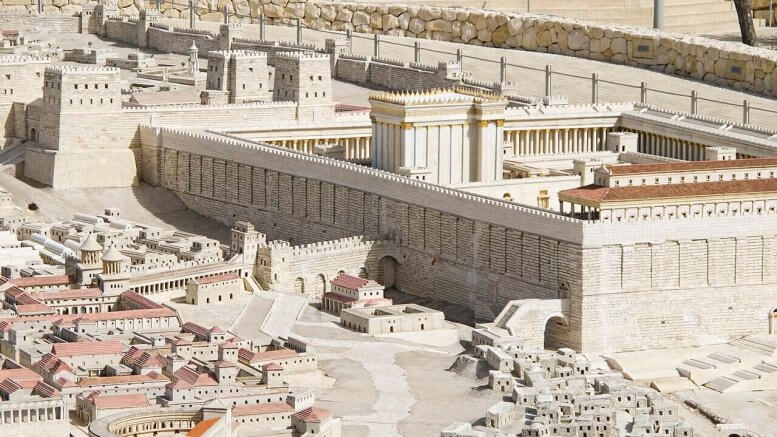
No photograph of any of these sanctuaries survives, from the Tabernacle in the wilderness to Solomon’s temple to Herod’s. But archaeological architect Leen Ritmeyer, who worked on the excavations beside the Temple Mount, has drawn careful reconstructions of all three from Scripture, Josephus, and Temple Mount archaeology itself. They are reconstructions, not photographs, yet few are more careful. You can see them at Ritmeyer Archaeological Design.
Scripture names the place. So what has the Temple Mount itself given up?
Temple Mount Archaeology From the 1999 Soil
Here is the irony of Temple Mount archaeology. The platform itself has never undergone a systematic archaeological excavation. Yet in 1999, it gave up some of its soil anyway.
That November, during construction work at the underground hall known as Solomon’s Stables, heavy equipment removed thousands of tons of earth. According to the Temple Mount Sifting Project, the work was done by the Northern Branch of the Islamic Movement, and the removed soil was dumped in the Kidron Valley.
In 2004, archaeologists Gabriel Barkay and Zachi Dvira began rescuing it. Their Temple Mount Sifting Project, under the auspices of Bar-Ilan University, has since run the soil through screens with the help of nearly 250,000 volunteers.
Among the finds the project reports:
- Pottery and objects from the First Temple period (10th to 6th centuries B.C.): figurines, stone weights, sling stones, and arrowheads.
- A clay seal impression with ancient Hebrew letters, from the 7th or 6th century B.C. The project’s tentative reading is “Belonging to [..]lyahu son of Immer.” The project calls it the first ancient Hebrew writing found from the Temple Mount.
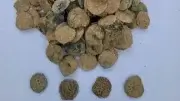
- More than 5,000 coins, including a coin from the Jewish revolt against Rome reading “For the Freedom of Zion.”
- Colored stone floor tiles, some of which the directors date by comparing them with floors in Herod’s palaces.
That seal deserves a second look. Immer was a priestly family that served in the temple (1 Chronicles 24:14; Ezra 2:37). Scripture names one of its sons: “Now Pashhur the priest, the son of Immer, who was chief officer in the house of the LORD, heard Jeremiah prophesying these things” (Jeremiah 20:1).
We should be careful here. The seal does not name Pashhur, and its reading is a proposal. If the proposed reading is correct, the name fits a priestly family known from Scripture.
The sifting has its critics, and they deserve a hearing. The bulldozed soil lost its layers, so finds can’t be tied to a precise spot or level. Some scholars have questioned how much such soil can tell us. The project answers that its methods account for this, and it says hundreds of thousands of its finds still await publication. So we’ll hold these finds with an open hand. They are witnesses, not the whole case. And they are not alone.
Temple Mount Archaeology Around the Walls
Abbas said Israel “dug everywhere.” In fact, most Temple Mount archaeology has happened around the Mount, not on its platform. And around the Mount, the stones speak plainly.
The trumpeting stone. Benjamin Mazar’s excavations at the Temple Mount’s southwest corner uncovered a large stone with a partial Hebrew inscription: “To the trumpeting place to…” Scholars connect it to the place Josephus describes, where a priest blew a trumpet to announce the start and end of the Sabbath.
The warning stone. In 1871, a Greek inscription from the barrier around the temple’s inner courts was found in Jerusalem. It is now in the Istanbul Archaeology Museums. It warns that no foreigner may enter the barrier around the sanctuary, and that anyone caught is himself responsible for the death that follows. Josephus describes notices like this, in Greek and Latin, telling foreigners not to enter.
Remember the riot in Acts 21. A crowd seized Paul, crying that he had “brought Greeks into the temple and has defiled this holy place” (Acts 21:28). The warning stone shows the kind of line they thought he crossed. Paul later wrote that Christ “has broken down in his flesh the dividing wall of hostility” (Ephesians 2:14). Whether or not Paul had this barrier in mind, the stone makes his words easy to picture.
The fallen stones. Along the western retaining wall of the Temple Mount, excavators uncovered a paved street from Herod’s day, lined with shops. On that pavement lie huge stones knocked down from the wall when Rome destroyed the city in A.D. 70. These are stones of the retaining wall, not of the sanctuary itself. Still, they lie where Rome threw them down, a sober echo of Jesus’ warning in Mark 13:2.
That street was one way up. Another, the Pilgrimage Road, climbed to the Mount from the Pool of Siloam. And beneath the Western Wall Plaza, excavators found a ritual bath from the late Second Temple period, sealed beneath the destruction of A.D. 70. We told that story in Buried Beneath Jerusalem: A 2,000-Year-Old Witness to Biblical Truth.
A Witness Carved in Rome
One more piece of Temple Mount archaeology stands far from Jerusalem. On Rome’s Sacred Way stands the Arch of Titus, built around A.D. 82. Its relief shows Roman soldiers carrying the vessels of Jerusalem’s temple in a victory parade. At the center is the seven-branched golden lampstand.
Rome had no reason to honor the Jewish temple. It carved the scene to celebrate destroying it. Yet in doing so, Rome left a record that the temple was real.
What Temple Mount Archaeology Adds Up To
Honesty cuts both ways. The evidence from Temple Mount archaeology is not all of one kind, and it is not all equally strong.
The strongest physical witnesses come from Herod’s temple, the Second Temple: the warning stone, the trumpeting stone, the fallen wall stones, and Rome’s own arch. For Solomon’s temple, the First Temple, the main witness is Scripture itself, with the 1925 guide’s plain statement and the sifted First Temple-era finds standing beside it. The Immer seal is a possible, not a proven, link.
But “we can’t pin down every detail” is very different from “there is nothing there.” Every one of these witnesses points the same way.
Why It Matters for Our Muslim Neighbors
Temple Mount archaeology is not a weapon against anyone. We said we would measure the claim, not the people. Our quarrel is with a claim the evidence doesn’t support, not with our Muslim neighbors. For a model of honest, loving conversation, see Reaching Muslims.
There is a deeper reason this matters. In the temple courts, Jesus said, “Destroy this temple, and in three days I will raise it up.” John explains, “But he was speaking about the temple of his body” (John 2:19, 21). The stones of Herod’s temple fell. The true Temple rose from the grave and still invites everyone, Jew and Muslim alike, to come to God through Him.
Jesus also said that if His disciples were silent, “the very stones would cry out” (Luke 19:40). In Jerusalem, they still do. So let’s keep praying for the peace of Jerusalem.
What do you think? Maybe we missed something. Leave us a comment below.
Sources
- Temple Mount Sifting Project, “About the Project” and “Finds”
- Supreme Moslem Council, A Brief Guide to al-Haram al-Sharif (1925), via the Jewish Virtual Library
- The Jerusalem Post, “Abbas disavows Jewish ties to Temple Mount” (May 15, 2023)
- Jewish Virtual Library, “Ancient Herodian Street Along the Western Wall”
- Arnold vander Nat, “The Temple Warning Inscription” (translation)
- Center for Jewish History, “The Arch of Titus – from Jerusalem to Rome, and Back”
- Dennis Ross, The Missing Peace (2004), 694; Clayton Swisher, The Truth about Camp David (2004), 305; both as cited in Thomas E. Levy, ed., Historical Biblical Archaeology and the Future (2016), 311
- Josephus, The Jewish War 4.582 and 5.193–194
Unless otherwise noted, Scripture quotations are from the English Standard Version (ESV).