

Fourth in a series
This article covers some material for understanding Islam in the areas of ancestry and language. Then closes with a few common cultural practices carried over from pre-Islamic times. These become relevant later when we look at Islam’s tenet and source development, and its growth.
Arab Muslims often claim lineage from Ishmael. However, the peoples within what we call the Middle East today are far older than Ishmael. Who were those individuals? The word Arab itself does not appear until the 9th century BC in Assyria, after the reigns of David and Solomon. Below we look at some other lineal branches from the Bible.
Arab Ancestry
From the book of Genesis we have the following peoples identified;
- Through Noah’s son Japheth; Gomer, Magog, Madai, Javan, Tubal, Meshech and Tiras. From these the coastlands of the nations were separated into their lands, every one according to his language, according to their families, into their nations. (Gen. 10:2-5)
- By Noah’s son Ham; Cush, Mizraim, Put, and Canaan. From Cush came Nimrod who went into Assyria and founded the city of Nineveh. Mizraim’s descendants included the Philistines. The descendants of Canaan settled in the land from Sidon to Gaza. (Gen. 10:6-20)
- And Noah’s son Shem; Peleg, “for in his days the earth was divided; and his brother’s name was Joktan.” Joktan’s descendants include Almodad, Sheleph, Hazarmaveth, Jerah, Hadoram, Uzal, Diklah, Obal, Abimael, Sheba, Ophir, Havilah, and Jobab. These settled in the hill country of the east. (Gen. 10:21-32)
- Lots daughters from whom the Moabites and Ammonites descended. (Gen. 19:37-38)
- Abraham’s descendants through his second wife Keturah, after Sarah’s death. These include Zimran, Jokshan, Medan, Midian, Ishbak, and Shuah. Abraham sent these and his concubine’s sons to the east away from his son Isaac. (Gen. 25:1-6)
- Fron Jacob’s brother Esau came the Edomites. (Gen. 36:9-43)
- Ishmael’s descendants included Nebaioth, Kedar, Adbeel, Mibsam, Mishma, Dumah, Massa, Hada, Tema, Jetur, Maphish, and Kedemah. Ishmael settled in the lands to the east of Egypt toward Assyria in defiance of all his relatives. (Gen. 25:12-18) Additional information about Ishmael in Genesis says “his hand will be against everyone, and everyone’s hand will be against him; and he will live to the east of all his brothers.” (Gen. 16:12) Kedar is father of the Bedouins.
From the above, the Bedouins can make a claim as being a descendent of Ishmael.
Arab Language Structure
Arabic is a Semitic language. In the sixth century the Arab language consisted of a string of unmarked characters representing consonants. The language didn’t possess the pointing or diacritical marks modern Arabic uses to both distinguish between some consonants and the insertion of short vowels. Without pointing it was impossible to distinguish between consonants such as: b from t or th, f from q, j from h and kh, s from d, r from z, s from sh, d from dh, and t from z. Understanding written text from that era was more difficult without these markings The individual either had to be: (1) present, hearing the words spoken or, (2) relayed the word’s meaning from a trustworthy transmitter (referred to as isnad), or (3) derive the meaning from the text itself.
When deriving meaning from unpointed Arabic text, one could interpret a number of variant readings from the same text. These variant readings were not simply grammatical differences in tense, person, or subject-verb agreement. Instead these variants produced phrases and statements sometimes having very different meanings. One could produce hundreds or thousands of variant readings from the same text. The differences produced simply by where the user decided to place these marks and which marks they used. Later, different sets of rules developed for applying these marks to unpointed text. We’ll see later, the Medinan codex selected by Uthman as the true Qur’an was initially written using unpointed text. The above Arabic language characteristics led to different text interpretations and developing a number of variant readings we’ll cover later.
An Example
One quick example from the Answering Islam website looking at the formation of and relationship between some words relevant to this topic. A three letter infinitive verb forms the root for many Arab words. The various words derived from these root forms may or may not have related meanings. Take, for example, the Arabic root SLM. From this root we get the infinitive SaLaMa, which means ‘the way of security’ or ‘the path of safety’. The words below all come from this one infinitive.
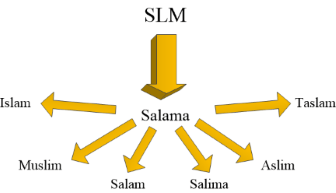
Below is each word’s meaning.
- ISLaM – submission to the will of Allah
- MuSLiM – one who submits to the will of Allah
- SaLaM – peace
- SaLiMa – to be saved or escape from danger
- ASLiM – see below
- TaSLaM – see below
On the surface there doesn’t appear to be any direct relationship between the words above. Adding to this perception, two other derivatives from the same infinitive Salama mean ‘the stinging of a snake’ and ‘the tanning of leather’.
Language Reflects Social Norms
The preceding example reflects words about different things, but I believe there is a common underlying construct. First, with each word there is a relationship between two objects. Whether one submits to his creator, another party, aid in a rescue, a person bitten by a snake, or a tanner working with leather. They are all acts of one object submitting to another. Augustine, in his book City of God, outlines two types of societies. In one society, peace is the norm marked by occasional periods of conflict. In the second type, conflict is the norm marked by periods of peace. [1] The second society type relies on submission. We will learn more about these two societies later, when discussing governance structures.
I believe the above tells us something about the path of safety within Arab culture. Safety comes through submission. This brings us to the meaning of the words Aslim and Taslim. Toward the end of Muhammad’s life, he sent letters to tribes or clans demanding they accept Islam, closing the letters with the words Aslim and Taslim. This phrase has two equivalent meanings; surrender and you will be safe, or surrender or face death. In other words submit and you will be safe. We will return to this aspect of language again later when discussing Islam’s tenet formation.
Arab Practices
It is difficult to determine many of the customs and practices within Arabic culture prior to Muhammad. Why? Because the early caliphs ordered all things pre-Muhammad contrary to Islam destroyed. This included literature, poetry, history, and art. What we know comes from a few non-Arabic sources and tradition.
Below are a few pre-Islamic Arab cultural norms we know about. Except for the first two and last in the list, all these practices carried over into Islam. Verses within the Qur’an prohibited the practice of female infanticide. Verses related to the Zaynab affair changed the status of adopted children. They were no longer considered to be the offspring of those adopting them. Finally, the status of women within Islam is very clear, and sanctioned by verses from within the Qur’an and other Islamic sources.
Some Pre-Islamic Cultural Norms
- Female infanticide (a pagan practice also performed within the Roman Empire, but reduced as the influence of Christianity grew).
- Adopted children became offspring of the person adopting them, both culturally and legally.
- Child weddings to girls as young as 8 or thereabouts.
- Multiple wives.
- Frequent blood feuds and payment of blood wit.
- Use of tribal leaders as arbiters.
- Owning of slaves.
- The tribe/clan was paramount in society, but these ties were beginning to fade, being replaced by economic mutual interests in the sixth century.
- The role and status of women is unclear. Some sources suggest women were property. Others indicate property passed through the female’s family, they participated equally with their men in taking care of their clan, and even contracted to be wives for a specific period of time. Muhammad’s first wife, Khadija, was a widow who had significant wealth of her own. Tradition has it she hired Muhammad as overseer for some of her caravans—caravans which she appeared to fund. Also according to tradition, one of the bases for their eventual marriage was Muhammad’s success in managing those caravans.
In the next article, we begin our study of Islam’s development by looking at Muhammad’s life and teachings.
Footnotes:
[1] Schaff, Philip, Nicene and Post-Nicene Fathers, Vol. 2, Augustin: City of God, Christian Doctrine, p. 286, Wm B. Eerdmans Publishing Company, 1989, Book XV, Section 4 and pp. 407-8, Book XIX, Section 12.