
This is the Way with Crowds
The FACE Act (Freedom of Access to Clinic Entrances), signed into law by Bill Clinton in 1994, was intended to prohibit “violent, threatening, damaging, and obstructive conduct” meant to intimidate or interfere with access to so-called reproductive health services. In practice, however, its enforcement reveals a substantially different narrative. From 1994 through 2024, there have been approximately 211 FACE Act prosecutions. Of those, 205 were brought against pro-life activists, while only six were brought against pro-abortion activists, according to data provided by the office of Chip Roy and reported by the Daily Caller.
Last year, on June 9, the House Judiciary Committee advanced a bill that would repeal the law that had been weaponized by the Biden administration to target pro-life activists after the Supreme Court overturned Roe v. Wade.

Don Lemon
Now, ironically, the Department of Justice is considering taking major legal action using the FACE Act following an anti-ICE protest assault during services at Cities Church in St. Paul, Minnesota, last Sunday (January 18). The FACE Act is being considered for prosecuting the mob that stormed into the church. Bizarrely, appearing among the protestors was former CNN host Don Lemon, who decided to film an on-the-spot interview with church pastor Jonathan Parnell:
Pastor: “This is unacceptable. It’s shameful to interrupt a public gathering of Christians in worship…”
Lemon: “Listen, there’s a Constitution—the First Amendment to freedom of speech and freedom to assemble and protest.”
Pastor: “We’re here to worship Jesus, because the hope of the world is Jesus Christ…”
Lemon: “But did you try to talk to them?”
Pastor: “No one is willing to talk. I have to take care of my church and my family, so I ask that you would also leave this building.”
“No one is willing to talk.” That is the sum and substance of protest movements in America. No one can talk. They can only shout—without thinking.
Two important observations should be made about Minnesota.
First, the disruption of worship services at a church in St. Paul, amid protests over the fatal shooting of Renée Good by an ICE agent, exposes how poorly much of the media understands the distinction between constitutionally protected worship and the rule of law governing lawful protest and law enforcement actions. Second, for those who still have friends on the left or in progressive circles, this episode illustrates what the “warmth of collectivism” actually feels like—political causes trampling constitutional rights. It serves only to inflame public outrage.

Al Mohler Southern Baptist Seminary
Albert Mohler, president of the Southern Baptist Seminary in Louisville, Kentucky, posted this on his Facebook page: “I normally do not post to social media on the Lord’s Day, but the unspeakably evil intrusion of a leftist mob into a Christian worship service today in Minneapolis must be called out for what it is—and Federal authorities should be fast and effective in response. May God bless this steadfast pastor, this faithful Gospel church, and the members who were traumatized, including children and youth. This was nothing less than the desecration of Christian worship.”
So, given everything we have seen in Minnesota after last week, I couldn’t help but wonder just what’s going on there when I saw a Facebook post from “Conservative Christians of Tennessee,” and later reposted by Jon Harris: (which I have condensed)
They posted a timeline of 13 migration waves, which I have edited for space. (Go to the original here, then scroll down to see the complete list.)
1. Early European Radical Seeding (1848–1870s)
German “Forty-Eighters,” along with utopian and cooperative socialists, laid the foundation. These political refugees brought radical republicanism, early socialism, labor politics, and hostility toward traditional church authority. They normalized collectivism long before Marxism became explicit, especially in the Upper Midwest.
2. Scandinavian & Agrarian Socialism (1870s–1890s)
Swedish and Norwegian immigrants introduced socialism framed as fairness, cooperation, and farmers’ rights. This version avoided revolutionary rhetoric, making socialism feel humane, communal, and compatible with Protestant ethics.
3. Finnish and Industrial Marxist Radicalism (1890s–1920s)
This was the most militant wave. Finnish Iron Range communities built Marxist halls, Red Guards, communist schools, and newspapers. Alongside Slavic, Italian, and Jewish industrial workers, they fueled the IWW (International Workers of the World) and early Communist Party infrastructure. This was unapologetic Leninism.
4. Bolshevik Shock and Institutional Entry (1917–1940s)
The Russian Revolution made communism feel inevitable. Communist Party activity surged during the Red Scare era, then shifted tactics during the Depression and WWII. Open agitation gave way to union leadership, city politics, and cultural institutions. Communists stopped calling themselves communists and began embedding themselves in education, media, churches, and progressive parties—the bridge to the modern DFL.
5. Post–Red Scare Mutation and Institutional Capture (1950s–1980s)
Communism did not disappear, it adapted. “Class struggle” became “equity.” Party cells became “community organizations.” Former Marxists became professors, administrators, grant managers, and policy advisors, protected by tenure and bureaucracy while continuing Gramsci’s “march through the institutions.”
6. Late-Stage Managerial and Refugee Marxism (1990s–Present)
By now, Neo-Marxism is no longer revolutionary, but administrative. It is enforced through HR departments, nonprofits, NGOs, and bureaucratic systems. After 1935, Minnesota stopped having to import communists and started reproducing them internally. Later arrivals had little difficulty partnering with the legacy networks already there. Once the ideology arrived, it never left.
For most people, this history has escaped attention, not to mention close study. Things like this are certainly not taught in American history classes. But what are American students being taught, particularly young Minnesotans?
In Minnesota, the U.S. Constitution is formally included in middle school social studies standards, and high school graduation requires social studies credits that explicitly cover government and citizenship, where constitutional study is required. The Minnesota Department of Education standards reference the Constitution itself, the Bill of Rights, and the rights and responsibilities of citizenship. While individual districts retain discretion over how the material is taught, they are required to teach it. The concern today is not whether the Constitution is present in the curriculum, but how it is taught.
Critics will admit that the instruction is, at best, uneven; students often learn about the Constitution without reading it closely, and emphasis has increasingly shifted away from constitutional structure toward identity, policy outcomes, or contemporary issues. The problem, then, is not absence, but depth, framing, and seriousness.
It will require another post to examine the issue more closely, but even with only a casual reading of the research results, this type of learning is no match for the ideologues promising utopia using the communist/socialist messaging.
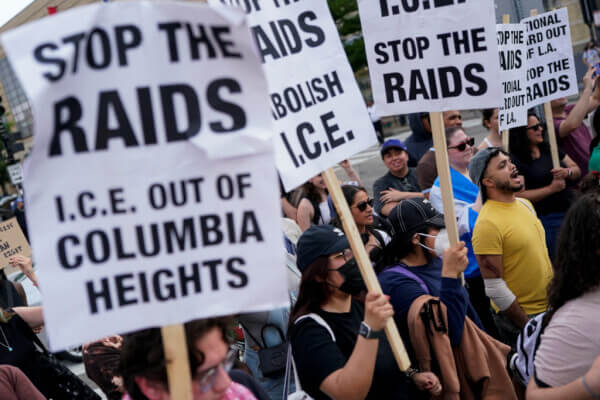
One thing we ought to admit so we can appreciate why the enemy appears to be gaining the upper hand: they are loud, persistent, in lock-step, and very well prepared. As an example, the same, or nearly the same, printed signs can be purchased online from print entrepreneurs all across the country. If you doubt it, look closely at any of the news photos and videos from last week.
- There is a way that seems right to a man, but its end is the way to death. — Proverbs 14:12 ESV
Cover photo creator: Nathan Howard | Credit: REUTERS