

Part eleven of a series.
This article describes Islam’s religious doctrine and document development during the Abbasid dynasty. During this period Islam’s core beliefs, and the documents reflecting those beliefs, hardened into those we know today. This article focuses on the Qur’an, Hadith, Sunna, Shri’ a, and Sirat. It uses traditional sources in its compilation.
Islam’s Borrowings
Before we begin, a reminder Islam added almost nothing new theologically. Instead it borrowed from every religion already existing on the Arabian Peninsula before it. One can find borrowings from Judaism, Christianity (primarily Monophysite), Zoroastrianism, Gnosticism, and paganism. In addition, one finds Aramaic, Hebrew, Syriac, Ethiopic, Greek, and Persian words within the Qur’an’s Arabic text—about 275 words in all. Ignaz Goldziher was a prominent twentieth century scholar on Islam. He said the following about Muhammad and Islam’s teachings.
“The dogmatic development of Islam took place under the sign of Hellenistic thought; in its legal system the influence of Roman law is unmistakable; the organization of the Islamic state as it took shape during the ‘Abbasid caliphate shows the adaptation of Persian political ideas; Islamic mysticism made use of Neoplatonic and Hindu habits of thought. In each of these areas Islam demonstrates its ability to absorb and assimilate foreign elements so thoroughly that their foreign character can be detected only by the exact analysis of critical research.
‘With this receptive character Islam was stamped at its birth. Its founder, Muhammad, did not proclaim new ideas. He did not enrich earlier conceptions of man’s relation to the transcendental and infinite. . . The Arab Prophet’s message was an eclectic composite of religious ideas and regulations. The ideas were suggested to him by contacts, which had stirred him deeply, with Jewish, Christian, and other elements …”[1]
Development Timeline
The timeline below provides an overview of doctrinal source development; much of it occurring during the Abbasid dynasty. See the article’s end for an enlarged view.
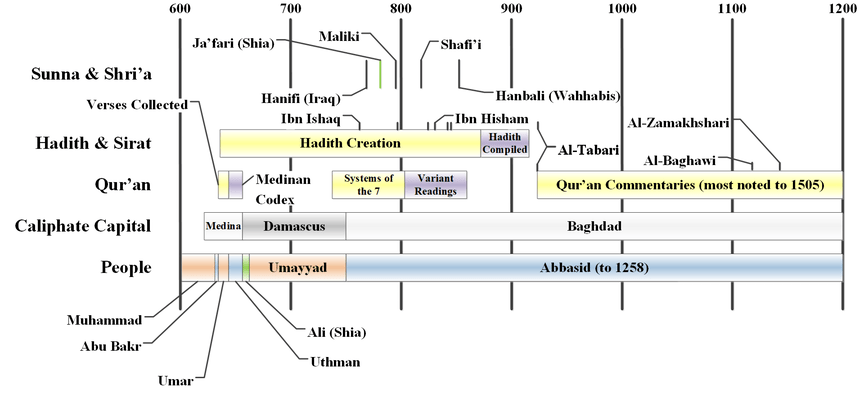
Figure 1: Timeline of Islam’s Development
The green item within the Sunna & Shari’ a row is Shia specific, and the lines roughly indicate when the Islamic schools of jurisprudence began. The lines atop the Hadith Creation bar are the traditional years of the sirat writer’s deaths. Only generally accepted writings are shown, and a few named. The lines atop the Qur’an bar indicate some commentary writers. Al-Tabari wrote both a sirat and one of the earliest Qur’an commentaries. Each source’s definition is shown below.
Definitions
- Qur’an – The reading or recital. Within Islam, God’s full and final revelation to man.
- Hadith – A story. Oral tradition later written down as to what Muhammad supposedly did, said, or approved of. Second in authority to the Qur’an.
- Sirat – The way. Biographies of Muhammad’s life and actions. Also, the bridge one is to cross to reach paradise on the day of judgement.
- Sunna – Written traditions about Muhammad’s conduct, considered authoritative by Sunni Muslims and the basis for Shari’ a.
- Shari’ a – The path. Code of Islamic jurisprudence.
The Qur’an
Several contradictory stories exist related to the Qur’an’s collection. We mentioned one of them in the last article. The seven Metropolitan Codex’s development, and Uthman’s selecting the Medinan codex as the Qur’an’s official consonantal text. Other texts came from Mecca, Basra, Damascus, and Kufa(3). Recent research indicates there were additional codices (see below), and none of these written texts appeared before the eighth or ninth centuries.[2] Codex text contained only consonants. The dots distinguishing certain consonants were not present, nor were the markings indicating short vowel placement. Different variant readings of the same consonantal text were possible by choosing what marks to insert and where to insert them.
From Charles Adams in the Encyclopedia of Religion:
“It must be emphasized that far from there being a single text passed down inviolate from the time of Uthman’s commission, literally thousands of variant readings of particular verses were known. … The variants affected even the Uthmanic codex, making it difficult to know what its true original form may have been.”[3]
“Although Muslims of the present time generally have forgotten the very existence of these variant version of the Qur’an … Arthur Jefferies has listed fifteen primary codices (i.e., from the Companions) and a large number of secondary ones.”[4]
Variant Readings
During the Umayyad and early Abbasid periods the variant readings of individual verses grew, and over time various centers developed their own traditions for inserting these marks. There were three ways to understand unpointed consonant Arabic texts. First, being present at the event. The Abbasid dynasty began almost 120 years after Muhammad’s death. No one remained who lived before Muhammad’s death.
Second, getting the information from a reliable transmitter. We mentioned the fabricated hadith creation during the Umayyad dynasty last time. Al-Burkari selected just 2 – 4 percent of reviewed hadith as authentic, and even some of those authenticity is questionable as we will see later. Hadith content were also contradictory. Finally, we have the unpointed text’s nature itself mentioned above. This left the third method, interpreting meaning from the text itself, through clerics applying both consensus and reasoning.
Using Consensus …
Consensus comes from the word ijma, meaning agreement. A saying attributed to Muhammad, “Allah has granted you protection from three things: Your Prophet lays no curse upon you, lest you perish; the party of falsehood among you will never triumph over the party of truth; you will never agree on a false doctrine.”[5] Consensus means “all that is approved by the sense of the community of believers is correct, and can lay claim to obligatory acknowledgment, and it is correct only in the form that the sense of the community, the consensus, has given it. Only such interpretations and applications of the Qur’an and sunna are correct as are accepted by consensus.”[6] Clerics applied consensus not only to the Qur’an and sunna, but the hadith and law (Shri’ a) as well.
But whose consensus? It is not simply that of the masses, but with all the fabricated hadith and variant readings, limiting ijma to either the consensus of Muhammad’s companions or the early Medinan leaders also wasn’t possible.[7] An approach acknowledging clerical authority was ultimately settled upon. “At last a formula was found and ijma defined as the concordant doctrines and opinions of those who are in a given period the acknowledged doctors of Islam. They are the men with the power ‘to bind and to loosen’; it is their office to interpret and deduce law and theological doctrine, and to decide whether law doctrine are correctly applied.”[8] This principle gave Islam the potential for changing over time as its existing spiritual leaders changed.
… and Reason
But consensus alone didn’t determine, interpret, or apply Islam’s doctrines. Reason was also used, and Greek philosophy – particularly that of Aristotle – exerted a strong influence on Islam. We can see this in Islam’s concept of Allah, which is firmly anchored in Plotinus’ ideas of the One. Plotinus was a pagan philosopher who despised Christianity, and his writings were widely read and accepted within Augustine’s time, over two hundred years before Muhammad’s first revelation. Augustine countered many of his thoughts and ideas in his The City of God. We’ll return to this topic again after completing Islam’s history. Muslims refer to Allah as God, but we use both terms throughout these articles as they don’t necessarily represent the same idea. A high level comparison covering some aspects of Christianity’s God, Plotinus’ The One, and Islam’s Allah are shown below.
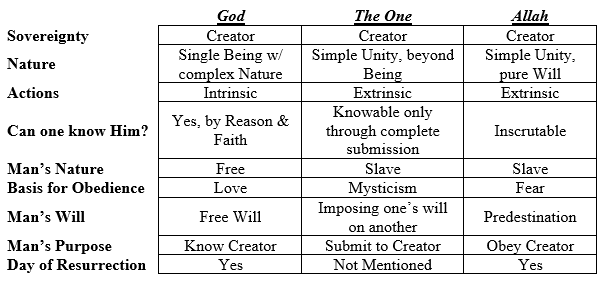
The Mu’tazalites brought Hellenistic thought into Islam during the latter Umayyad period; two of their main tenets were divine justice and God’s unity. Their rationalist thought brought them into conflict with their day’s established belief. For much of the first half of the 9th century the caliphs supported their views. This was the time of the Mihnah, the Islamic Inquisition. Their combination of intolerance and doctrine resulted in the rejection of their beliefs, but the Mu’tazalites still had a lasting influence through the rationalism they brought to Islam.
The System of the Seven
Variant readings continued increasing for several more centuries. It was not until the 10th century, under the Islamic scholar Ibn Mujahid’s influence, that Islam canonized a single system of consonants and limits on vowel insertion. The seven accepted systems were each traced through two different transmitters, leading to twenty one accepted variant readings. None of the texts below existed before the 8th century. These are:
- Nafi of Medina according to Warsh and Qalun
- Ibn Kathir of Mecca according to al-Bazzi and Qunbul
- Ibn Amir of Damascus according to Hisham and Ibn Dhakwan
- Abu Amr of Basra according to al-Duri and al-Susi
- Asim of Kufa according to Hafs and Abu Bakr
- Hamza of Kufa according to Khalaf and Khallad
- Al-Kisai of Kufa according to al-Duri and Abul Harith[9]
The Same, but Different
The above texts, and others added later, serve as the basis for the Qur’an used today. While the contents are not exactly the same, Islam accepts all of them. From Charles Adams again:
“It is of some importance to call attention to a possible source of misunderstanding in regard to the variant readings of the Quran. The seven (versions] refer to actual differences in the written and oral text, to distinct versions of Quranic verses, whose differences, though they may not be great, are nonetheless real and substantial. Since the very existence of variant readings and versions of the Quran goes against the doctrinal position toward the holy Book held by many modern Muslims, it is not uncommon in an apologetic context to hear the seven [versions] explained as modes of recitation; in fact the manner and technique of recitation are an entirely different matter.”[10]
“What appears to have happened in this instance is that the community, being unable to agree on a single reading, accepted diversity as the norm and proclaimed all of the seven (or ten or fourteen) to be correct.”[11]
A Collection of Revelations
The Qur’an was a collection of revelations, without context or sense of history. Those come from other sources—the hadith and sirat. The accepted hadith collections came to codify the Qur’an, and bring some consistency to Islam. From Goldziher:
“As the hadith would have it, believers had already harassed the Prophet by pointing out dogmatic contradictions in the Qur’an. Such discussions (according to the hadith) stirred him to anger. ‘The Qur’an,’ he says, ‘was not revealed with the purpose that you might seize on one part of it to strike at another, as the nations of the past did with the revelations of their prophets. Rather, in the Qur’an one thing confirms another. You should act according to what you understand of it; you should accept on faith what is confusing to you.’”[12]
There are hadith contradicting the passage above, and over time inconsistent verses within the Qur’an resulted in Muhammad’s abrogating them. So in summary, there were initially different Qur’an texts, having many variant readings, requiring reasoning and consensus to determine their meaning—and the reasoning used having its basis in pagan thought. Finally, any confusing verses should simply be accepted on faith, there should be no questioning of doctrines derived from the Qur’an.
The Hadith
The Sunni generally accept six hadith collections as authentic. Most were not written until the latter half of the ninth century, nor canonized until the fourteenth century. Al-Bukhari and Muslim ibn al-Hajjaj compiled the most authoritative hadith, and are sometimes referred to as the “Sound Ones”. As noted earlier, hadith were originally oral stories, relying on a train of trustworthy transmitters (isnad). Again, many hadith were fabricated during the Umayyad and Abbasid periods. Each compiler devised his own criteria for evaluating hadith and determining its soundness.
Idea Assimilation
On its face, fabricating hadith was not necessarily bad in itself, so long as the fabrications improved Islam’s ethics or brought it more consistency. The following saying, attributed to Muhammad, indicated that fabrications would happen. “After my death more and more sayings will be ascribed to me, just as many sayings have been ascribed to previous prophets (without their having really said them). When a saying is reported and attributed to me, compare it with God’s book. Whatever is in accordance with that book is from me, whether I really said it or no.”[13] “Muhammad said” came to mean it was right, unassailable, desirable, and that Muhammad himself would agree with it.
In addition, hadith concerned subject matter beyond religion. “Not only law and custom, but theology and political doctrine also took the form of hadith. Whatever Islam produced on its own or borrowed from the outside was dressed up as hadith. In such form alien, borrowed matter was assimilated until its origin was unrecognizable. Passages from the Old and New Testaments, rabbinic sayings, quotes from apocryphal gospels, and even doctrines of Greek philosophers and maxims of Persian and Indian wisdom gained entrance into Islam disguised as utterances of the Prophet.”[14]
Isnad—Authoritative Weight
Sayings originating from Muhammad, or his companions, were the best sources for learning Muhammad’s will. “Conduct and judgment were considered correct and their legitimacy was established if a chain of reliable transmission ultimately traced them back to a Companion who could testify that they were in harmony with the Prophet’s intentions.”[15] Each saying sought authority. “The Prophet’s authority was invoked by every group for every idea it evolved: for legal precepts couched in the form of tradition, as well as for maxims and teachings of an ethical or simply edificatory nature. Through solid chains of tradition, all such matters acquired an unbroken tie to the ‘Companions’ who had heard those pronouncements and statutes from the Prophet or had seen him act in pertinent ways. It took no extraordinary discernment on the part of Muslim critics to suspect the authenticity of much of this material.”[16]
Isnad Examination
In his Muslim Studies (Volume 2) Goldziher demonstrated “a vast number of hadith accepted even in the most rigorously critical Muslim collections were outright forgeries from the late 8th and 9th centuries – and as a consequence, that the meticulous isnads which supported them were utterly fictitious.”[17]
Joseph Schacht and R.S. Humphreys extended Goldziher’s work. “Humphries sums up Schacht’s theses [on the hadith] as: (1) that isnads going all the way back to the Prophet only began to be widely used around the time of the Abbasid Revolution – i.e., the mid-eighth century; (2) that ironically, the more elaborate and formally correct an isnad appeared to be, the more likely it was to be spurious. In general he concluded, no existing hadith could be reliably ascribed to the Prophet, though some of them might ultimately be rooted in his teaching.”[18] From the above, “a vast number” of accepted hadith were forgeries, the isnad used to support them came later, and more convincing isnad were more likely to be false.
Text Authenticity
In addition to using different criteria, there is also doubt about these collection’s authenticity itself. “For example, at one point there were a dozen different Bukhari texts, and apart from these variants, there were deliberate interpolations. As Goldziher warns us, ‘it would be wrong to think that the canonical authority of the two [collections of Bukhari and Muslim ibn al-Hajjaj] is due to the undisputed correctness of their contents and is the result of scholarly investigations.’ Even a tenth-century critic pointed out the weaknesses of two hundred traditions incorporated in the works of Hajjaj and Bukari.”[19] Islam’s documents have not yet undergone the kind of rigorous scrutiny other religions have received.
Instead one accepts Islam’s doctrines through tradition and faith. Rituals play a critical role in Arabic culture, and over time grow in importance. “On the strength of such traditions, certain customs in ritual and law were established as the usage of the authoritative first believers of Islam, and as having been practiced under the Prophet’s own eyes. As such, they acquired a sacred character.”[20] These are sacred tradition—sunna. Hadith are a stated form of these traditions. The two concepts are not identical. A hadith is a tradition’s documentation. The sunna are where we head next.
The Traditions
Sunna are traditions for living, based upon Muhammad’s example. These traditions came from Islam’s sources – the Qur’an and hadith. However, sunna were not new. Instead Islamic traditions replaced those existing prior to Muhammad. “When the Arabs accepted Islam – which had commanded them to break with their authentic sunna – they brought the concept of sunna with them. From that time forth it became the main pillar of the Islamic view of law and religion. There was, naturally, one essential modification: in Islam one could not draw one’s precedents from the pagan sunna. Its point of departure was shifted; its source now consisted in the doctrines, conceptions, and practices of the oldest generation of Muslims, founders of an entirely different sunna from what the original Arab one had been.”[21]
Hadith included cultural, legal, political, and religious concepts. The Abbasid viewed themselves as secular rulers and princes of Islam; everything tied to religious doctrine and the divine law underlying it – studying and practicing the traditions became increasingly important.
“Since state, law, and the administration of justice were to be ordered and built up according to the precepts of religion, preference had to be given to people who practiced and studied the sunna, or who used scholarly methods to ascertain the divine law. … Not only the rules for the ritualistic aspects of life were now based on religious law, but also the institutions of the state. The administration of justice in all kinds of transactions, down to the simplest statutes of civil law, must fulfill the requirements of the divine law. Consequently those requirements must be discovered down to the minutest detail. This was the age of the development and fixing of the law, the age of fiqh and of the scholars of jurisprudence.”[22]
Shri’ a
The reason and consensus noted above created new traditions based upon Islam’s doctrines, superseding historic Arab ones. These new ideas became Islamic law’s source. Islamic law’s initial development took place under the first caliphs and Umayyad. The rapid change from military expansion to consolidation created new circumstances for the caliphate. Arab tribal structure and Islam provided limited guidance. Instead, Islam absorbed constructs from the more advanced cultures it encountered.
But unlike the West, where law is separate from a society’s religious sphere, within Islam every aspect of life falls under it. Human and divine law are one, all having its basis in the Qur’an and hadith, as embodied in the sunna. This leads to a significant difference between Sunni and Shia. The Sunni do not view the Shia as dissenters due to their differences in law, but instead due to Shia deviating from accepting the Sunni’s traditions.[23]
Legal School Development
Reason and consensus also marked Shri’ a’s early development.
“Hadiths were carried and handed about; new postulates and rules were derived from received material. On occasion the results were contradictory. Points of view and methods also led to differences. Some lawyers deferred to hadith. Gradations between these opposing tendencies gave rise to scholarly factions and schools that differed mostly in particular details of legal rulings, but were also at variance on some points of method. But contradictory hadiths would furnish contradictory answers to a question.
‘One would have to determine in such cases which hadith outweighed the other. Because of the dubiousness of proof from hadith, other lawyers wanted freedom in legal reasoning, and refused to be much inconvenienced by received material. Deeply rooted local usage and customary law could not be simply done away with. Gradations between these opposing tendencies gave rise to scholarly factions and schools that differed mostly in particular details of legal rulings, but were also at variance on some points of method.”[24] These became Islam’s legal schools.
Cultural Tolerance
Islamic law developed in several phases. In its early stages, the Islamic state showed some tolerance to conquered peoples as no regulations existed for dealing with their more ancient culture, religions, and customs. The Umayyad also were more concerned with accumulating land and wealth than in applying religious doctrine. They needed the conquered people’s assistance in sustaining order and a revenue stream sufficient for maintaining the caliphate’s large army.
These conditions did not last when the Abbasid assumed power, the shift toward religion had implications for law. Clerics found it more difficult to rely on fraudulent hadith in developing legal opinions, especially as different groups with differing viewpoints developed contradictory hadith. Law’s development also applied the same consensus and reasoning approach outlined earlier. Hadith were incorporated when they seemed to offer a firm footing, but only if there were a justifiable method of arriving at the end.
Outside Influences
Outside influences also found their way into Islamic law. According to Goldziher, “Islamic jurisprudence shows undeniable traces of the influence of Roman law both in its methodology and in its particular stipulations.”[25] This shift led to the concept of fiqh, the Islamic science of religious law. “A science which, perverted by casuistry, was soon to become disastrous for religious life and religious learning.”[26] Goldziher indicates the Abbasid rise was a factor in this change. While Islam asserts this shift purified its religion, human history has shown repeatedly that combining both the state and religious spheres results in the corruption of both.[27]
Islam’s position comes from believing a collective consensus protects its community from error. “We shall have occasion to study more closely the application of this principle as a criterion of orthodoxy. We shall see that only the continued effectiveness of this principle, throughout the history of Islam, explains that certain religious phenomena gained the stamp of orthodoxy because they had gained general acceptance, although in theory they should have been ensured as being contrary to Islam.”[28] So, like before, we have Islamic law coming from Islam’s sources, the same reasoning being applied, in rapidly expanding geographic and cultural areas, its initial minority position in those lands, and its reliance on the native people for the caliphate’s income.
An Example
Law development often aimed at relieving perceived religious burdens. “The jurists pressed their ingenuity into service to find means of evasion whenever the literal text of the Qur’an would have led to an oppressive situation for the believers. Liberal interpretation of the text would often lighten a burden, or explain it away entirely.”[29] Goldziher illustrated using the prohibition against drinking wine, and the application of reasoning to that prohibition in order to relieve this burden. By the middle of the ninth century, “Although outright permission of the ‘water of the grape’ was out of the question, they [legal scholars] furnished the legal conscience of the believers with diverse means of relief, and of these means even well-intentioned people widely availed themselves.”[30] This focus on searching into law, using sophistry, led to a form of legalism which stamped Islam.
The Sirat
There are seven primary sources for information on Muhammad’s life. The earliest biography is Ibn Ishaq’s Sirat Rasul Allah,[31] written around the beginning of Abbasid rule. A complete original copy of this work does not exist. Ibn Hisham edited the version we have today, almost one hundred years after Ibn Ishaq’s work. Al-Tabari (10th century) quotes are also incorporated into this sirat. Although this work is not the original, it still presents a compelling view of Islam’s belief development. The other biographies were all written in the late eighth to ninth centuries.
The relationship between Islam’s sources can be shown as in the diagram below. The application of reasoning and consensus to the interpretation of the Qur’an, the development of the sunna, and the selection and codification contained within the hadith, all resulted in a closed system of divine orientation. It was from this closed system that Islam’s legal system developed. The biographies add some context and a sense of history to the Qur’an’s development.
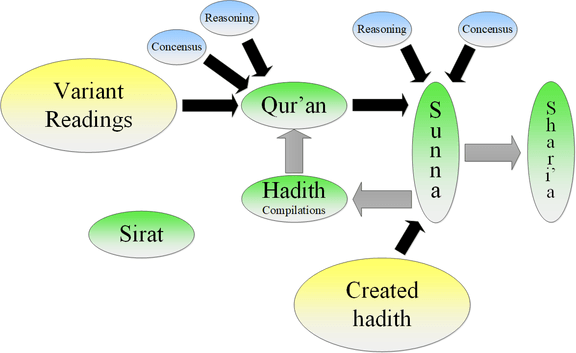
Figure 2: Relationship Between Islam’s Sources
The final installment of the Abbasid looks at the treatment of the dhimmi, and the continued development of Islamic law.
Footnotes:
[1] Goldziher, Ignaz, Introduction to Islamic Theology and Law, pp. 4-5, Princeton University Press, 1981.
[2] Jones, Lindsay, Ed., The Encyclopedia of Religion, 2nd Edition, Vol. 11, p. 7563, MacMillan Publishing Co., 2005. The full quote is ‘While Muslim tradition holds that some written works indeed existed from the mid-seventh century, the evidence of recent research indicates that they had begun to emerge at least by the early part of the eighth century … The earliest exegis … was primarily oral and depended on oral transmission.’
[3] Eliade, Mircea, Ed., The Encyclopedia of Religion, Vol. 12, p. 164, MacMillan Publishing Co., 1987.
[4] Ibid.
[5] Goldziher, Ignaz, Introduction to Islamic Theology and Law, p. 50, Princeton University Press, 1981.
[6] Ibid, p. 51.
[7] Ibid, p. 52.
[8] Ibid.
[9] Warraq, Ibn, Why I Am Not a Muslim, pp. 109-110, Prometheus Books, 1995.
[10] Eliade, Mircea, Ed. The Encyclopedia of Religion, Vol. 12, p. 165, MacMillan Publishing Co., 1987.
[11] Ibid.
[12] Goldziher, Ignaz, Introduction to Islamic Theology and Law, p. 69, Princeton University Press, 1981.
[13] Ibid, pp. 43-44.
[14] Ibid, p. 40.
[15] Ibid, p. 37.
[16] Ibid, p. 43.
[17] Humphreys, R.S., Islamic History, A Framework for Inquiry, Princeton, 1991 as quoted in Warraq, Ibn, Why I Am Not a Muslim, p. 69, Prometheus Books, 1995.
[18] Warraq, Ibn, Why I Am Not a Muslim, p. 71, Prometheus Books, 1995.
[19] Ibid.
[20] Goldziher, Ignaz, Introduction to Islamic Theology and Law, p. 37, Princeton University Press, 1981.
[21] Ibid, p. 231.
[22] Ibid, pp. 46-47.
[23] Ibid, p. 205.
[24] Ibid, p. 47.
[25] Ibid, p. 44.
[26] Ibid.
[27] Wolf, Dan, Collectivism and Charity: The Great Deception, Living Rightly Publications, 2016.
[28] Goldziher, Ignaz, Introduction to Islamic Theology and Law, p. 51, Princeton University Press, 1981.
[29] Ibid, p. 56.
[30] Ibid, p. 61.
[31] Guillaume, A., The Life of Muhammad: A Translation of Ibn Ishaq’s Sirat Rasul Allah, Oxford University Press, 2006.