
Thirty-seventh in a series
The original articles, from this part of the series, used data from a 2013 Pew Research Center global survey of the Muslim population. In searching for updates, even the articles written since 2020 still reference this same survey. As there does not appear to be any more recent data, I am reposting the original articles, with a few tweaks where some things have changed. There was a 2017 survey of the US Muslim population, also gathered by the Pew Research Center. I’m reviewing that now. If there is enough material in it, I will present it later as a separate article.
Extremism and Islam
We hear it repeatedly from the media, politicians, talking heads, and our leaders. Extremists are a very small part of Islam, and the figure is normally put at about 1%. We further hear that the world’s Muslim population is about 1.6 billion. Even 1% of that population is about 16 million people – and while that is a lot, it is still less than 5% of the entire US population.
However, several things are missing from this conversation. First, what exactly is meant by extremist? Is it action or belief? Attitude or thought? Second, what is the 1% figure based upon? Is that assertion supported? Toward the first question, being an extremist is a relative term. There are likely some issues where I could view you as an extremist, and undoubtedly others where you could view me as one as well. This label really doesn’t help very much in even determining what is extreme, let alone a solution. So let’s start with a definition. According to the dictionary, an extremist is someone who carries something to excess. From a Westerner’s perspective, that could be interpreted as simply adhering to a very literal meaning of Islam and its doctrines. For more information on Islam’s tenets and their development, see The First Caliphs and the Umayyad Dynasty and The Abbasid Dynasty – Part II.
The Pew Research Center asked Muslims “What is Islamic extremism?” and obtained the following responses.[1]
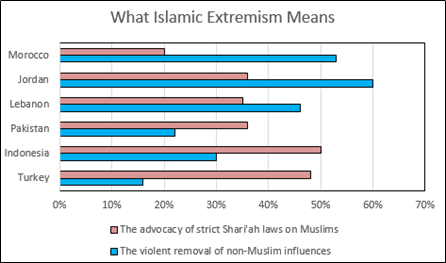
Muslims themselves interpret this term differently. In the Middle East/North Africa it generally meant the violent removal of non-Muslim influences, but within non-Arabic countries it generally meant the imposition of Shari’ah law upon other Muslims. In addition, a significant percentage in all countries, except Jordan, declined to respond to this question. From a Western perspective, both responses would likely be considered Islamic extremism.
Survey Areas
This and the next two articles take an initial step in providing information relevant to both the initial questions posed above. My hope is that it will spark conversations for you with your friends, your families, and your co-workers. It is, after all, okay to disagree, but at least you should understand what it is that you agree or disagree about. Otherwise, how can we effectively ever solve a problem?
The Pew Research Center survey results, whose subjects were Muslims from various parts of the world, are extrapolated to Muslim populations across several regions. The specific topics incorporated are:
- General Attitudes (This article)
- Politics
- Law
- Culture, with a focus on women’s rights
Information on politics and law will be presented in the next article. The Pew Research Center has performed Muslim population surveys across the globe for over fifteen years. They have the experience to ask relevant questions, and have done it long enough to have some trend information available.
Why It Matters
Before we begin, there is one point critical to this discussion. The contents of these articles are not to say that Muslims are good or bad. Rather, the decisions each one of us makes determines our character and who we are. Instead, their purpose is to examine Muslim opinion relevant to several aspects of Islam and society; it is Islam’s tenets that matter. Muslim opinion is shaped by Islam, so how consistent are those opinions with the foundations of our society? This is the discussion we need to have. In the end, the results of those discussions should determine what is extreme and what is not, and therefore how many people make up what is called the “1%”, and what our response as a people needs to be. Currently, it is a discussion we have yet to take up, and some of our leaders have not even wanted us to have.
We only need to use a couple of foundational principles as a baseline in these discussions to begin understanding the gulf that exists. These can be used to determine consistency or difference, and include:
- We have a common ancestry, a common nature, and therefore the same rights. We are not equal in all ways, but as concerns our nature and rights – we are all unequivocally the same.
- The institutions of the church and state, along with the family, were implemented by our Creator. The Church and State have separate domains, but both – just like the family – are to be oriented toward our Creator. This does not mean the State should be directly connected to any religion, but rather the belief and morality underlying religion should carry over as an influence on those who govern. If not, man is only accountable to himself. (See the previous article.)
Population Demographics
Let’s start by looking at the general Muslim population. We often assume that it is primarily Arabic, but that is not the case. If we look at the top 10 countries in terms of Muslim population, they were:
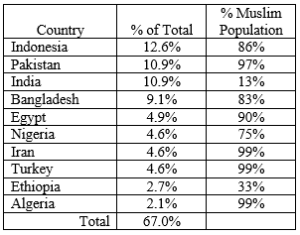
The top five countries in this list accounted for about 48% of the world’s Muslim population. Since this article’s original posting, Nigeria has moved into fifth place. Not one of the top five population countries is in the Middle East. Further, only two of the ten are countries whose primary language is Arabic (Egypt and Algeria). In all only about 22% of the world’s Muslim population lives in countries within the Middle East and North Africa. Finally, with the exception of India and Ethiopia, the non-Muslim populations are the minority in these countries.
Survey Regions
The surveys were all conducted in the Eastern Hemisphere and were broken into the following six regions:
- Southern-Eastern Europe – including Albania, Bosnia-Herzegovina, Kosovo, and Russia.
- Middle East – North Africa – the countries of the Arabian Peninsula and on the African continent along the Mediterranean Sea. These include Egypt, Morocco, and Tunisia.
- Sub-Saharan Africa – all countries on the African continent, except those bordering the Mediterranean Sea. These include: Cameroon, Ethiopia, Mozambique, Nigeria, Senegal, and Tanzania.
- Central Asia – including Azerbaijan, Kazakhstan, Tajikistan, and Turkey.
- South Asia – including Afghanistan, Bangladesh, and Pakistan.
- Southeast Asia – including Indonesia, Malaysia, and Thailand.
The survey included the largest Muslim population countries within each region. These surveys are The World’s Muslim Population: Religion, and Politics, and Society[2] and Muslim Publics Divided on Hamas and Hezbollah.[3] The percentages are the median from a region or countries within the region. These percentages are applied to the Muslim population within the entire region, using 2010 Pew Research Center Muslim population estimates. Pew’s population estimates were compared to the 2008 CIA Handbook figures. Where significant population differences exist, the Pew Research Center population figures were consistently lower. The numbers are in millions. Dashes indicate a particular question was not asked in a region. Remember that 1% of the current Muslim population is about 16 million.
General Attitudes
Area 1 – Religious Beliefs
The relevant questions asked in the survey were:
- Is it necessary to believe in God to be a moral person?
- How many faiths lead to heaven?
- Converting others is a religious duty.
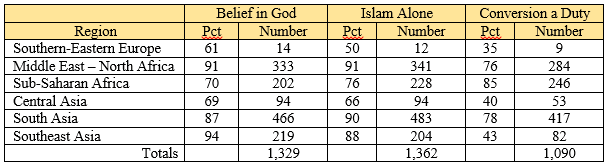
The above results should not be a surprise. Most Muslims believe that: (1) you need to believe in God to be moral, (2) that Islam is the only way of being obedient to God, and (3) you have a responsibility to reach out to others. These thoughts are typically held by any religion.
Area 2 – Muslim Integration
These next survey results concern Islam and things outside it. These are:
- Percentage of Muslims who say Islam and Christianity are very different.
- Percentage of Muslims who say all or most of their close friends are Muslims.
- Percentage of Muslims who say Western music, movies, and TV hurt morality in their country.
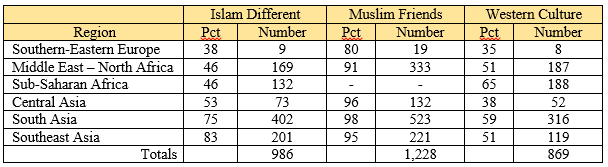
It is interesting that the regions with the largest percentages saying that Islam and Christianity are different are those where a significant non-Muslim segment still exists (Indonesia in Southeast Asia and Bangladesh in South Asia). Those who see much less difference between the two religions are places where either: (1) there are almost no Christians (or other minority religions), or (2) a communist state controlled religion for much of the last one hundred years.
It is not surprising that people living in areas where there are few non-Muslims have Muslims for most of their close friends. What is more interesting is this trend continues in places where there are other religions (Southern-Eastern Europe, South Asia, and Southeast Asia). A fair number of Muslims also view Western culture as a moral threat. The responses to all three of these questions all approach 1 billion people or more – out of 1.6 billion.
Area 3 – Islamic Charities or Terrorists
The final panel in this article looks at Muslim support for institutions and actions that are generally looked upon as supporting terrorism by the West.
- Percentage that view Hezbollah favorably.
- Percentage that view Hamas favorably.
- Percentage that say support for suicide bombing is often/sometimes justified.
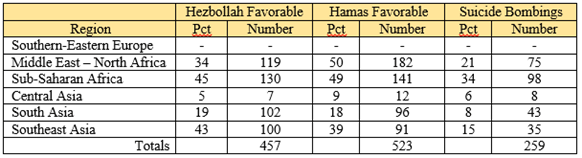
While the support for these items is less, they still approach half a billion people for Hezbollah and Hamas, and a quarter billion people say suicide bombings are often or sometimes justified – considerably more than 1%. I think that there is a common thread through these three items. Within the Muslim world, Hezbollah and Hamas are viewed as charitable organizations. Islamic charitable organizations are not like their Western counterparts in some respects. Islamic charities can only expend funds on the support of Muslims, and then only in a few areas that include: (1) supporting the person collecting the funds, (2) supporting travelers – particularly those on the hajj, (3) supporting those in need – the poor, widows, and orphans, (4) payment of individual’s debts, and (5) jihad.
Links to Jihad
As outlined in the last two articles, jihad is much broader than we typically think of it in the West. It does include warfare (jihad of the sword), but also the more non-violent means of the hand (piety), mind (teaching), pen (writing), tongue (speaking), and wealth (resource use). Wealth in many Muslim majority countries is relatively concentrated in the hands of a small elite. Witness the building of mosques in the US financed by Saudi Arabia. This is no different than in any other collectivist society
It is interesting to note that those places expressing the greatest support for Hezbollah and Hamas are also the largest supporters of suicide bombings. These are regions where there is generally a high concentration of Muslims in the general population, or where there is civil unrest or open warfare. Examples at the time, included Afghanistan, Iraq, Syria, Nigeria, Cameroon, Niger, Somalia, Kenya, Libya, Pakistan, Yemen, Egypt, and the Sudan.
The next article will look at the areas of politics and law.
Footnotes:
[1] The Pew Research Center, How Muslims See Themselves and Islam’s Role, July, 2005.
[2] The Pew Forum on Religion & Public Life, The World’s Muslims: Religion, Politics, and Society, April, 2013, .
[3] Pew Research Center, Muslim Publics Divided on Hamas and Hezbollah: Most Embrace a Role for Islam in Politics, December, 2010.