

Twenty sixth in a series
We’ll finish the conversation we started last time by discussing law. Once again, we’ll create a baseline using the Biblical Principles model, before proceeding with the State Religion model and Shari’a. You might want to have the previous article available to reference as the topics of rights and law are closely related.
What is Law?
We saw last time that Webster’s 1820 Dictionary defines law as a permanent rule prescribed by a society’s supreme authority—its sovereign. As the sovereign within the two primary governance models differ, the law’s source with each of these two societies are also different. Within the Biblical Principles model, God is creation’s sovereign, and His law prescribed through both nature and revelation—natural law. Man’s law lies below God’s, and is to align with His law. However, the State Religion model’s sovereign governing power is man.
Within the Biblical model, there are three law areas (jurisdictions) created in the first two chapters of Genesis. That’s where we’ll begin before moving to the State Religion model and then Shari’a. Note, none of this is legal advice, but is presented for educational purposes only.
In the Beginning …
Note the passages from Gen. 1:26-30 and Gen. 2:15-7 again. God created man in His image and likeness, then gave man dominion over the things of the earth. He placed trust in man, creating the first trust. Trust law is the first jurisdiction. Man’s nature and dominion form the basis of his natural rights, as discussed last time. In addition, God placed man within the midst of a garden providing everything he needed. God placed man within the midst of His property and gave man its use for man’s benefit. This is the second jurisdiction of common law related to rights and property.
The last area concerns contracts. While a trust is a contract, it is one designed for a unique purpose, and not what we normally think of when hearing the word contract. More typical are the events from Genesis 2. There God placed the man in the garden to tend it. If he did so, the garden would provide everything he needed. There was only one condition, man was not to eat from the tree of the knowledge of good and evil. A contract is an agreement between two beings with terms and conditions. This is the admiralty law jurisdiction over commerce and contracts. God created all three law forms during His act of creation. Those actions form the basis for all law within each jurisdiction as they happened first, before anything man did. Man even breaks this law in Genesis 3. He breaks trust and a contract with God by his actions. We’ll go into a little more detail into each law jurisdiction next.
Types of Law
Trust Law
As stated above, God placed trust in man when granting him dominion, creating the first trust. All trusts have three parties; a grantor, trustee(s), and beneficiary(ies). God as creation’s creator is this first trust’s grantor. God placed the things of the earth He created into trust with man. A grantor places assets into a trust for benefit of another—an act of service again. One creates trusts through their writing, speech, or even their actions. Trustees are responsible for complying with the trust’s rules. Beneficiaries are those for whose benefit a trust is created.
Man is both trustee and beneficiary within this first trust. All trusts have rules stated within a contract called an indenture. This first trust’s indenture is the Bible. It was likely originally implied by actions, later passed on to succeeding generations by the spoken word, and finally at some point written down. It contains God’s rules for the trust (revealed law), and the benefits one receives when following the rules.
Think this is not the case? Check out Deuteronomy Chapters 27 (curses), 28 (blessings), and 30 (our choice). I believe the Israelites also recognized this trust arrangement. That is one reason why lineages are a significant part of the Old Testament. If one could not trace their lineage back to one of the Old Testament families, clans, or tribes; then they were not a beneficiary of God’s promise to Abram, they were outside the trust.
Common Law
Common law, the second area, again concerns rights and title. We’ll discuss rights and law first. Three of the four areas within the private side of common law are present in Genesis 1. These are Personal Security, Personal Liberty, and Property. At creation, God gave man life (Personal Security), reason and language (Personal Liberty), and placed man within abundance meeting his every need (Property). When God created woman in Gen. 2:18, 21-4, the family was created and a fourth area of private common law (Private Relationships) formed. Each area protects rights inherent in our God given nature. Except for the trust law mentioned previously, God created common law before all other law. Common law is therefore superior to all law but trust law, as trust law came first.
Creation came first. Natural rights are inherent in our nature—our creation. Natural rights therefore come before law. Man’s nature and God’s commands shape natural law. Common law relies on the principles forming natural law.
Common Law’s Source
What is natural law? It is the law of nature and revelation, prescribed by God.
“Upon these two foundations, the law of nature and the law of revelation, depend all human laws; that is to say, no human laws should be suffered to contradict these.”[1]
“The law of nature … is that which God, the sovereign of the universe, has prescribed to all men, not by any formal promulgation, but by the dictate of right reason alone. … [I]t comprehends all the duties we owe either to the Supreme being, to ourselves, or our neighbors.”[2]
Natural law is also called the moral law. Christian principles form natural law and create common law’s foundation. America’s law concerning rights and title, at its founding, was formed by Common Law.
“England never accepted the Roman civil law, … The English civil law is divided into Common Law or lex non scripta (i.e., not written at first), or Statute Law or lex scripta. They are related to each other as oral tradition and the Bible are in theology. … It [Common Law] is Anglo-Saxon in its roots, and moulded by Norman lawyers, under the influence of Christian principles and equity. Blackstone, the standard expounder of English law, says, ‘Christianity is a part of the Common Law of England.’”[3]
This is why America’s founders believed we have a set of natural rights; coming from God, and preceding natural law. Natural law protects these rights. These rights are unalienable, meaning no man can place a lien upon these as they come from God.
Title
Title has to do with the right of ownership and/or beneficial use. These, too, have their basis in the Bible. A natural person (i.e., a man/woman) may have both or only one type of title in relation to an object. God made a distinction between land and the things of the earth—between real and personal property. The land is not to be permanently sold. We only have the right of its use (Lev. 25:23). Further, we see this same principle at work in the parable of the bags of gold/talents (Luke 19:12-27). The king (God) gave the use of gold to his servants, but retained its ownership. The king demanded an accounting when he returned. God granting man dominion man over the things of the earth gave man beneficial use of those things. We do not own them if we did not create them.
It is different with the things we create through our labor, either directly or indirectly. Labor is a natural right, and we have the right to keep the fruits of our labor. It is God’s gift to man (Eccl. 3:12-3). For these things (personal property) we have both ownership and right of beneficial use. This is consistent with God’s title through His act of creation; a part of His image and likeness man bears. It also means we are able to create trusts with the things we create through our labor—just as God did. We can pass ownership and/or beneficial use on for another’s benefit through a trust we create. As we cannot create everything we need, money provides a store of value for man’s labor. Man can exchange this store of value for the things man needs, but cannot create for himself.
Contract Law
The third area is contract law. As mentioned earlier, God placed man in the Garden to cultivate and care for it, and in return it would supply all man’s needs. God placed one condition on the arrangement. Man must not eat from the tree of the knowledge of good and evil. This action created a fifth area within Common law private relationships, that of Private Contracts. When man ate from the tree, he broke the contract and was cast out of the Garden. Man also broke his spiritual relationship with God as man rebelled against God by his actions. He broke a condition of the trust.
Contracts also take written or oral forms, or are implied by the parties actions. However, common law contracts differ from Roman civil law contracts, which we’ll cover next. Common law contracts require;
- An agreement between like kinds (living men/women or legal fictions such as corporations—no mixing of the two types),
- Competency to create a contract,
- A meeting of the minds between parties,
- Free and genuine consent between parties,
- Full disclosure of all terms and conditions,
- An exchange of real value (consideration),
- Signatures of all parties, and
- Privity, meaning only the parties named in the agreement are part of it.
Roman Civil Law
This law is the child of the pagan State Religion governance model. As man is sovereign within this model, this law varies from that of the Biblical Principles model. A bit of history. With Rome’s fall, its governance disappeared, replaced by Germanic tribal rule. The new kingdoms were generally small, limited in size by the European terrain. The new rulers needed the support of those they attempted to govern. While Rome’s influence was gone, the Church remained. These new rulers relied on the Church; they often did not know the people or speak their language. The Church also held records, documents, and provided education.[4]
Roman civil law’s influence largely disappeared after the Empire’s collapse. England came under Norman influence through William the Conqueror from 1066 – 1087. Additionally, a copy of Justinian’s writings was discovered in about 1130. Both almost destroyed Common Law. In Blackstone’s words, “And an accident, which soon after happened, had nearly completed its [Common Law’s] ruin. A copy of Justinian’s pandects, being newly discovered at Amalfi, soon brought the civil law into vogue all over the west of Europe, where before it was quite laid aside and in a manner forgotten; though some traces of its authority remained in Italy and the eastern provinces of the empire.”[5]
Only two countries have used Biblical governance; Israel of the Bible and America. All others have followed the pagan model. England was different with its common law, which largely came from the island’s Germanic invasion by the Angles, Saxons, and Jutes in the 5th century. Common law formed the basis for America’s law at the country’s founding.
What Are Some of the Differences?
Not all Roman civil law is bad. However, it often disregards God’s natural law. Rome’s government declared civil law through statutes, code, regulations, ordinances, etc. This type of law exists in America today; a lower form of law all based upon contracts. How we got there is a topic for another time. Just know America began with Common Law and transitioned over a period of time to Roman civil law.
Some differences from common law include;
- Trusts are constructed from statutes rather than common law—recorded (public) rather than unrecorded (private).
- Under civil law, rights become privileges, granted by the governing power. They are conditional rather than inherent, subject to licensing, registration, recording, regulations, certification, etc.
- Title is shared. The governing power is sovereign, owning all property as they take God’s place—either by denying Him or standing in His stead. The governing power grants the right of beneficial use to persons; subject again to licensing, registration, and various rule and regulatory compliance. This forms the basis for property taxation, something America’s founders rebelled against.
- Contracts form the basis of pagan governance, including the trusts, rights, and titles discussed previously. Legal fictions create contracts, such as corporations, persons, statutory trusts, associations, etc. Below are a few significant differences.
- The common law requirements for contracts are not necessary.
- There is no need for a meeting of the minds or disclosure. One party makes an offer, normally a public official in authority. Unless one rejects the offer, it is accepted. Silence presumes acceptance.
- After acceptance, if a person later changes their mind, they break the contract and must defend their action. There is no longer an assumption of innocence and proving of guilt. One is guilty and must prove their innocence.
Shari’a
This next area explores shari’a compatibility with US law. As should be clear by now, Islam is more than simply a religion. It is politics, military, civics, ethics, culture, law, and religion – all in one package. Further, it is impossible to separate one aspect from another. Islam is all.
We’ll look at shari’a from two perspectives. First its structural origin. Second, a look at its thought basis. We’ll compare both aspects to some of our relevant founding principles. All presidents, before Barack Obama, viewed Islam as contrary to our society and way of life. One should ask themselves why this president was different. Has something changed within Islam to warrant this change in attitude, or is it a change occurring within us? You can go as far back as Thomas Jefferson and John Quincy Adams, who both made serious studies of Islam in connection with the Barbary Pirates in the early 1800’s. Both these men professed Islam is contradictory to our founding principles, something they were both intimately involved in helping to shape.[6]
A Brief History
Ignaz Goldziher marked Islam’s development from several significant outside influences. He said, “The dogmatic development of Islam took place under the sign of Hellenistic thought; in its legal system the influence of Roman law is unmistakable; the organization of the Islamic state as it took shape during the ‘Abbasid caliphate shows the adaption of Persian political ideas; Islamic mysticism made use of Neoplatonic and Hindu habits of thought. In each of these areas Islam demonstrates its ability to absorb and assimilate foreign elements so thoroughly that their foreign character can be detected only by the exact analysis of critical research.
‘With this receptive character Islam was stamped at its birth. Its founder, Muhammad, did not proclaim new ideas. He did not enrich earlier conceptions of man’s relation to the transcendental and infinite . . . The Arab Prophet’s message was an eclectic composite of religious ideas and regulations. The ideas were suggested to him by contacts, which had stirred him deeply, with Jewish, Christian, and other elements, and they seemed to him suited to awaken an earnest religious mood among his fellow Arabs. The regulations too were derived by foreign sources; he recognized them as needed to institute life according to the will of God.”[7]
Goldziher recognized several influences relevant to shari’a development. These included: (1) the political ideas taking shape with the Abbasid caliphate, and (2) the incorporation of Hellenistic thought into Islam’s development. Remember Blackstone’s comment about Roman civil law remaining in the empire’s eastern provinces—the Byzantine Empire. One source Islam absorbed in forming Shari’a.[8] Further, both of these were incorporated into a specific culture which in many respects differs from our own—the Bedouin culture.
Shari’a Development
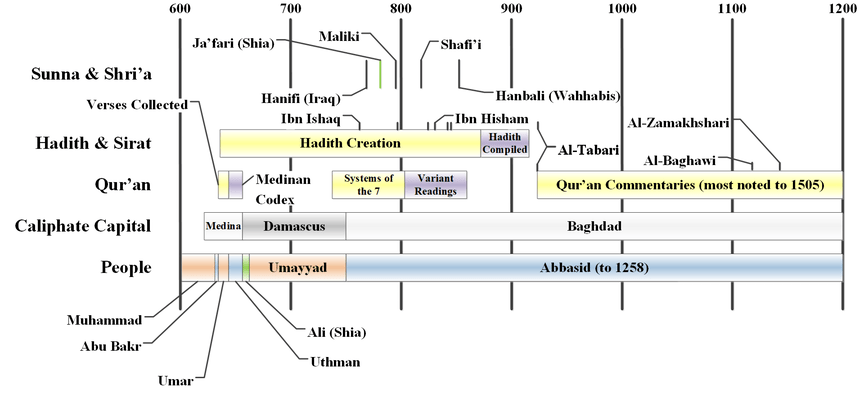
We’ll start with Muhammad’s death in 632. The first four caliphs came from Muhammad’s inner circle and family. The third caliph, Uthman, selected the Medinan codex as the true Qur’an and ordered all others destroyed. The first four caliphs reigned a total of twenty nine years, before one of Muhammad’s wives (Aisha) conspired with the Syrian Governor to overthrow the fourth caliph – Ali, one of Muhammad’s nephews. The result was the Umayyad Dynasty which lasted until 749.[9] The new dynasty was largely secular and its primary goal was the acquisition of land and wealth. They went as far west as present day Spain and southern France, and as far east as the Indus river in modern Pakistan.
The Umayyad were in turn overthrown and the Abbasid dynasty established in 750. The Abbasid were concerned with religion and the spreading of Islam. During the first one hundred and fifty or so years of the Abbasid’s rule, the following events took place: (1) the development of the Systems of the 7 (with their variant readings) of the Qur’an, (2) the selection and compilation of the trustworthy hadith, (3) the writing of Muhammad’s biographies (the sirat), (4) the development of the Sunna, and (5) the development of the four Sunni and one Shia schools of jurisprudence. This development is shown in the timeline below.[10]
Separation of Church and State
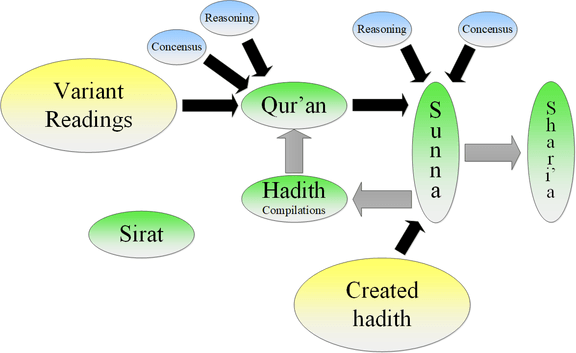
We’ll pick up the above with a look at the relationship between each of these components. First, the Qur’an. As mentioned in another article, the Medinan codex contained unpointed text.[11] As a result, there were literally thousands of variant readings of some Qur’an verses by the middle of the 8th century. Clerics applied reasoning and consensus in developing rules resulting in the System of the 7 and their variant readings—21 variants in all. The second source of Islam, the hadith, contained many fabrications by this time. Some clerics admitted on their deathbed that they had created some of the fabrications, but these were not necessarily viewed as bad if they were consistent with the meaning of Islam. These two sources, along with clerical reasoning and consensus, formed a new Islamic Sunna.
The Sunna forms the basis for Shri’a law. The traditions, actions, and sayings of Muhammad as revealed within the Qur’an and hadith form the Sunna. The hadith compilations by those, such as al-Burkhari, became the codification of the sunna used in interpreting the Qur’an. The sirat provided a sense of history as to when events occurred as related to the contents of the Qur’an and hadith. As noted in the timeline above, the development of the initial twenty one Qur’an variations, the writing of the sirat, and the creation of the schools of jurisprudence all occurred during the same period in time. Scholars generated the hadith compilations a short time later. By the middle of the tenth century, shari’a was fully developed and a final set of rules canonized, limiting the Qur’an variant readings—although nine more variants were later added by the Ottoman Empire. The relationship between each of these components is shown in the diagram below.
A Closed Loop
Those items in green are those which form Islam’s basis. The items in yellow are its written sources before clerical application of reasoning and consensus, and the ones in blue are the cleric’s interpretation applied to those sources. The black arrows indicate relationships relying on reasoning and/or consensus. The gray arrows indicates structures derived from the Sunna.
From the above diagram, it is clear that there is a direct relationship between the Qur’an and shari’a. The development of the meaning of the Qur’an, the Sunna, the hadith, and the sirat all lead to a closed system which only divine revelation can change. While we may have some disagreement within America as to the meaning of “the separation of Church and State”, all agree this notion is one of our society’s foundations, and discussed at length by our Founding Fathers. It is also consistent with the Biblical Principles model. Shari’a directly contradicts that notion and is incompatible with it, instead being a State Religion model variation. It is the very thing that our Founders strove to prevent as putting these powers together leads to the corruption of both—as they had seen firsthand in England.
Footnotes:
[1] Blackstone, Sir William, p.42, Commentaries on the Laws of England, Vol. I, The Clarendon Press, Oxford, 1765.
[2] Bouvier, John, p. 4, Institutes of American Law, Vol. I, Robert E. Peterson & Co., 1854.
[3] Schaff, Philip, p.348, History of the Christian Church, Vol. IV, Christian Classics Ethereal Library, 1910.
[4] For more information see, Wolf, Dan, pp. 4-30, The Light & The Rod; Biblical Governance Corruption, Living Rightly Publications, 2020.
[5] Blackstone, Sir William, p. 11, Commentaries on the Laws of England, Vol. I, The Clarendon Press, Oxford, 1765.
[6] See Wolf, Dan, The Ottoman Empire, Part II, Virginia Christian Alliance, https://vachristian.org/the-ottoman-empire-part-ii/ , April 16, 2026.
[7] Goldziher, Ignaz, pp. 4-5, Introduction to Islamic Theology and Law, Princeton University Press, 1981.
[8] Wolf, Dan, The Ottoman Empire, Part II, Virginia Christian Alliance, https://vachristian.org/the-ottoman-empire-part-ii/ , April 16, 2026.
[9] Wolf, Dan, The First Caliphs and the Umayyad Dynasty, Virginia Christian Alliance, https://vachristian.org/?s=umayyad , March 30, 2026.
[10] Wolf, Dan, The Abbasid Dynasty—Part I, History, Virginia Christian Alliance, https://vachristian.org/the-abbasid-dynasty-part-i-history-2/ , April 1, 2026.
[11] Wolf, Dan, The Abbasid Dynasty—Part II, It’s Religious Development, https://vachristian.org/the-abbasid-dynasty-part-ii-its-religious-development/ , April 8, 2026.