
Thirty-sixth in a series
Jihad is holy war. One fought in both the physical and spiritual realms. The previous article referenced Islam, focusing on jihad’s physical aspect, as its form of jihad is primarily physical and a part of Islam’s ideology. Allah is creator of all creation, and also separate from it. However, Allah is pure will. One cannot have a relationship with Allah. He is inscrutable. What kind of spiritual relationship is possible with one beyond any relationship, and man being only a slave? So today we are going outside of Islam for much of this topic.
Jihad’s Spiritual Aspect
The spiritual aspect of jihad discussed today lies largely outside of Islam, with globalist organizations. This jihad is also a war. So far, not a hot war fought with men and material, but a cold one. A war based on ideas and so far fought with information, economies, and technology.
We see a “new” religion based on oneness that is not new at all. It’s the pagan past repackaged; and only new to us in the present because we forget. We’ll begin by comparing some of this religion’s ideas to Judeo-Christian notions. Then review its history and some problems inherent in its ideas. Those discussions lead to who supports, or is using, these ideas—and their purpose. They’ve made it plain for those who want to hear. In fact, we’ll see it’s been going on for decades. We don’t realize it because we’ve not learned history. But that, too, is part of this war.
In 2020, I came across this topic listening to Carl Teichrib speak, and have since listened to several of his Bible conference lectures. Carl spent over twenty years researching this movement. He’s a Christian who’s gone to their conferences and events to learn what they are about. His book, Game of Gods,[1] covered his research results to date. The information from his lectures and book is quite good. His ideas provide some of this article’s framework.
Oneness or Otherness?
Both the above are today’s words. But they represent ideas several thousand years old. Oneness professes there is no difference between nature, man, and some supreme being, essence, or nature. All is one. Today’s movement focuses on nature—ecology and saving mother earth. Otherness, on the other hand, asserts there is a separation between Creator and creation.
Oneness-like ideas were prevalent among the ancient state religion societies, and still exist in eastern religions today. They worshiped creation. Man made his own god(s). In these ancient societies, a close relationship existed between governance and religion. Society was maintained through a class structure imposed from the top, by self-proclaimed elites whose goals included seeing their social order maintained. Those ideas exist within today’s oneness movement.
Another idea within these state religions is that creation has always existed. It alone is eternal. Creation within this view is only about transformation. It generally comes about in one of two ways. First, two gods fight. One kills the other. From the dead god, the earth, heavens, seas, etc. are made. Second, a male and female god unite and from their union form the earth, heavens, seas, etc. In both cases, creation comes from something that already exists.
We find otherness in the monotheism underlying Judaism, Christianity, and Islam. There is what I call dualism within this idea. But not what is meant by dualism today, where it denotes two opposing forces—such as good and evil. Instead, it refers to an older idea of separation between God and His creation. Within otherness, God alone is eternal; creating creation out of nothing.
Personal/Infinite or Just Infinite?
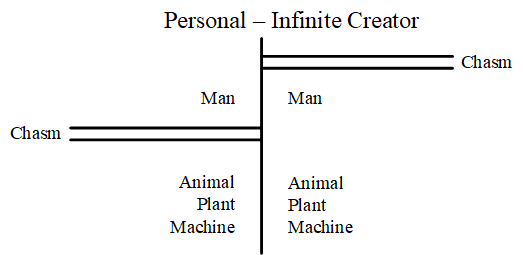
Francis Schaeffer’s diagram below captures the difference in ideas.[2] It is one of the best I’ve seen. Christians and Jews accept the separation between man and God. They accept Him as both personal and infinite. They worship God. Oneness sees only the diagram’s right side—without a God separate from nature. There is only nature and no difference between man and the rest of creation. Those following oneness worship creation. There is nothing else. I’ve written extensively elsewhere about the implications of this difference.
We can come back to Islam again for a moment. Christianity and Judaism both accept a God who is infinite and personal. Islam accepts only a God who is infinite. It, too, is left with just the right side of the diagram. There is a chasm between Allah and his creation. Allah is separate from creation, but man is no different from the rest of it. There is otherness, but it is different from the other two monotheistic religions as Allah is pure will.
A Biblical Proposition
Throughout history, man has repeated the same error. Some begin to look to themselves for their own salvation, to be like God. We see it in the Garden of Eden with Adam and Eve eating from the tree of knowledge. (Gen. 3:4-6) Cain’s leaving the Lord’s presence and creating the first city of man. (Gen. 4:16-7) The city of man rebelling against God and trying to become like God by building the tower of Babel. (Gen. 11:4-6) This last item is the first recorded instance of collectivism and attempt at global governance. While the means have changed, the objective hasn’t. Some men still want to be like God.
Those following this path turn away from God and toward themselves. As they have only themselves, they attempt to create their own salvation. They turn to worshiping creation, even themselves, rather than a creator. This course leads only to death, because one rejects truth and accepts what is false. (Rom. 1:21-5) This is liberation theology’s basis. Man attempting to create heaven on earth, using every means possible within the realms of both religion and governance. In doing so they reject God, and develop an appetite for global governance.
The Alternative
God loves us and is always with us. Man can only choose to turn away from that love. (Isa. 41:8-10) Even when we do, God is still there waiting for us to return to Him. All we need do is accept Him and stand fast in what He’s taught us. He will not abandon us. (Isa. 54:4-5) Instead, He will gather us from the four corners of the earth. Those who finish the race will find eternal peace in God’s presence. It’s no more complicated than that.
God asks very little in return. First, to consecrate ourselves and be holy. Second, learn how He wants us to live and then act accordingly. Third, obedience to His law. Fourth, worship God in faith, hope, and love. By these we fulfill our purpose.[3]
He desires we love Him and our fellow man—part of God’s creation. God calls us to be creation’s stewards as man was given dominion over the earth—it is not a god.
Being God’s Diplomats
Jonathan Edwards was a leading First Great Awakening minister in America. In addition to preaching principles such as faith, hope, love, and charity, he spoke about the roles of faith and governance. One sermon on 1 Peter 2:9 explained who Christians are, and their relationship with the world. [4]
Some of its main points. First, Christians are a distinct nation derived indirectly from God. By accepting God, we accept His governance. Second, we all speak the same language (the Word) and share the same fundamental doctrines. Third, we are one society under the same government. Christ is our king; we are one body politic. Heaven becomes our native country. Fourth, all are subject to the same law, share the same natural rights, and common good. Fifth, anyone can join this society of free people. Last, each of us is to build and practice virtue.
Carl Teichrib supplied a useful extension to these thoughts.[5] By claiming Heaven as our native country, we become God’s diplomats while on earth—His ambassadors. God’s diplomats have several duties. First, we are to subordinate our personal interests to those of our native country. Second, we live in a foreign country while on earth. Third, we are to understand the culture we live in, but not become part of it. Fourth, we are to communicate our country’s interests and listen to theirs as well. Fifth, we are to alert fellow diplomats within our community about what we learn. Sixth, we are to communicate with our native country (prayer and reflection) for direction when needing assistance.
Where are We as a People?
We’ve gone beyond post-modernism, which rejects all notions of God. It left man alone, creating a vacuum that ideas like oneness have rushed in to fill. It’s time to turn to oneness, and some of its idea development. We’ll see these ideas entered Christianity at least a hundred years ago. They’ve been a corrupting influence. We’ll also look at some problems these ideas present. When man turns to himself, there is much he can no longer explain. He becomes irrational, losing the benefit God’s gift of reason provides man.
As mentioned above, oneness is not new but simply repackaged pagan religion. A brief recap. Ancient state religion societies believed creation always existed. Society experienced repeating cycles of birth, development, decay, and death. These societies made their own god(s). Each god had a temple served by priests/priestesses. There was no worship as we know it today. Instead, those serving a temple conducted rites on behalf of a client. They believed by correctly performing a rite, man could cause a god to enter an idol and invoke it.
Monotheism Development
Monotheism never developed in these religions because these gods were not substantial enough. Instead, many gods developed, with the same roles found across societies—despite these societies sometimes being continents apart. These religions were inherently mystical, particularly those in the east. They were experiential. Their gods were part of the cosmos and normally had no interaction with man. There was no basis for a relationship. Instead, man must transcend creation to glimpse oneness. This is very much like the second century thoughts of Plotinus about the One.[6] These notions exist within oneness, and to some extent within Islam—which mirrors Plotinus’ philosophy regarding first cause.
Judaism and Christianity stood these notions on their head. Islam developed later. However, while there is separation between creator and creation within Islam, there are also many differences between it and the first two monotheistic religions.[7] We see Judeo-Christian principal corruption in Machiavelli’s writings, and later by many others. Ideas coming from Aristotle and other Greek philosophers, through Averroes (Islam) into Christianity in the thirteenth century. These ideas included accepting virtue as a mixing of good and evil, and man being bad so he must be ruled. Coerced to do what is right. Man creating heaven on earth. A return to ancient Roman society.
Early Twentieth Century
Carl Teichrib traces modern oneness to an interfaith conference in Chicago in 1893.[8] This began the many paths to salvation we see today. The conference’s attendees advocated a religion that would be universal in every sense. Man needed to create a heaven on earth, not Christ. By World War I men like Frederick Lynch and Samuel Batten preached creating a Christian world order. This notion underlay Wilson’s creating the League of Nations at that war’s end.
By World War II, this movement had expanded. Creating heaven on earth became a Christian duty. Such ideas were discussed and supported by the Federal Council of Churches, Methodists, and Northern Baptists, among others. Christian churches within America supported creating the United Nations. An extract from the Southern Baptist World Peace Committee from 1946 reads as follows;
“[W]e should look sympathetically, hopefully, and cooperatively upon the United Nations as the best existing organization through which to secure a just and durable peace. We fully recognize that it is not perfect, that it has glaring defects, and may even be only a step toward the World Government which will later be found imperatively necessary to the peace and order of the world.”[9]
This passage serves as an example. In another article, I mentioned the Southern Baptist’s acceptance of critical theory, whose ideas align with oneness and today’s cancel culture.[10] The above shows it, and other denominations, accepting oneness related ideas is not new, but rather the further evolution of an existing idea supporting global governance and oneness within the Christian community.
Today
Bring it forward to this past decade. The 2010 G8 World Religions Summit in Winnipeg (yes there is really such a summit) advocated religious unity through coexistence and social justice. Second, creating a global financial system, a concept failing every time it’s been tried. Third, supporting ecological justice. Oneness views man as earth’s parasite. Finally, empowering the United Nations to carry out all the above.[11] Oneness advocates for a global coordinator.[12] A global king or Caesar.
More disturbing is the list of participants. They include: All Africa Council of Churches; Canadian Baptist Ministries; Canadian Council of Churches; Canadian Council, Catholic Bishops; Church of England; National Council of Churches, USA; Mennonite Church, Canada; Salvation Army; and the World Evangelical Alliance.
World Religion Ideas
The 2015 and 2018 Parliaments of the World’s Religions went further. Compare the following ideas to those expressed earlier by Joanathan Edwards.
The first parliament declared;
- Sin was abusing mother earth.
- We all speak the same language; we just have different doctrines.
- It’s our experiences that matter. Truth comes from those experiences.
And the second;
- Exclusive ideas are divisive. They have no place in human society and must be removed.
None of this is new either. Corruption occurring within both the spheres of religion and governance. Like Innocent III’s declaring his spiritual charge superseding all else in the thirteenth century. Another attempt at creating a Christian world order with Innocent as its head.
Religious leaders attending these conferences have gone down the same path. While they probably meant well, they shifted their faith from God to man. However, such ideas produced all the religious and political wars during what we call the Renaissance. The same ideas produce the same fruit. How much death and destruction did we see in the twentieth century, as these ideas were once again embraced?
Implications
I’m going to focus briefly on just two implications. First, can man have a relationship with this supreme deity? Second, what is oneness impact on salvation.
Experience or Relationship?
Oneness doesn’t look at who or what God is, but rather what’s in the supreme deity. Nothing is permanent within this framework. All is temporary and becomes chasing experiences in order to find release. But man looks for what is permanent. It is part of his God given nature, and that permanence can be found in God alone. The one Being standing outside of time and universal dimensions.
God is love. It is His love that is experiential. That love can only be found through a relationship with Him. God desires we have a relationship with Him; that desire is a part of our nature—the way we were made. Like all collective deceptions, this one too looks at the end (love) while ignoring the means (relationship). This leaves the worshiper unfulfilled because they’ve turned away from that relationship.
Salvation
This oneness corruption could have come straight from Islam. It, too, borrowed many pagan ideas.[13] Within ideas like oneness, man’s reason becomes god. Original sin is not recognized. Without original sin, there is no fallen nature. Therefore, there is no need for the cross or a savior. There is no notion of grace. Instead, man’s salvation becomes his own works. As all nature is one, healing the earth becomes a virtuous act and violence a legitimate means to achieve this goal.
From a Christian perspective, this is simply heresy. It denies history and the evidence. Again, denying the truth doesn’t change the truth. God not only created man, but created him in His image. That image is our ability to reason. There are several implications of this single act. They include (1) the need to know oneself, (2) we all possess an equality of nature, (3) we all have choice, and (4) we’ve all been given the gift of freedom. Denying God denies man’s nature and these implications as well.[14] Disagree? Show me your proof. I’ll wait.
Oneness Idea Problems
Like all deception, oneness ideas present some logical, metaphysical, and moral inconsistencies. They can deny truth, but the denial doesn’t change it. These problems include;
- If oneness is all there is, then things can never get better than they are today. So how do we explain progress, or do we just deny it?
- If all religions are equally valid, then none of them are. Christ’s death, burial, and resurrection refute this notion, and was witnessed by many.
- Oneness asserts experience alone. But without a permanent relationship, man will always search but never find what he searches for—love.
- Without a set of morals greater than himself, man will seek but never find justice.
- Oneness denies man’s true nature, embracing a status quo and the kind of corruption leading to Rome’s decline and fall.
- Like all deception, oneness sows confusion and division—in a word, chaos. These do not come from God but man. Tools like critical theory and cancel culture create division; and oneness provides the religious underpinnings.[15]
Oneness ideas directly challenge Christianity, including;
- Undermining God’s truth.
- Undercutting the Great Commission to spread the Gospel.
- Declaring Christ can only be a man, a prophet.
- It is not man that is earth’s parasite, but his sin (Isa. 24:4-5).
We must become effective ambassadors for God. Not just by defending our faith, but asking other faiths to show their proof as well. Judeo-Christian principles offer the hope that things can be better tomorrow and the freedom to change them through service to others. We have proof of the teachings, and the history supporting their use. We need to simply know them, live them, and stand for them.
Conclusion
Oneness professes salvation through saving mother earth, and Christ’s followers stand in the way of that salvation. Oneness considers our belief in Christ as God and Messiah divisive. An obstacle requiring removal at all costs. Love and unity wrapped in violent actions to achieve it. This is jihad.
Chicago’s Cardinal Francis George countered the oneness salvation claim in one of his Easter sermons. It points to truth and salvation’s real source.
“[T]he beloved Lord who shows us that revealed truth and self-sacrificing love are more real, more trustworthy, than anything else. If the Earth is our mother, then the grave is our home and the world is a closed system turned in on itself. [But] if Christ is risen from the grave and the Church is our mother, then our destiny reaches beyond space and time, beyond what can be measured and controlled. And therein lies our hope.”[16]
Our present time is akin to the last days of the Roman Republic. When Caesar, Crassus, and Pompeii conspired to divide the Empire. Will we follow their course or remain true to God’s purpose for us? It is time for all God’s people to come together as His Church, in His Truth and Love.
Footnotes:
[1] Teichrib, Carl, Game of Gods: The Temple of Man in the Age of Re-Enchantment, Whitemud House Publishing, 2018.
[2] Schaeffer, Francis, p. 26, Escape from Reason, InterVarsity Press, 1968.
[3] Wolf, Dan, p.4-5, A Handbook of Natural Rights, Living Rightly Publications, 2018.
[4] Edwards, Jonathan, pp. 936-949, The Works of Jonathan Edwards, Vol. 2, Hendrickson Publishers, 2006.
[5] Teichrib, Carl, Spiritual Politics and the Cult of World Order and Game of God’s, Encounters in Divine Identity, 2019 Last Days Bible Conference, https://www.youtube.com/watch?v=wzvp_ZZrmG0 and https://www.youtube.com/watch?v=bqbrt4jDn18 respectively. Both accessed November, 2020.
[6] Plotinus, Translated by Armstrong, A.H., Enneads, Harvard University Press, 1984.
[7] See Wolf, Dan, Chapter 5, A War for God: A Christian View of Islam, Living Rightly Publications, 2017.
[8] This section’s information comes from Teichrib, Carl, Spiritual Politics and the Cult of World Order, Last Days Bible Conference, 6/3/2019, https://www.youtube.com/watch?v=wzvp_ZZrmG0. Accessed November, 2020.
[9] Annual of the Southern Baptist Convention, World Peace Committee, 1946, p. 64, http://media2.sbhla.org.s3.amazonaws.com/annuals/SBC_Annual_1946.pdf. Accessed November, 2020.
[10] Wolf, Dan, Christian Confusion, Virginia Christian Alliance, https://vachristian.org/christian-confusion/ , Nov. 17, 2020.
[11] This section’s information comes from Teichrib, Carl, Spiritual Politics, Last Days Bible Conference, 6/3/2019, https://www.youtube.com/watch?v=wzvp_ZZrmG0, and the Cult of World Order and Game of God’s, Encounters in Divine Identity Theft, Last Days Bible Conference, 6/4/2019, https://www.youtube.com/watch?v=bqbrt4jDn18. Both accessed November, 2020.
[12] Sultanmurat, Yermentay, p. 25, Transformation of the World, 2000.
[13] Wolf, Dan, Islamic Borrowings and the Arabic People, Virginia Christian Alliance, https://vachristian.org/?s=islam+borrowings , March 12, 2026.
[14] Wolf, Dan, pp. 111-52, A War for God: A Christian View of Islam, Living Rightly Publications, 2017.
[15] Wolf, Dan, Critical Theory Idolatry, Virginia Christian Alliance, https://vachristian.org/critical-theory-idolatry/ , Sept., 24, 2020. This is the first article in a short series addressing critical theory.
[16] Our Catholic Faith, Archbishop Sartain’s Homily at Cardinal George’s Funeral … We Only Take With Us What We Have Given Away, 5/6/2015. Accessed November, 2020.