
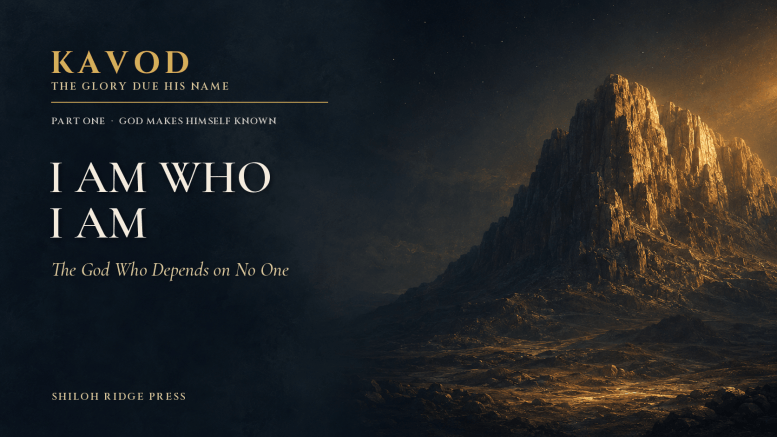
KAVOD SERIES · PART ONE · ARTICLE 3 OF 6
THE GLORY DUE HIS NAME — GOD MAKES HIMSELF KNOWN
This is Article 3 of 6 in Part One of KAVOD: The Glory Due His Name, a four-part journey through the names, titles, character, and self-revelation of God. Article 1: Hallowed Be Thy Name: Why the Names of God Matter serves as the cornerstone. Part One considers how God makes Himself known; the later parts will examine the character His names reveal, His fullest revelation in Jesus Christ, and the Holy Spirit’s work in those who bear His name faithfully before the world.
The Answer No Creature Could Give
We have heard the LORD bind His name to His promises. Now we return to the words spoken from the fire:
“I AM THAT I AM.” —Exodus 3:14
Moses had asked what he should say when Israel demanded to know who had sent him. God did not answer by comparing Himself with Egypt’s gods. He did not trace His beginning, identify the source of His authority, or name some greater power from which He received life.
He answered from Himself.
Every creature must say, I am because. I am because God gave me life. I continue because He sustains me. Everything I possess—breath, strength, knowledge, time, and opportunity—has been received.
But God does not say, I am because.
He says, I AM.
The LORD receives life from no one. He borrows no strength, answers to no higher authority, and depends upon nothing He has made. Before there was a world to display His glory, God was. If everything He created were taken away, God would remain fully and eternally God.
This is not theology meant to be admired from a distance. It is the foundation beneath every promise God has made and beneath the feet of every believer who trusts Him.
“I AM THAT I AM”
The title of this article uses the familiar rendering I AM WHO I AM. The King James Version renders the same Hebrew declaration, I AM THAT I AM. Neither form gives us a definition that places God within a category we can master. God identifies Himself by Himself.
The same Hebrew form stands behind God’s promise to Moses, “Certainly I will be with thee,” and His declaration, “I AM.” The One who sends Moses is not merely announcing that He exists. He is assuring Moses that His presence does not rest upon Moses’ sufficiency or Pharaoh’s permission. God will be present because He is eternally and freely Himself.
Theologians sometimes call this God’s aseity. The word may be unfamiliar, but the truth is simple: God does not receive His existence from anyone or anything outside Himself. He has no cause, no source, no beginning, and no unmet need that creation must supply.
Everything else depends upon God. God depends upon no one.
The Giver Who Needs Nothing
When Paul spoke in Athens, he distinguished the living God from every god fashioned by human imagination and human hands:
“God that made the world and all things therein, seeing that he is Lord of heaven and earth, dwelleth not in temples made with hands; Neither is worshipped with men’s hands, as though he needed any thing, seeing he giveth to all life, and breath, and all things.” —Acts 17:24–25
Human hands cannot complete God. Our worship does not add glory that He lacks. Our service does not supply strength that He has lost. Our belief does not make Him more real, and our unbelief cannot make Him less God.
Yet this does not make worship unimportant. It reveals why worship belongs to Him. We do not worship because God is needy; we worship because God is worthy. We bring Him nothing that did not first come from His hand.
Nor does God’s independence make Him cold or distant. Need is not the source of His love. The Father loved the Son before the foundation of the world. God did not create because He was lonely, and He does not redeem sinners because something is missing in Him. He loves from the fullness of who He is.
Grace is not God bargaining to fill a lack. Grace is the God who needs nothing giving Himself freely to those who can give Him nothing in return.
From Everlasting to Everlasting
Moses would later pray:
“Before the mountains were brought forth, or ever thou hadst formed the earth and the world, even from everlasting to everlasting, thou art God.” —Psalm 90:2
We move from yesterday into today and from today toward tomorrow. We remember beginnings, measure years, watch strength fade, and know that our days will end. God does not move toward an expiration.
He is not merely very old. He had no first morning. No moment brought Him into existence. Before the mountains stood, before the earth turned, before there was a sun by which a day could be measured, God was God.
He will never become less than He is. Time cannot deplete Him, surprise Him, educate Him, or carry Him somewhere He did not intend to go. The LORD who met Moses at the bush was not a diminished remainder of some greater past. He was—and forever is—the eternal God.
Everything within creation that we lean upon is temporary. Generations pass. Institutions rise and fall. Bodies weaken. Possessions decay. Even mountains wear away. But from everlasting to everlasting, He is God.
Free, Yet Never False to Himself
The psalmist declares:
“But our God is in the heavens: he hath done whatsoever he hath pleased.” —Psalm 115:3
God is free. No power outside Him can force His hand, overturn His purpose, or deny Him what He wills. He does not seek permission from His creation. He is never cornered by circumstances or surprised into changing His plan.
But God’s freedom is not caprice. He does not act on a whim or become something contrary to His nature. Everything that pleases Him is consistent with His perfect holiness, wisdom, justice, goodness, and truth.
Scripture says:
“If we believe not, yet he abideth faithful: he cannot deny himself.” —2 Timothy 2:13
God’s inability to deny Himself is not a weakness. Falsehood and unfaithfulness are not freedoms that a perfect God lacks. He cannot cease to be God. He cannot become unholy, unwise, unjust, or untrue. His character is not a costume He may discard.
Therefore, God’s promises do not rest upon a passing mood. When He binds His name to His word, He acts in perfect freedom and perfect faithfulness.
“I Am the LORD, I Change Not”
Through the prophet Malachi, God gave His covenant people this reason for hope:
“For I am the LORD, I change not; therefore ye sons of Jacob are not consumed.” —Malachi 3:6
God’s unchanging nature does not mean that He is inactive or impersonal. The living God speaks, judges, shows mercy, answers prayer, enters history, and acts toward His creatures. But nothing can make Him cease to be holy, loving, just, wise, or true.
His faithfulness is not held in place by favorable circumstances. He does not need the world to cooperate before He can keep His word. Israel’s preservation rested finally upon the character of the LORD: “I change not; therefore ye sons of Jacob are not consumed.”
Our moods change. Our strength changes. Our understanding changes. Sometimes our grip upon God’s promises feels firm; sometimes anguish leaves us barely able to hear them. But the LORD is not carried by the currents that carry us.
His faithfulness is not the reflection of our steadiness. It arises from who He eternally is.
“Before Abraham Was, I Am”
Centuries after Moses stood before the burning bush, Jesus spoke with men who appealed to their descent from Abraham. They asked how Jesus, not yet fifty years old, could speak as though He had seen Abraham.
Jesus answered:
“Jesus said unto them, Verily, verily, I say unto you, Before Abraham was, I am.” —John 8:58
Jesus did not say, “Before Abraham was, I was.” He said, “I am.” In this setting, His words are more than a claim to unusual age or even existence before Abraham. He speaks with the language of divine identity. His hearers understood the weight of the claim; in the next verse, they took up stones to cast at Him.
The Son did not begin at Bethlehem. The eternal Word took flesh and dwelt among us. Jesus is not a dependent creature pointing toward a distant God. He is the eternal Son who makes the Father known and gives life to the world.
We do not confuse the Father with the Son, nor the Son with the Holy Spirit. The three Persons are distinct, yet the divine glory is undivided. The God who revealed Himself to Moses has made Himself known supremely in Jesus Christ.
The One who said, “Before Abraham was, I am,” entered our time, bore our sin, died under judgment, and rose bodily from the grave. The self-existent God did not remain beyond our reach. In the Son, He came near to save.
Because This Is Who God Is…
Because God depends upon no one, His promises cannot fail because He runs out of strength, wisdom, authority, or time.
Because He gives “life, and breath, and all things,” we must receive His gifts thankfully without turning them into the foundation of our lives.
Because He is free, we cannot bargain with Him as equals or recruit Him to serve plans He has not ordained. We belong to Him.
Because He is eternal, no crisis in our generation places Him in danger or forces Him to hurry.
Because He does not change, we can trust His character when everything visible appears unstable.
Because Jesus declared, “Before Abraham was, I am,” we must not reduce Him to a teacher, example, or messenger. We must confess Him as Lord and trust Him as Savior.
A man may build his identity upon strength, usefulness, provision, competence, or control. Time will expose every one of these as temporary. The answer is not to become less responsible, but to stop asking created strength to carry divine weight.
Dear Christian, God does not ask you to pretend that created supports do not matter. Family, work, health, church, and daily provision are good gifts from His hand. But no created thing can bear the weight that belongs to God alone.
When strength fades, plans collapse, people disappoint, or the future becomes difficult to see, the believer’s foundation has not moved. Everything around us may change, but the God upon whom we depend depends upon no one.
We began this journey with the petition, Hallowed be thy name. We then heard YHWH bind His name to His covenant promises. Now the words I AM THAT I AM deepen our worship. The LORD is faithful not because circumstances support Him, but because His life, power, and character are borrowed from no one.
I AM WHO I AM—the God who depends on no one—hallowed be Thy name.
Prayer
Eternal LORD, You are from everlasting to everlasting. You receive life from no one, yet You give to all life, breath, and every good thing. Forgive us for resting the weight of our hope upon created things that cannot bear it. Teach us to receive Your gifts with gratitude without making idols of them. When our strength fades and circumstances change, anchor us in Your unchanging character. Thank You that the eternal Son entered our time, bore our sin, and rose to give life to all who trust Him. By Your Spirit, make us faithful witnesses. I AM WHO I AM—hallowed be Thy name. In Jesus Christ our Lord. Amen.
The God who depends upon no one is the One upon whom everything depends. Next we open Scripture’s first sentence and behold Elohim: The Mighty Creator, who speaks the heavens and the earth into being.
Scripture to Carry With You
“And God said unto Moses, I AM THAT I AM: and he said, Thus shalt thou say unto the children of Israel, I AM hath sent me unto you.” —Exodus 3:14
“Before the mountains were brought forth, or ever thou hadst formed the earth and the world, even from everlasting to everlasting, thou art God.” —Psalm 90:2
“Jesus said unto them, Verily, verily, I say unto you, Before Abraham was, I am.” —John 8:58
What Is KAVOD?
Kavod is the Hebrew word commonly translated glory, honor, or majesty. It carries the sense of weightiness and worth. When Scripture speaks of the kavod of God, it directs us to the overwhelming greatness, holiness, beauty, and splendor of who He is.
To give God glory is not to add something He lacks, but to recognize, proclaim, and live in the light of the glory that is already His.
“Give unto the LORD the glory due unto his name.” —Psalm 96:8, KJV
© 2026 Shiloh Ridge Press, LLC. Published by the Virginia Christian Alliance with permission. Scripture quotations are from the King James Version unless otherwise noted. Cross-posting is permitted when this article is reproduced in full and unaltered, with attribution and a link to the original publication.



We serve a mighty God!!!