

Forty-fourth in a series
Within Islam, Muhammad is the last of the prophets. His actions, behavior, and directives serve as a model for all time, superseding all others. Muslims are to follow his example in all things through their obedience. Muhammad’s life is documented in the Qur’an, sirat, hadith, and other writings.
We know Jesus primarily through revelation. Islam’s counterpart to this is the Qur’an. But at another level, Jesus claimed to be God.[1] Islam’s counterpart to this idea is Allah and his prophet. There is a different paradigm, or model, between Islam and Christianity. We have the words Jesus spoke within the Gospels, and Muhammad’s revelations within the Qur’an, along with their context and Muhammad’s actions within the sirat and hadith. As Christians, we must compare other models against Christ’s example, determining which model is better to follow.
Again, this is not about people, but rather the ideas underlying the models presented within both Christianity and Islam. Much of this article’s source material comes from a Pfander Center presentation on this topic recorded earlier this year.[2]
Jesus in the Qur’an
The Qur’an refers to Jesus as Isa. We’ll cover the name’s potential source later. Two titles ascribed to him are “ibn Maryam” (23 times) and “al masihu” (11 times).
The Isa of the Qur’an as a child: speaks from the cradle (S3.46), creates birds from clay (S 3.49), and provides food for his mother (S 19.25). As an adult, he denies his divinity (S 5.72, 75), confuses the Trinity (S 5.116), and permits another man to die in his place (S 4.157).
Son of Mary
The first title above means “son of Mary”, which appears only once in the Bible (Mark 6:3). The Qur’an places emphasis on Jesus’ humanity, and the title is used for Jesus within Syriac sources.[3] However, the Qur’an refers to Isa being the son of Mary, the sister of Moses (S 19.28-9)[4] and Imran’s daughter (S 66.12, below), rather than the Mary of the Bible. Some scholars refer to Heli as the father of Mary, the wife of Joseph, within the Bible (Luke 3:23).
“And Mary, daughter of ‘Imrān, who guarded her chastity, therefore We breathed into (her body) something of Our Spirit. And she believed in the words of her Lord and His Scriptures, and was of the obedient.” (S 66.12) [5]
The Qur’an refers to the wrong Mary, and Allah breathed something of His Spirit into Mary’s body. More about this last bit later.
The Messiah
The second title refers to Isa as the Messiah, but the Qur’an never defines what this term means. Muslim scholars are unclear on its meaning, but it is used within Morocco to refer to its king—the anointed one.
The name Jesus in Arabic is Yesua. It is the name used in the earliest Arabic New Testament manuscript (Mt. Sinai Arabic Codex Sinaiticus 151) from the year 868.[6] This indicates early Arab Christians referred to Jesus as Yesua. Finally, the word ibn doesn’t refer to a biological son, but a relational one—one receiving an inheritance. From whom did Jesus receive an inheritance, and what was it? Jesus is the Messiah, and anointed to save.
A Comparison
The two titles above used for Jesus present a puzzle for Islam’s followers. On the one hand, Isa is a man, and on the other something more. Especially as the Qur’an recognizes the virgin birth, and the verse above suggests Allah “breathed into (her body) something of Our Spirit.”
But if Allah is absolutely one, can Allah have a spirit? Is this another instance of an attribute, as noted earlier with the historical critique of the Qur’an?[7] Is this spirit Allah, but distinct from Allah? This is similar to the inconsistencies Plotinus ran into in his philosophical writings on First Cause. He named them: the One, Intellect, and Soul.[8] Could these ideas have found their way into Islam as: Allah, Allah’s Word (Qur’an), and Allah’s Spirit? Scholarly investigations are ongoing into Islam’s sources.
Islam claims Muhammad was a man of peace, but can that claim be supported by the Qur’an and other Islamic writings? We’ll approach this in two parts. The first is a table below comparing the Jesus from the Qur’an and Bible with the Muhammad of the Qur’an.[9] The second is the first argument listed in the next section, that Islam is a religion of peace.
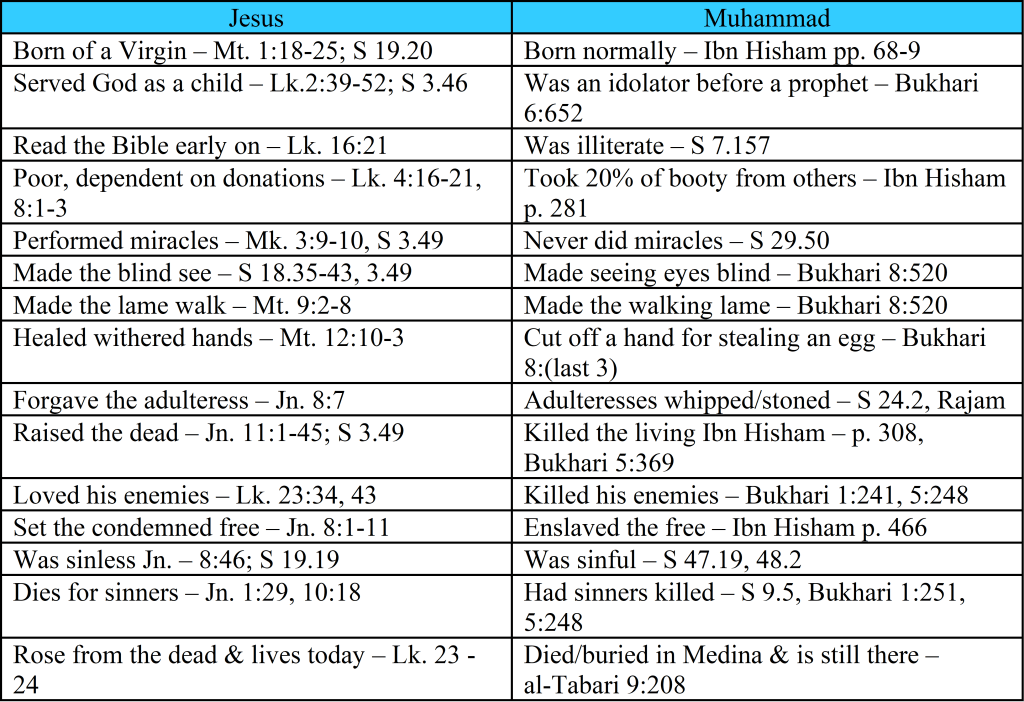
Common Islamic Arguments and Responses
The Pfander Center video noted earlier presents a number of common arguments from Islam concerning Jesus and Muhammad, and some responses to them. Those are outlined below. The earlier items contain more detail as the topic has either not yet been addressed, is more complex, or there is additional information to add. Most of the latter items have been addressed elsewhere in this series, and are included to complete the list.
Islam is a Religion of Peace
Muslims often assert Islam is a religion of peace, and they will cite S 2.256 as support for their position. But they often only refer to the first part of the verse. The full verse is:
“There is no compulsion in religion. The right direction is henceforth distinct from error. And he who rejects false deities and believes in Allah has grasped a firm handhold which will never break. Allah is Hearer, Knower.
‘Allah is the Protecting Friend of those who believe. He brings them out of darkness into light. As for those who disbelieve, their patrons are false deities. They bring them out of light into darkness. Such are rightful owners of the Fire. They will abide there forever.” (S 256-7)[10]
The verses indicate there is a compulsion concerning religion — for Muslims. This is considered a weak verse within the Qur’an, as there are 149 verses of the sword, many of which abrogate the above verse’s meaning.
Abrogation[11]
While God’s will does not change, Allah’s will does. Below are two contradictory passages from the Qur’an.
“Theirs are good tidings in the life of the world and in the Hereafter — There is no changing the Words of Allah — that is the Supreme Triumph.” (S10.64)
“Nothing of our revelation (even a single verse) do we abrogate or cause be forgotten, but we bring (in place) one better or the like thereof. Knowest thou not that Allah is Able to do all things?” (S2.106)
This difference presents an inconsistency within Islam. Allah’s word does not change over time, but Allah’s will does. Allah’s revelations are therefore revealed over time and have changed over time. Such changes are difficult to square with the Qur’an’s stated consistency. Also, can Allah be all-knowing if abrogation represents change?
Verses of the Sword
All but nine of the verses advocating violence come from the later Medina suras. These modify, or abrogate, earlier verses advocating peace. A list of the 149 verses of the sword is presented below. That is followed by a list of the Qur’an’s suras revealed early at Mecca, and those revealed later at Medina.[12]
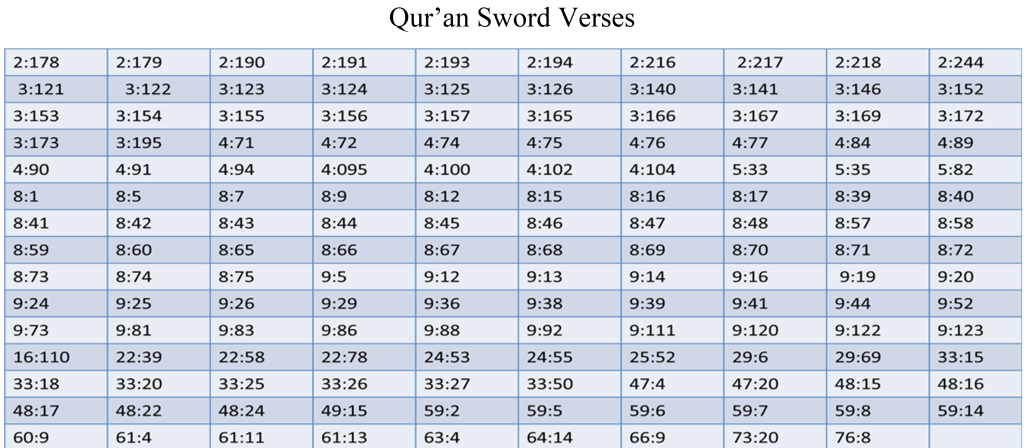
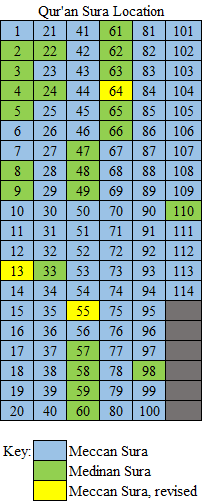
A couple of further examples are shown below. The “Children of Israel” refers to the Jewish people, and “those who have been given the scriptures” refers to Christians. The phrase “human being” in the first verse can refer to either everyone or only Muslims.
“Then Allah sent a raven scratching up the ground, to show him [Cain] how to hide his brother’s naked corpse. He said: Woe unto me! Am I not able to be as this raven and so hide my brother’s corpse? And he became repentant.
‘For that cause We decreed for the Children of Israel that whoever kills a human being for other than murder or corruption in the earth, it shall be as if he had killed all mankind, and who saves the life of one, it shall be as if he had saved the life of all mankind. Our messengers came unto them of old with clear proofs (of Allah’s sovereignty), but after wards lo! Many of them became prodigals in the earth.” (S 5.31-2)
“Fight against such of those who have been given the Scriptures as believe not in Allah nor the last Day, and forbid not that which Allah has forbidden by His Messenger, and follow not the religion of truth, until they pay the tribute readily, being brought low.” (S 9.29)
The sword verses are to be applied using Muhammad’s example from the sirat, hadith, and the military expeditions planned and led by Muhammad (Maghazi).
War and Peace in the Bible[13]
Within the Old Testament, God used the Israelites in judgment of the sinful nature of the surrounding peoples. The Israelites relied on divine intervention for their victories. See: the Israelites leaving Egypt (Ex. 7 – 12), the battle of Jericho (Josh. 6), the Amorites (Josh. 10), Canaanites (Judges 5), Midianites (Judges 7), Arameans (2 Kings 6), Assyrians (2 Kings 19), and Easterners (2 Chron. 20).
Jesus is the Messiah, and one of his titles is Prince of Peace (Isa. 9:5-7). The war spoken of in the New Testament is one of words over ideas that will divide people (Matt. 10:34 and Luke 12:51), rather than a war in the traditional sense. See examples in the verses below.
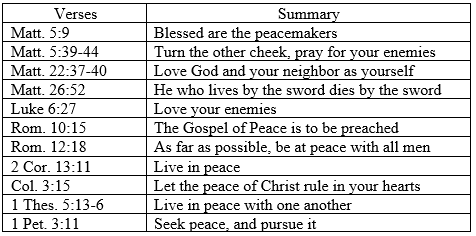
Our choice to follow Christ may result in our persecution. All of Jesus’ disciples faced persecution, and only one died a natural death. Instead of war and violence, Christians are to: suffer (Matt. 5:38-9), forgive (Matt. 6:15-7), share (Luke 12:33-4), serve (Luke 22:24-7), and love (Matt. 5:43-5 and Luke 6:27-31).
There are a few verses that Muslims may point to as contrary to the above view. These include:
- Killing a servant (Luke 19:27) – This is a parable about what God will do with those who stand against Him at the end of time.
- Jesus cleansing the temple (Matt. 21:12-3) – The only violence was driving the animals away. He used words to drive away the money changers and their customers, and overturned their tables.
- Swords at the Last Supper (Luke 22:36-8) – This refers to a Makhaira, a tool similar to a utility knife, not exactly a weapon of war.
- Jesus not to bring peace, but a sword (Matt. 10:34, 38) – This refers to our commission in following Christ. The sword will be against us, even from our own families. See above.
Salvation[14]
There is no notion of grace or salvation within Islam as exists for believers within Christianity. In death, Islam’s followers have no certainty whether they will go to Paradise or Hell. The only possible exception is jihad. Even Muhammad did not know whether he would go to Paradise when he died. This leads to a very fatalistic view of life for those following Islam.
The Crusades and Inquisition
Islam’s followers may ask about the hypocrisy of the Crusades and Inquisition. Ask them why they disapprove. If they respond that one should not kill another over their God, simply agree with them. Then point them to some of the examples set by Muhammad shown above, and ask if they will condemn those examples.
The Crucifixion
This question arises from sources outside the Bible and Christianity. The main passage cited for this will likely be S 4.157-9. These verses state: the Jews believed they killed Jesus, Allah reveals he was not killed or crucified, someone who looked like Jesus died in his place, and Allah took Jesus up into Heaven. Islam believes that Allah would not allow his prophets to suffer (S 3.181-3) A Muslim will likely claim no one can die for another’s sin, therefore no atonement is necessary (S 6.164; 3.38).
However, consider the Garden of Eden (S 7.24). Did Adam and Eve transgress against God’s commands? Yes. Were Adam and Eve cast down from the Garden for their transgression? Yes. Are you in the Garden today? No. Then aren’t you paying the price for Adam’s sin? Jesus’ death atones for this sin, and those we commit.
Some Problems the Crucifixion Presents to Islam
These include:
- If Jesus wasn’t crucified, then what is the meaning of S 19.15, 33, which says, peace be on me on the day I was born, the day I die, and the day I rise again.
- The Qur’an generally objects to the idea of atonement (S 6.164 and 53.38). However, the ideas expressed within these verses actually agree with Christianity’s view of the topic. We cannot atone for another’s sin, only Christ can.
- Jesus’ crucifixion is written about in other historical sources which were not supportive of Christianity. These include Thallus (50AD), Josephus (80-90), Tacitus (80), and Pliny the Younger (112). All written within eighty years of the event.
- The eyewitness of John and Mary at the crucifixion (4 Gospels) versus one supposition written 600 – 900 years after the fact (Qur’an).
- The verses in S 4.157-9 also bring up a moral problem. Is Allah deceitful since he used another man to take Jesus’ place, and then didn’t reveal it to anyone for 600 years?
The Source of “Isa” Within the Qur’an
Where did “Isa” come from? We have already mentioned the earliest Arab New Testament manuscript refers to Jesus as Yesua, the Hebrew counterpart of Yeshua. That manuscript came from the ninth century, over two hundred years after Islam is said to have been fully formed. So, why does the name Isa appear in the Qur’an if it was written down in 652? Scholars and etymological sources suggest Isa may be an Arabized form of the Syriac name Isho (or Isho’yahb), which is derived from the Hebrew name Yeshua. This is another indication that Syriac sources were incorporated into the Qur’an.
The following material, from 5th century Syriac sources, suggests the Qur’an borrowed material on Jesus (“Isa”) from these sources.
- Monarchists – “God has no children.” (S 4.171; 19.34)
- Docetists – “Jesus didn’t die.” (S 4.156-8)
- Monophysites – The Collyridians mentioned earlier. The progression of Mary’s status between the 1st and 5th centuries, and confusion of the Trinity. (S 5.116)
- Nestorians – Jesus was a God-chosen human. (S 3.42-8, 51, 59; 4.171; 5.116-7; 19.30, 34-5)
- Proto-Evangelion’s James the Lesser – Imran and Zachariah as Mary’s father and patron (S 3.35-7)
- The Gospel of Infancy of Jesus Christ – Jesus speaks from the cradle (S3.46; 5.110; 19.29-30) and creating birds from clay (S 3.49; 5.110).
- Lost Books of the Bible – Jesus has a palm tree feed Mary. (S 19.22-6)
The Jesus of the Bible is in the Right Period
Jesus is the right person, in the right period, concerned with the right issues. Per N.T. Wright, Josephus refers to three debates within Judaism in the first century. These were: the kingdom of God (Matt. 18:20), the Law of God (Matt. 5), and the Temple of God (John 2:19). The Jesus of the Bible addressed all three. The last makes no sense after the temple is destroyed in 70 AD, and places Jesus’ life before the temple’s destruction. The Isa of the Qur’an never mentions any of these items. Why?
In the first century, Mary is mentioned as the mother of Jesus, and Joseph is mentioned often. By the 5th century, Mary had a major role as the Eternal Virgin, Mediator, and a pious, holy woman. Joseph had all but disappeared. The Qur’an’s writing about Mary and Joseph is more consistent with the 5th century, rather than the 1st.
Credibility
Arab inscriptions from the late 7th century mention nothing about Muslims, Islam, nor the Qur’an. In the Caliphal Protocols, up to Abd al-Malik (691), there are no references to Muhammad as a prophet, or the shahada, until the latter appears on coins minted in the same year.
Researchers find Islam’s compilers drew on information from the decades around 800, and not from the 7th century. The Maghazi are the stories of Muhammad’s battles and campaigns. They are the earliest Muslim sources we possess. These tell us little about Muhammad’s life or teachings, nor is there any veneration of Muhammad as a prophet. These go to the gaps between the time when Islam was fully formed, within the standard Islamic narrative, and the manuscript material we have today.[15]
Contradictions
One example. Al-Tabari’s writings contain fifteen conflicting accounts of a young Muhammad meeting a religious man.
Proliferation
Ibn Ishaq’s sirat (765) mentions Muhammad’s father Abdallah, but there are no specific details about his death. From Waqidi’s writings, seventy years later, we now have details about Abdallah’s death, how he died, where he died, his age, and burial place. From where was this additional information obtained?
We also have a comparable proliferation within the hadith. Al- Bukhari reviewed 600,000 sayings in compiling his work containing only 7,397 hadith. That is just over 1% of the total sayings he reviewed.
Isnad
This topic has been covered in the Road So Far …[16] and Historical Critique, Part II.[17]
Wrapping Up
Next time we’ll finish this series by looking at a potential alternate history, based on research of manuscripts and documents from the period around Islam’s formation.
But before closing, I want to mention a recent video I saw by David Wood. David spends time within America in outreach to Muslims. He is very successful, but his approach is aggressive — likely not for everyone. The video’s subject is why Muslims are leaving Islam.[18]
He mentions about 25% of the young people today following Islam are leaving, and that many of those converting to Islam as adults are leaving after only a few years. Those are much greater numbers than only a few decades ago, when very few left Islam. Why? Because of the kinds of inconsistencies within Islam, such as those presented in this series. Its followers often feel they’ve been deceived.
Some leaving Islam try Christianity; others become atheist or agnostic as they feel betrayed about religion. This is consistent with a figure I recently heard that about 10% of the Saudi Arabian population are now atheist. Maybe in time they will return to God. Jesus will be waiting with joy.
Footnotes:
[1] Wolf, Dan, Differences in God’s Nature, Virginia Christian Alliance, https://vachristian.org/differences-in-gods-nature/ , Sept. 7, 2026.
[2] Pfander Center for Apologetics & Polemics, Jesus vs. Muhammad, https://www.youtube.com/watch?v=p_wmRYymU3c&t=1s , June, 2026. Accessed August, 2026.
[3] Wolf, Dan, Historical Critique, Part III, Virginia Christian Alliance, https://vachristian.org/historical-critique-part-iii/ , July 15, 2026.
[4] All Qur’an references come from Pickthall, Muhammad, The Glorious Qur’an, amana publications, 1996.
[5] Pickthall, Muhammad, p. 578, The Glorious Qur’an, amana publications, 1996.
[6] Pfander Center for Apologetics & Polemics, Jesus vs. Muhammad, https://www.youtube.com/watch?v=p_wmRYymU3c&t=1s , June, 2026. Accessed August, 2026.
[7] Wolf Dan, Islamic Inconsistencies, Virginia Christian Alliance, https://vachristian.org/islamic-inconsistencies/ , June 22, 2026.
[8] Wolf, Dan, pp. 128-40, The Light & the Rod: Why Biblical Governance Works, Living Rightly Publications, 2020.
[9] Pfander Center for Apologetics & Polemics, Jesus vs. Muhammad, https://www.youtube.com/watch?v=p_wmRYymU3c&t=1s , June, 2026. Accessed August, 2026.
[10] Pickthall, Muhammad, p. 38, The Glorious Qur’an, amana publications, 1996.
[11] This section comes from, Wolf Dan, Why the Differences in God’s Nature Matter, Virginia Christian Alliance, https://vachristian.org/why-the-differences-in-gods-nature-matter/ , May 7, 2026.
[12] Pfander Center for Apologetics & Polemics, Jesus vs. Muhammad, https://www.youtube.com/watch?v=p_wmRYymU3c&t=1s , June, 2026. Accessed August, 2026.
[13] Ibid.
[14] For more, see, Wolf, Dan, The New Jihad, Virginia Christian Alliance, https://vachristian.org/?s=the+new+jihad , July 29, 2026.
[15] Wolf, Dan, Historical Critique, Part III, Virginia Christian Alliance, https://vachristian.org/historical-critique-part-iii/ , July 15, 2026.
[16] Wolf, Dan, The Road So Far …, Virginia Christian Alliance, https://vachristian.org/the-road-so-far/ , Aus. 20, 2026.
[17] Wolf, Dan, Historical Critique, Part II, Virginia Christian Alliance, https://vachristian.org/historical-critique-part-ii/ , July 13, 2026.
[18] Wood, Danid, Why Muslims are REALLY Leaving Islam, Apologetics Roadshow, https://www.youtube.com/watch?v=VpgSKgCWKxc , Sept. 12, 2026. Accessed Sept., 2026.