
Thirty-second in a series
This article continues the discussion from last time applying historical critique to Islam. Please go to that article if you are unfamiliar with historical critique/criticism. Both terms represent the same construct. Jay Smith’s presentation from a couple of months ago provides much of the material for this article.[1] It contains the most current information available on this subject.
Last time we presented the historical critique results to date for the city of Mecca. Today, we turn to Muhammad. Bear in mind there is still much active research being performed around Islam, so the available information is changing. Finally, once again, the purpose behind this entire series concerns ideas, and not people.
To identify the Muhammad of Islam, four criteria must be met;
- He must have used the name Muhammad,
- He must have lived in the city of Mecca from about 580 until 622,
- He must have received all 114 Suras of the Qur’an during his life, and
- The preceding must have existed by 632.
Some Background
Seventh century Arabic was unpointed, meaning the markings distinguishing between certain consonants, and where short vowels were inserted, did not yet exist. So, in the seventh century the word pronounced today as Muhammad, was then pronounced as either “MahMad” or “Mamed”. The word’s consonantal spelling in English would be “Mhmd”. It means “the praised one”, “the blessed one”, or “the anointed one”. It is a title. It may also be used as a name, and was, during the seventh century, but anyone could also use it as a title.
The word was first used in Ugaritic in 1400 BC, and then in Hebrew about 1000 BC. The Hebrew word is “Machmad”. It means “desirable”, “precious treasures”, or “altogether lovely”. The Old Testament uses the word 11 times, as a title rather than a name. Solomon uses it to refer to himself in the Song of Solomon 5:16. Later on it also came to mean “Messiah”. St. Ambrose used the word in the 4th century AD as a title for Christ, the Messiah. Jews used it in an inscription in 523 AD, also referring to the Messiah. So by the seventh century, both Jews and Christians used this word to refer to the Messiah. Christians for His return; Jews for His coming. However, the word was not pronounced “Muhammad” but rather as “Makh-MAWD”.
People References
The Qur’an contains only four references to MHMD. In comparison; Moses is mentioned 136 times, Jesus 93 times, Abraham 79 times, and Pharoah 74 times. None of the four Qur’an references refer to a person. Instead, they refer to “the blessed one”. A title. These could be additional references to Jesus.
Seventh-century documents mention only five references to a person named Muhammad. The first is from 634, describing a battle between the Romans and “Tayeye d-Mhmt” in Gaza. The Tayeye and Pahlavi (Mhmd) were Lakhmid tribes, Arabs ruled by the Persian Empire. This reference is too far north as these tribes were located in Iraq. The second reference “Arabs of. Mhmd” is to an Arab who killed many Syrians in Yarmuk. This reference is also too far north as tradition does not have Muhammad leaving the Arabian Peninsula. Also, while both of these dates are the earliest references, both occur after Muhammad’s death in 632.
From the 660’s there is a reference to an “Ishmaelite called Mahmet” leading a band of 12,000 Arabs and Jews in a battle against the Byzantine Empire. No historical record exists of such a battle. In 690, John bar Penkaye references a “Muhammad … teacher/leader of the Arabs.” This is the first good reference, but still too far north. It also mentions nothing about Islam nor Muslims. The final reference comes from John of Damascus in 730 to “Mahmed, ludicrous doctrines”. This instance references a Muhammad with four books. These are; cow (S2), women (S4), table (S5), and camel (?). This reference is from the eighth century and only mentions the names of three of the 114 surahs in today’s Qur’an.
We’ll turn next to some relevant things that do not change; coins and inscriptions.
Coins
Whenever someone became ruler, they would normally mint coins. These would have their image on one side, telling the people who governed them. They also typically contained the date, the mint, and something about the ruler. Often these coins contained something about the ruler’s religion. This last item created a religious identity for the people.
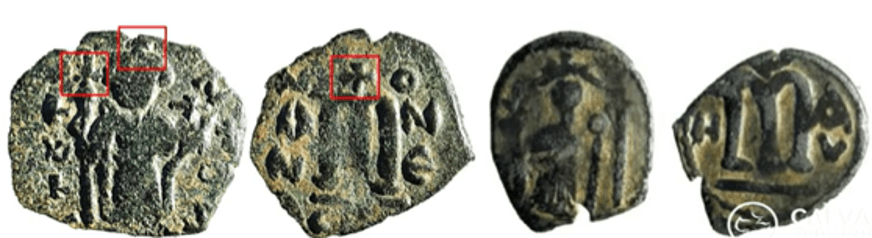
No coins were minted in Mecca with Muhammad’s name during his lifetime, nor for the four caliphs following him who ruled until 661. However, the Sassanian Empire (Persia) fell to Arab invaders in 651. Below are images of some of the Arab coins minted between the fall of the Sassanians and the rise of the Umayyad. Notice there are crosses on both the front and back of these coins. Would someone following Islam put crosses on their coins?
If we look at the location of the mints during this period, there were none anywhere along the Hijaz. Why? There was no water at Mecca’s site. (See prior article.) There were mints to the north in what are today Jordan, Israel, Lebanon, and Syria, and also some to the east in what was Persia. These mints are all located from 600 to 1,000 miles away from Mecca. But when the Sassanians fell, these mints were accessible to whoever invaded those lands.
The Umayyad
The Umayyad ruled from 661 until 749. They governed from Damascus in Syria. Why? There was water in Damascus, and it was a major trade hub in the East.[2] There were mints nearby and this kingdom began minting coins. Tradition says the Umayyad followed Islam. We are going to look at some coins and inscriptions of this Empire’s first two rulers—Muawiya (661-680) and Abd al-Malik (685-705).
Muawiya
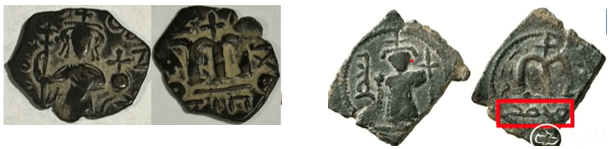
Below, on the left, you see the earliest coin minted by Muawiya. Note there are three crosses on the front and one on the back. The presence of the crosses indicates he is a Christian. On the right is a coin issued in 663 by the same ruler. We still have the crosses, but on the back is the Arabic word MHMD (in the red box). The praised one. Who is the praised one within Christianity? Jesus. Would someone following Islam mint such coins?
Abd al-Malik
There is a five-year gap between Muawiya and Abd al-Malik, and a shift in the coinage. The earliest coins minted by Abd al-Malik are the gold solidus used by the Byzantines. During this period, were the Umayyad required to pay tribute to the Byzantines? Images of that coin are shown below on the left. On the front is Justinian II and his two sons, and on the back is the Byzantine cross representing the Trinity. However, in 691 Abd al-Malik minted coins mocking the Byzantine ruler, his sons, and distorting the Byzantine cross. Also on the back of this coin is the Shahada. There is no god but God and the praised one (MHMD) is a servant of God. That coin is on the right. This is not an attack on Christianity, but on the Byzantine view of the Trinity.
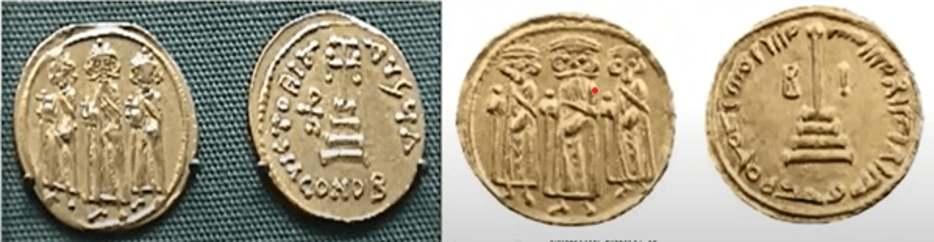
This second coin sparked a war between the Byzantines and Umayyad. The Umayyad won. In 693, Abd Al-Malik minted a coin showing him holding a sword as the war’s victor on the front, and an empty stand with the Shahada still on the back. This is the same inscription appearing in the Dome on the Rock, and discussed in the next section. This third coin is shown below on the left. The coin on the right was minted in 696. In addition to the Shahada, it contains two other verses now within the Qur’an. The first is, “Say not three, for God is one” (S4.171). The second, “For God neither begets, nor is he begotten. (S 112)”
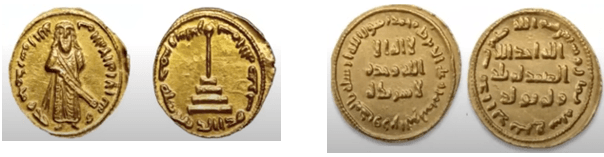
These are not attacks on Christianity, but rather against Jesus’ divinity. It is a confrontation between two different sects of Christianity. The Byzantine represent the Trinitarian view, and the Umayyad an Arian (non-Trinitarian) view of Jesus.
Inscriptions
In addition to coins, we also have inscriptions existing from the seventh century. Ilkka Lindstedt examined 100 rock inscriptions dated from about 640 to 740. Most of these inscriptions are found in Jordan and Syria, about 600 miles north of Mecca. A few inscriptions from the later part of this period are also found in Yemen, to the south. Except for pious formulae, there is no mention of Muhammad or Islam until after 690. We will look at two particular inscriptions in this article.
Muawiya
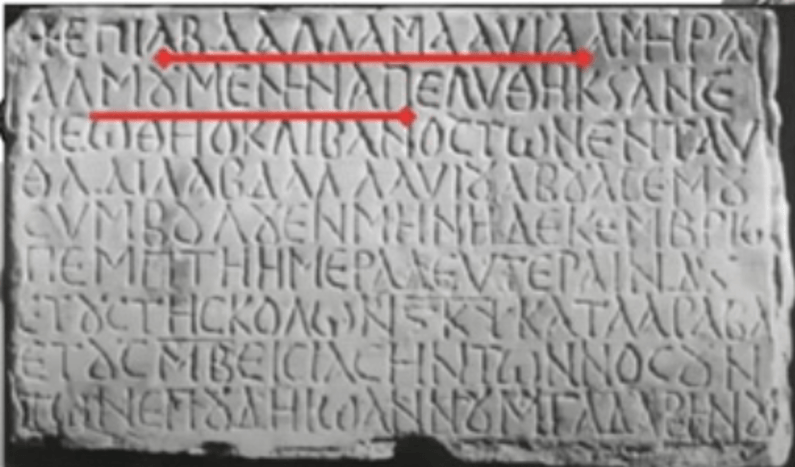
The first is a rock inscription from Muawiya. It is carved in Greek letters rather than Arabic. The inscription contains his name, and the phrases “servant of God” and “commander of the believers”. Which believers? The very first character in the upper left corner of the inscription is a cross. This reinforces the coins he minted, indicating he was a Christian. Further, would a follower of Islam use Greek for an inscription, instead of Arabic? Below is an image of this inscription. The letters for the two phrases noted above are underlined in red.
Abd al-Malik
The second inscriptions are located in the Dome of the Rock in Jerusalem. It was built in 691 by Abd al-Malik. This is the same year he minted coins mocking Justinian II, his sons, and the Byzantine view of the Trinity. We also find the same inscriptions upon entering the building as found on the coin he minted in 696. On the walls of the inner ambulatory (covered walkway) are the phrases, “Say not three, for God is one” and “For God neither begets, nor is he begotten.” These both appear to be references to Jesus, as noted above. Those are followed by an inscription of the Shahada, “There is no god but God alone, and ‘the blessed one’ (MHMD) is his messenger.”
Is “the blessed one” a title once again referring to Jesus? Another instance of a difference in belief between Byzantine Trinitarians and Umayyad non-Trinitarians? It should be noted these verses are not the same as exist in the Qur’an today. Instead, they may be precursors of those same verses.
Sources
Another question. If Muhammad existed, then who wrote down what he said? Within the Bible, the gospels were written by Jesus’ disciples (Mathew and John), a disciple of a disciple (Mark, a disciple of Peter), and one who collected evidence from the disciples and other eyewitnesses (Luke). The early church history, the book of Acts, was also written by Luke. Letters were written by Paul, Peter (another disciple), and John. Paul encountered the risen Jesus on the road to Damascus. All were either companions of Jesus (Sahaba), or those who obtained their information from his companions (2nd generation). The earliest scrap of the Gospels is from John and written in about 114 AD, only about eighty years after the events it chronicled.
Iman (Belief)
Drs. Yasir Qadhi and Shabir Ally are two of today’s leading Islamic scholars. In July 2025, Dr. Qadhi was asked how Muslims know what the Sahaba said about Muhammad and how we know whether they got it correct, as we have nothing written down from the seventh century. He replied, “[T]here is no middle ground, and the historical critical method (Western academia) and isnad analysis (Muslim science) are two diametrically opposed ways of looking at early Islam.”
Later that same month, Dr. Ally was asked about Dr. Qadhi’s statement that the Islamic Traditional sciences were ‘discredited’ by Western academia. He admitted that everything Muslims know concerning what Muhammad said and did came from 200-300 years of isnad (oral tradition) until it was tabulated in the 9th – 10th centuries. He further stated all Muslims could believe these isnads because the Sahaba (all 120,000 of them) were completely “Trustworthy, since they had perfect memory, and what they recited to others was 100% accurate.”
Historical Critique Use
Later that July, Dr. Qadhi stated historical critique was only good for the Bible, because it was authored over many centuries and redacted by later Christians who “misinterpreted what Jesus said”. In applying historical critique to the hadith, he said, “We will not agree with these tools … because they are not neutral … but have a western non-faith biased paradigm.” So historical critique is only for the West, and not Islam.
What tools did he suggest Muslims use? “When you don’t have iman (belief), or live in the bubble of iman, you will believe the [Muslim] sources are weak … [but] we know that the Sahaba [1st generation witnesses] will never lie … our hadith system is unprecedented, yet some aspects require faith … a leap of faith.” So the criteria becomes the extant manuscripts written in the 9th century derived from the oral traditions. These accurately convey the oral traditions noted in Islam’s source materials. But were these manuscripts written in the 9th, or even the 10th, century?
Final Results
Scholars searched for the documents Islam’s tradition say were written between the seventh and tenth centuries. These include the writings of the Sahaba, hadith,[3] Sira[4] (biographies of Muhammad’s life), Tafsir (commentaries), and Tarikh (histories). No manuscripts for any of these categories have so far been found before the 11th century. That is more than 400 years after Muhammad’s death.
In addition, the primary sira used today was written by Ferdinand Woostenfeld, a German scholar, between 1857 and 1860.[5] This is the book translated into English by A. Guillaume. The primary commentary and history was written by Michael Jan De Goeje, a Dutch scholar, between 1879 and 1901. Both European scholars used the source manuscripts written after the 11th century to compile their works. See the diagram after the footnotes.
The Muhammad of iman (belief) came from stories about him supposedly written by those who saw and heard him, or by others a few generations later. Yet, in reality, the stories of the Muhammad of history were compiled 400 – 500 years after he presumably died. These manuscripts were not canonized into final texts until 1,200 – 1,270 years after that presumed death. These differences suggest accretions, deletions, and text corruption could be present. The findings also paint a different picture of some of Islam’s history and beliefs in what tradition views as its early history.
Ties to Earlier Articles
This series’ previous articles used traditional sources representative of Islam’s standard narrative. One it presents to the world today. These articles also incorporated material from Ignaz Goldziher[6] and other sources[7] regarding Islam’s borrowings from other cultures. One area covered is hadith fabrication. The combination presents Islam from both a traditional view, and another coming from questions its ideology raises—some of those questions from within Islam itself. An example. Even Al-Bukhari accepted only a very small percentage of the hadith he reviewed for his compilation. The hadith he reviewed came from the period in question that Jay Smith covered above.
These earlier articles include material regarding; religious ideas, law, hadith fabrication, historic development, philosophy, and ideology. Links to some of that content are below.
- Islamic Borrowings and the Arabic People
- Muhammad’s Life and Teachings, Part III
- The First Caliphs and the Umayyad Dynasty
- The Abbasid Dynasty – Part I, History
- The Abbasid Dynasty – Part II, Its Religious Development
- Who is Allah?
- Man’s Nature and the Two Threads
- Islam is All
- US Law and Shari’ a
In the next article, we will cover the Qur’an.
Footnotes:
[1] Jay Smith presentation, Dismantling Islam presentation on about May 1, 2026. https://www.youtube.com/watch?v=FHtr5wUMfo4 , Accessed July, 2026.
[2] Wolf, Dan, The First Caliphs and the Umayyad Dynasty, Virginia Christian Alliance, https://vachristian.org/the-first-caliphs-and-the-umayyad-dynasty-2/ , March 1, 2026.
[3] Ibid.
[4] Guillaume, A., The Life of Muhammad: A Translation of Ibn Ishaq’s Sirat Rasul Allah, Oxford University Press, 2006.
[5] Ibid.
[6] Goldziher, Ignaz, Introduction to Islamic Theology and Law, Princeton University Press, 1981.
[7] Such as; Ye’or, Bat, The Decline of Eastern Christianity under Islam, Fairleigh Dickinson University Press, 1996, and Geisler, Norman L. and Saleeb, Abdul, Answering Islam, Baker Books, 2002.