
Looting and Pillaging the System
- “Yo ho, yo ho, a pirate’s life for me. We pillage, we plunder, we rifle and loot. Drink up me ‘earties, yo ho.”
Between 800 and 1100 AD, immigrant Muslim Arabs and Persians established coastal trading posts along the Gulf of Aden and the Indian Ocean, solidifying present-day Somalia’s close commercial ties to the Arabian Peninsula. In the late 19th century, Britain, France, and Italy carved colonies out of the Somali Peninsula—colonies that lasted until 1960, when British Somaliland and Italian Somaliland gained independence and formed the Republic of Somalia. The new nation functioned as a parliamentary democracy until 1969.
That year, Mohamed Siad Barre seized control in a coup. During his 22-year socialist dictatorship—and in an effort to centralize power—Siad declared that the Somali clan system had to be eradicated. Big mistake. Clan identity was, and remains, the essential cultural and social organizing principle in Somali life.
- “When a strong man, fully armed, guards his own house, his possessions are safe. But when someone stronger attacks and overpowers him, he takes away the armor in which the man trusted and divides up his plunder.” —Luke 11:21–22
Predictably, the people resisted his socialist regime, and the military overthrew him in 1991. The result was total state collapse. After the tragic “Black Hawk Down” rescue attempt in Mogadishu, the international community largely backed away from further intervention—at least until the piracy began.
Somali pirates plundered the waters around Somalia—from the Indian Ocean to the Gulf of Aden and beyond—for nearly twenty years before it was no longer viable for them to continue.

Crime can certainly arise from desperation and survival, especially when hope is absent. But the deeper truth is found in Somalia’s toxic confluence of tribalism and the brute force of Islamism.
Somalia is 99.9% Muslim, with 98% adhering to the Sunni tradition. No Western country should expect the Somalis to assimilate to a code of conduct they have never known or appreciate.
The economic situation is catastrophic. Somalia exported roughly $2.424 billion in 2024, but imported $9.002 billion—a deficit so vast it makes piracy and welfare fraud far more explicable. For many Somalis, the only viable path to survival is emigration—and once abroad, they bring their social structures with them. In the U.S., the Minneapolis–St. Paul metroplex became, by far, the largest Somali community. That was no accident.
Somali migration to the United States was not random. It was facilitated by the refugee-resettlement infrastructure—dominated by faith-based organizations known as Voluntary Agencies, or VOLAGs. Beginning in the early 1990s, the most active VOLAGs were Catholic Charities/U.S. Conference of Catholic Bishops (USCCB).
Alongside them stood the Lutheran Immigration and Refugee Service (LIRS), drawing from both ELCA and LCMS congregations. LIRS became one of the top three VOLAGs in Somali resettlement. Because Minnesota has historically deep Lutheran roots, its congregations pushed hard for refugee sponsorship while LIRS offices in the Upper Midwest handled massive caseloads. Lutheran networks were arguably the single most influential force in concentrating Somalis in Minnesota.
Other agencies have played significant roles as well:
- Church World Service (CWS) in New York, Texas, North Carolina, and Washington
- Episcopal Migration Ministries (EMM) in Virginia, Texas, and California
- World Relief through the National Association of Evangelicals (NAE) in Washington State, Idaho, North Carolina, and Georgia
- And, somewhat surprisingly, the Hebrew Immigrant Aid Society (HIAS), which has become a major resettler of non-Jewish refugees—including Somali Muslims.
Overall, the church infrastructure of the Upper Midwest—especially among Lutherans—explains why Minnesota became the global center of the Somali diaspora outside East Africa. Approximately 80,000 Somalis now live in Minnesota, roughly 1.25% of the state’s population, all within just 30 years. VOLAGS are largely dependent on Government funding through grants from the U.S. Department of State and the Office of Refugee Resettlement (ORR). The U.S. government has spent billions on refugee and asylee resettlement over the past 15 years, with federal funding accounting for approximately $331.5 billion of an estimated total of $457.2 billion.
The Journey From Piracy to Welfare Fraud
The churches in America could have learned a great deal about politics simply by watching events in the world around them. Yet now, the news has broken across the internet: Minnesota has become the epicenter of one of the most astonishing episodes of public-fund looting in modern memory. Billions of taxpayer dollars have vanished—funneled through sham nonprofits, phantom service providers, and shell corporations. Even more disturbing, federal investigators report that some of the stolen money ended up in the hands of Al-Shabaab, the al-Qaeda-linked terrorist group in East Africa.
One law-enforcement official put it plainly in a statement that should have stunned the nation:
“The largest funder of Al-Shabaab is the Minnesota taxpayer.”
A significant portion of this fraud has been traced to bad actors operating within Minnesota’s Somali community—individuals who learned to manipulate the state’s sprawling welfare bureaucracy with remarkable precision. What was intended as compassion transformed into a racket.
Consider the Medicaid Housing Stabilization Services (HSS) program. Designed to help seniors, addicts, and the disabled find stable housing, it instead became a gold mine for opportunists. In just a few years, payments exploded from $2.6 million to more than $104 million, much of it flowing to “providers” operating out of run-down storefronts or empty office suites—billing the state for services they never offered and never intended to deliver.
This isn’t merely bureaucratic incompetence. It is a case study in what happens when a government loses the will to govern—when a culture of unearned trust collides with actors who have every incentive to exploit it.

Christopher Rufo
It is also what happens when people in power, enabled by those of goodwill but lacking discernment, lose their will to govern with honesty and integrity. Not because they were evil, but because they were blinded by their own good intentions. In the name of charity, they quietly surrendered to corruption. We discovered the audacity of this crime only when it became too large to conceal. For a full accounting, you please read the Christopher Rufo detailed investigation in City Journal:
https://www.city-journal.org/article/minnesota-welfare-fraud-somalia-al-shabaab
For many Christians, the influx of Muslims into America is a topic they would rather avoid—until circumstances force their attention. To make matters worse, Muslims are taught from birth to consider Jews and Christians not merely as theological adversaries, but to be hated. They will dissemble as migrants because they have no desire to assimilate into any culture other than Islam. Yes, the word Islam does mean “submission”—but not submission for the Muslim to another authority. It means submission by everyone else to them. In that worldview, stealing from the kafir—the unbeliever—is not considered a crime.
One final and encouraging thought: don’t assume that Muslims cannot convert to Christianity. In the last 3 months alone, over 600 Muslims in the northern Nigeria slaughterhouse [https://www.youtube.com/watch?v=FWMloyWeFio] have accepted Christ as their savior through the efforts of missionaries like Judd Saul and his ministry outreach, Equipping the Persecuted here: [https://equippingthepersecuted.org]
- “Therefore go and make disciples of all nations, baptizing them in the name of the Father and of the Son and of the Holy Spirit, and teaching them to obey everything I have commanded you. And surely I am with you always, to the very end of the age.” —Matt. 28:19-20
Sources:
https://www.city-journal.org/article/minnesota-welfare-fraud-somalia-al-shabaab
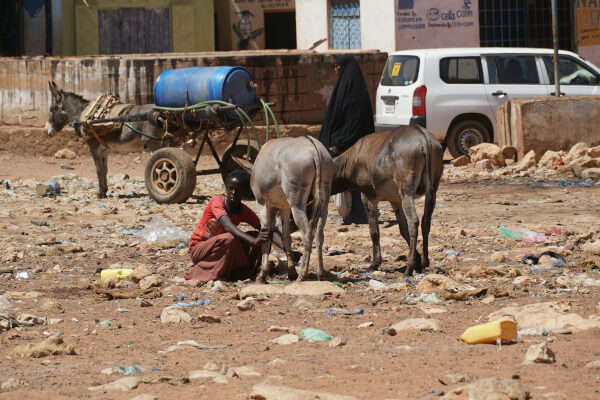
Photo by Ismail Salad Osman Hajji dirir on Unsplash