
When I first heard that the United States and Israel had launched military strikes against Iran, my reaction was hesitation.
Christians should never rush to support war. Scripture calls us to pursue peace whenever possible. “Blessed are the peacemakers, for they shall be called sons of God” (Matthew 5:9). War brings suffering, destruction, and the loss of human life. No honest believer should cheer for it.
Then I learned something that changed my perspective.
The Math That Changed Everything
Israeli analyst Caroline Glick, international affairs advisor to Prime Minister Netanyahu, recently laid out a reality that most Western media have barely touched.
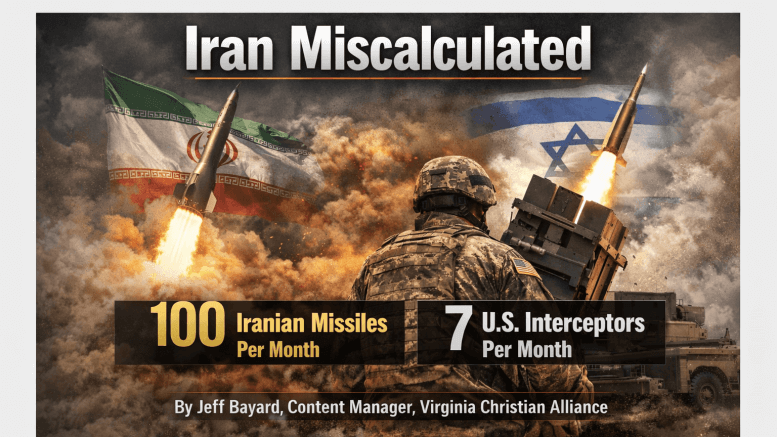
Iran had industrialized its ballistic missile production to the point where it could build roughly 100 ballistic missiles every month. Meanwhile, Western missile defense systems were producing interceptor missiles at a pace of only six or seven per month.
Think about what that means. Even the best missile defense system cannot stop an unlimited barrage. When one side can manufacture offensive missiles fifteen times faster than the other side can build interceptors, the math eventually favors the attacker. As Glick explained, Iran was building the capacity to overwhelm missile defenses and devastate cities.
And that was only half of the problem.
According to U.S. special envoy Steve Witkoff, Iranian negotiators boasted that they controlled 460 kilograms of uranium enriched to 60 percent—enough to produce approximately eleven nuclear warheads within a week and a half if taken to weapons grade. When Iran’s additional stockpile enriched to around 20 percent is included, Glick notes the regime could potentially field roughly twenty-five more nuclear weapons within a month to a month and a half.
Missiles without nuclear warheads are dangerous. Missiles paired with nuclear weapons change the balance of power entirely.
Iran Bet the West Would Never Act
For years, Iran appeared confident that Western leaders would keep choosing negotiation over confrontation. Sanctions came and went. Talks dragged on. Meanwhile, Iran continued expanding both its missile arsenal and its nuclear program.
That strategy relied on a dangerous assumption: that the West would always delay hard decisions. Eventually, that assumption collapsed. When U.S. negotiators returned from a third round of talks and reported that Iran had no intention of ending its weapons program—that Iranian officials were, in Glick’s words, “just playing for time”—the calculus changed. Waiting longer meant facing a far stronger and more dangerous adversary later.
Iran miscalculated. They treated American restraint as permanent weakness rather than patience with a limit.
The Doctrine Most Western Analysts Ignore
But here is where the story goes deeper than most Western commentary will take you—and where Christians especially need to pay attention.
Iran is a Twelver Shia nation. At the heart of Twelver Shia theology is the doctrine of the Twelfth Imam—also called the Mahdi, or “Guided One.” Shia Muslims believe that Muhammad al-Mahdi, born around 868 AD, did not die but was hidden from humanity by Allah in what they call “occultation.” He has remained supernaturally concealed for over a thousand years and will return at the end of time to establish justice and peace on earth before the Day of Judgment.
For centuries, this belief was largely passive. The faithful waited. Allah would act in His time.
That changed with the Islamic Revolution of 1979. Under Ayatollah Khomeini, eschatology became state policy. Iran’s clerical rulers declared their nation the “Vanguard of the Mahdi”—chosen by Allah to prepare the world for his return. And the preparation they envision is not peaceful. In Twelver Shia tradition, the Mahdi’s return requires chaos, bloodshed, and the defeat of Islam’s enemies.
Israel, specifically, is identified as the greatest obstacle to the Mahdi’s reappearance.
According to a 2022 study from the Middle East Institute, the Islamic Revolutionary Guard Corps increasingly views the eradication of Israel as a necessary precondition for the Twelfth Imam’s return. Senior IRGC cleric Mehdi Taeb stated openly in 2015 that the IRGC must “remove the obstacles to the emergence of the Imam of the Age, the most important of which is the existence of the usurper regime of Israel.”
This is not fringe theology. It is official IRGC doctrine. And the indoctrination is intensifying. Since 2009, ideological training within the IRGC has expanded dramatically. According to the Middle East Forum, it now accounts for more than half of all required training for recruits and active members. Younger generations of IRGC officers are more radical than their predecessors, not less.
Why Mutually Assured Destruction Does Not Apply
During the Cold War, the logic of Mutually Assured Destruction kept nuclear superpowers from launching first strikes. The assumption was simple: no rational leader would invite his own annihilation.
But that assumption depends on leaders who fear destruction. Iran’s ruling ideology does not fear it—it welcomes it.
If Iran’s leaders sincerely believe that nuclear war against Israel would trigger the Mahdi’s return and the final victory of Islam, then nuclear weapons are not a deterrent. They are a sacrament. The normal rules of deterrence do not apply to a regime that sees apocalyptic destruction as the fulfillment of divine prophecy.
As analyst Tim Orr wrote in the Times of Israel, whereas other states treat nuclear weapons as tools for deterrence, Iran’s regime views them as instruments to destroy Israel and facilitate the chaos their theology requires.
This is why the chants of “Death to America” and “Death to Israel” are not political slogans. They are theological commitments. Governments sometimes say exactly what they intend to do.
A Christian Perspective: Two Eschatologies in Collision
As Christians who hold a premillennial view of Scripture, we recognize that the Bible also speaks of an end-times climax. Daniel, Ezekiel, and Revelation all point to a period of tribulation, the rise and fall of nations, and the ultimate return of Christ to establish His kingdom.
But here is the critical difference. Biblical eschatology teaches that God is sovereign over the timeline. No human hand can force God’s schedule. Jesus told His disciples plainly: “It is not for you to know times or seasons that the Father has fixed by his own authority” (Acts 1:7). We are called to occupy until He comes (Luke 19:13)—to be faithful, to proclaim the Gospel, to defend the vulnerable, and to trust God with outcomes.
Iran’s Mahdist theology drives its leaders in the opposite direction—to manufacture an apocalypse. To create the chaos they believe will compel their messiah to appear. That is not faith. That is presumption dressed in religious language. And it is extraordinarily dangerous when paired with ballistic missiles and nuclear material.
Romans 13:4 tells us that governing authorities do not “bear the sword in vain.” God has ordained government to restrain evil and protect the innocent. The moral challenge for Christians is always to discern when military action represents unjust aggression and when it represents necessary defense. That judgment is never simple. But when a regime is building nuclear weapons, industrializing missile production, surrounding its enemies with proxy armies, and operating under a theology that welcomes global destruction as a pathway to paradise—waiting is not wisdom. It is negligence.
Watch. Understand. Pray.
I am embedding Caroline Glick’s interview above because I believe every Christian who cares about what is happening in the Middle East needs to hear it. She lays out the military realities with a clarity that most American media will not give you.
But beyond the military facts, understand the theology driving Iran’s decisions. This is not merely a geopolitical conflict. It is a clash of eschatologies—and the stakes are measured in human lives.
Pray for the Iranian people, millions of whom are oppressed by this regime and many of whom are turning to Christ in record numbers. Pray for Israel. Pray for wisdom for American leaders. And pray with knowledge, not ignorance.
“The battle is real, but so is our God. He who sits in the heavens laughs at the schemes of men” (Psalm 2:4). Our calling is not to manufacture the end of the world, but to be faithful witnesses until the One who holds all things in His hands returns to make all things right.
References
Caroline Glick interview (YouTube)
Middle East Institute, “Iran’s Revolutionary Guard and the Rising Cult of Mahdism” (2022)
Middle East Forum, “Mahdism: The Apocalyptic Ideology Behind Iran’s Nuclear Program” (2023)
GotQuestions.org, “What is the Twelfth Imam in Islamic Eschatology?”
Tim Orr, “Iran’s War Against Israel: The Shia Eschatological Vision,” Times of Israel (2025)

Terrific insight into what the reason for America’s action in Iran! If not now, another later time just might not be possible. It took courage to act! Great article!
I forgt to thank you for this one Jeff…sent it to all the armchair quarterbacks!
Thank you Jeff for your article.