
By Jeff Bayard
Step Into Fear Ben Bergquam is more than a book title or a political interview theme. Ten years ago, Bergquam says he was living two lives.
To his wife, children and the outside world, he was a husband, father and businessman. In secret, he was trapped in alcoholism and crack cocaine addiction, lying to the woman he loved and watching his life collapse from the inside. Bergquam believed the road he was on could end in prison or death.
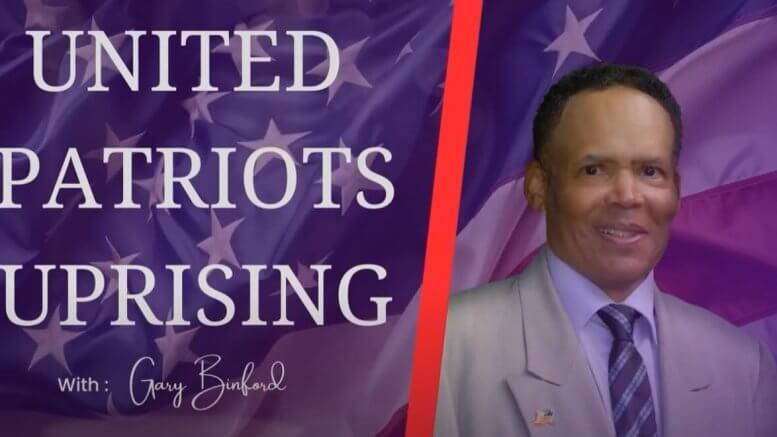
Today, the man Gary Binford interviews on United Patriots Uprising bears little resemblance to the man Bergquam describes from those years. He is an investigative journalist, host of Law & Border on Real America’s Voice, and a reporter who has traveled along America’s southern border and through the dangerous Darién Gap. His first book, Step Into Fear: A Journey from Addiction to Courage and Purpose, is scheduled for release September 8.
But this interview is about more than border enforcement, election integrity or even Bergquam’s remarkable professional transformation.
At its center is a question Christians cannot escape:
What happens when obedience to God requires walking directly toward what frightens us?
Watch Gary Binford’s full conversation with Ben Bergquam:
Ben Bergquam Says America Must See What Is Happening
Gary begins by asking Bergquam what issue Americans most need to understand.
Bergquam does not hesitate.
Border security and the consequences of illegal immigration remain among his principal concerns. He describes spending years reporting from the United States, Mexico, Central and South America and embedding with federal immigration officers. More recently, he says much of his work has involved accompanying Immigration and Customs Enforcement and Border Patrol personnel while documenting enforcement operations.
Bergquam argues that much of what Americans hear about immigration enforcement reverses the identities of victim and protector.
He praises ICE and Border Patrol agents as men and women attempting to enforce the law while political activists, sanctuary jurisdictions and some media organizations portray them as villains.
That is Bergquam’s argument, and it deserves to be distinguished from a broader question Christians must examine carefully: What does genuine compassion look like?
Compassion does not require abandoning borders.
It does not require pretending that governments have no legitimate authority to determine who may enter their countries.
And it certainly does not require ignoring the vulnerable people exploited on the journey north.
Bergquam says he has witnessed that exploitation personally.
He describes cartel control, human trafficking, sexual violence and migrants becoming indebted to criminal organizations as they travel toward the United States. His conclusion is blunt: policies advertised as humanitarian can become profoundly inhumane when they encourage desperate people to place themselves in the hands of traffickers and smugglers.
Christians should be capable of holding two truths simultaneously.
The foreigner is made in the image of God and must never be treated as less than human.
The civil magistrate also has a God-given responsibility to restrain evil and maintain order.
Biblical compassion and lawful government are not enemies.
The Darién Gap and a Difficult Question About Compassion
One of the most disturbing moments in the interview comes when Gary asks Bergquam about an item he has displayed publicly while recounting his trips through the Darién Gap.
Bergquam calls it a “rape kit.”
That terminology needs some clarification.
Human Rights Watch has independently documented that CARE distributed what the organization called “sexual violence prevention kits” to women traveling through the Darién region. According to Human Rights Watch, those kits included items such as emergency contraception, a whistle for signaling an emergency or assault, menstrual underwear, a privacy changing shelter and other supplies.
Bergquam interprets the existence of such supplies as evidence that humanitarian organizations knew how dangerous the journey was while migrants nevertheless continued entering the jungle.
The organizations involved would frame the matter differently. From their perspective, providing emergency contraception, whistles and other supplies to vulnerable women is harm reduction—an attempt to protect people already making an extremely dangerous journey.
That is the argument Christians should honestly confront rather than caricature.
But it does not dispose of Bergquam’s larger question.
If a migration route has become so dangerous that humanitarian organizations must prepare women for the possibility of sexual assault before they enter it, shouldn’t policymakers also ask what is encouraging the journey in the first place?
Human Rights Watch has documented extensive violence, including sexual violence, against migrants crossing the Darién Gap. Bergquam says he saw evidence of that danger repeatedly during his own reporting.
Calling attention to those realities is not a lack of compassion.
It may be precisely what compassion demands.
Sometimes love does not consist of making a dangerous road slightly easier to travel.
Sometimes love requires warning people not to walk down that road at all.
The SAVE America Act and the Battle Before the Midterms
The interview then moves from border security to election integrity.
For Bergquam, the issues are connected.
He argues that a nation unable or unwilling to control its borders will eventually face deeper questions about citizenship itself—including the foundational question of who gets to choose the government.
That brings Gary and Bergquam to the SAVE America Act.
The legislation is more complicated than the shorthand often used to describe it. Broadly, the proposal would require documentary proof of United States citizenship for federal voter registration and impose national voter-identification requirements at the polls.
Supporters argue that citizenship verification is a straightforward election-security measure. Federal law already limits voting in federal elections to American citizens; supporters contend that the registration system should require documentary evidence confirming eligibility rather than relying principally upon an applicant’s attestation.
Opponents counter that millions of lawful citizens do not routinely possess the qualifying documents contemplated by the legislation and that name changes, lost documents and difficulty obtaining records could create unnecessary obstacles for legitimate voters.
Those concerns should be addressed seriously.
Protecting the franchise means accomplishing both objectives: preventing unlawful voting while ensuring that every eligible American citizen can reasonably exercise his or her lawful right to vote.
Bergquam believes Congress has failed the first responsibility.
During the interview, he expresses frustration that Republicans controlling the presidency and Congress had still been unable to enact the SAVE America Act.
That frustration remains relevant.
As of September 3, the Senate still has not passed the legislation. The proposal has been advanced through several procedural and legislative strategies during 2026, but Senate efforts have repeatedly stalled.
For Christians, however, election integrity cannot be reduced to winning for our preferred political party.
Scripture demands something more difficult: honest scales whether the result favors us or not.
We should want lawful citizens to vote.
We should want unlawful votes prevented.
We should want legitimate ballots counted accurately.
And we should demand those principles regardless of which candidate benefits.
An election system worthy of public confidence should not fear careful safeguards—or careful scrutiny of those safeguards.
Executive Orders Cannot Substitute for Congress Forever
One of Bergquam’s strongest constitutional points receives less drama than some other moments in the interview, but it may be among the most consequential.
He warns that executive action is temporary.
A president can reverse the executive actions of his predecessor. The next president can do precisely the same.
That matters greatly in immigration policy.
Bergquam supports President Trump’s border and immigration actions, but he argues that supporters should not mistake presidential action for permanent law.
If Americans believe certain border-security policies are essential, Congress ultimately has to legislate.
That is how the constitutional system is supposed to work.
- Presidents execute the laws.
- Congress writes them.
- Courts resolve constitutional and legal disputes.
Executive orders may direct the executive branch within the president’s lawful authority, but they cannot permanently substitute for legislators doing the difficult work for which voters sent them to Washington.
That is why Bergquam places such importance on the 2026 midterm elections.
He believes control of Congress will determine not only whether the Trump administration can continue implementing its agenda but whether portions of that agenda ever become durable federal law.
Christians do not have to agree with every policy proposal to recognize the underlying civic principle:
Elections have consequences because governing authority has consequences.
Sitting out the process does not make us spiritually neutral.
It merely leaves decisions to somebody else.
From Addiction and Deception to Freedom
Yet if the interview ended with legislation and immigration enforcement, we would miss the most important part of Bergquam’s story.
Gary deliberately turns the conversation away from Washington and back toward the man sitting across from him.
How did a crack addict living a double life become this man?
Bergquam’s answer is not politics.
It is God.
“I am where I’m standing today only because of God’s hand and provision and direction and His mercy in my life,” he tells Gary.
Bergquam says he grew up in the church. His parents had served as missionaries in Africa, and his father later pastored a church.
Yet proximity to Christianity is not the same thing as walking obediently with Christ.
Bergquam recounts choices that eventually led through alcoholism into crack cocaine addiction. For three years, he says, he hid the addiction from his wife.
Outwardly, life continued.
Inwardly, he was dying.
He prayed for God to keep his wife from discovering what he was doing because, he says, he did not want to hurt her.
But finally the deception broke.
Bergquam confessed.
He connects that night with a passage from Peter:
“Likewise, ye husbands, dwell with them according to knowledge, giving honour unto the wife, as unto the weaker vessel, and as being heirs together of the grace of life; that your prayers be not hindered.” — 1 Peter 3:7, KJV
Bergquam says he came to understand that the woman from whom he had been hiding was the very person before whom the truth needed to be exposed.
He describes that moment as the breaking of his chains.
According to his testimony, he was freed from crack cocaine and alcohol and began a completely different journey.
We should be careful not to turn one man’s testimony into a formula promising that every addiction disappears instantaneously when someone prays. God works in different lives through different means and circumstances.
But we should be equally careful not to explain away what Bergquam himself declares:
He believes Jesus Christ rescued him.
That is his testimony.
And ten years later, his wife, his children, his work and his public life stand on the other side of that confession.
The man had been hiding in darkness.
Freedom began when the darkness was exposed.
Step Into Fear Ben Bergquam: Turning Fear Into Courage
That transformation explains the title of Bergquam’s new book, Step Into Fear: A Journey from Addiction to Courage and Purpose.
The phrase sounds almost contradictory.
We usually run from fear.
Bergquam argues that some of the most important moments of his life began when he did the opposite.
Fear itself did not disappear. What changed was his response to it.
He says the circumstances that once immobilized him eventually became opportunities to learn dependence upon God. As his faith grew, he began viewing frightening situations differently—not necessarily as signs to retreat but sometimes as doors through which obedience required him to walk.
Scripture says:
“For God hath not given us the spirit of fear; but of power, and of love, and of a sound mind.” — 2 Timothy 1:7, KJV
That verse does not say a Christian will never experience fear.
Paul himself knew danger, imprisonment, rejection, beatings and eventually martyrdom.
Biblical courage is not the inability to feel afraid.
It is refusing to allow fear to become lord.
That distinction matters tremendously in an age when fear can silence Christians without a single law being passed.
Fear of offending someone.
Fear of losing friends.
Fear of being labeled.
Fear of speaking at a school-board meeting.
Fear of challenging political leaders.
Fear of talking about Christ.
Fear of admitting our own sin.
Fear of telling the truth inside our own homes.
A person can spend a lifetime constructing an elaborate prison out of things that might happen.
Bergquam says he discovered something different.
The obstacle did not always disappear.
The fear did not always disappear.
But when he trusted God enough to walk forward anyway, the thing he feared sometimes became the very place where God taught him courage.
That is much bigger than politics.
Christian Courage Must Be Rooted in Christ
Bergquam uses the Armor of God to describe what repeated trials have taught him.
His point is not that Christians manufacture armor by becoming tougher people. Scripture teaches that God supplies what His people require for spiritual battle.
The lesson is dependence.
The Christian who has watched God sustain him through yesterday’s battle has reason to trust Him in tomorrow’s.
And that brings this entire interview together.
Border security matters.
The suffering of migrants matters.
The safety of ICE and Border Patrol agents matters.
Election integrity matters.
The midterms matter.
Congress matters.
But none of those things sits on the throne.
God does.
“And he changeth the times and the seasons: he removeth kings, and setteth up kings: he giveth wisdom unto the wise, and knowledge to them that know understanding.” — Daniel 2:21, KJV
That truth prevents civic involvement from becoming political idolatry.
Christians should vote without worshiping elections.
We should defend constitutional government without pretending government can save souls.
We should tell the truth about evil without forgetting that we ourselves require grace.
And we should exhibit courage without confusing courage with anger.
Bergquam’s life is a useful reminder.
Before he was confronting cartels, reporting from the border or interviewing federal agents, he had to confront something much closer to home.
He had to tell the truth about Ben Bergquam.
That may have been the most frightening battlefield of all.
And according to his testimony, when the hiding stopped, God began writing a very different story.
What You Do This Week
- Know what the SAVE America Act actually says. Read the legislation and the strongest arguments both for and against it before repeating slogans about it.
- Contact your senators. Ask where they stand on citizenship verification, voter identification and protecting lawful access to the ballot before the 2026 midterms.
- Pray for immigration law-enforcement officers and the vulnerable people they encounter. Compassion should extend to agents, citizens, lawful immigrants and migrants exploited by criminal organizations.
- Identify the fear controlling your own obedience. Is there a truth you need to speak, a sin you need to confess, someone you need to forgive or an act of Christian courage you keep postponing?
Politics may be one battlefield.
The harder battlefield may be much closer to home.
Key Takeaways
- Ben Bergquam says his border reporting has convinced him that illegal migration creates victims as well as political controversy.
- He argues that enforcement and compassion are not opposites.
- Human Rights Watch confirms sexual violence is a serious danger for migrants crossing the Darién Gap.
- CARE distributed “sexual violence prevention kits” to women traveling through the region.
- Bergquam believes sanctuary policies can complicate ICE enforcement and increase confrontations in communities.
- The SAVE America Act would impose documentary citizenship-verification and voter-identification requirements for federal elections.
- Supporters call those provisions election safeguards; opponents warn legitimate voters could face documentation barriers.
- As of September 3, 2026, the SAVE America Act has not cleared the Senate.
- Bergquam argues durable immigration reform requires legislation rather than reliance solely upon executive action.
- His upcoming book, Step Into Fear, recounts his journey from addiction through faith to a new sense of purpose.
- Bergquam credits Jesus Christ with freeing him from the life of deception and addiction he once lived.
- Biblical courage is not the absence of fear; it is obedience to God despite fear.
Resources
- Watch the Full Interview: Ben Bergquam Raises The Curtain On Issues Critical To Our Nation
- Ben Bergquam Official Website: Frontline America
- United Patriots Uprising Archive: Radio Influence — United Patriots Uprising
- Related VCA Content: United Patriots Uprising with Gary Binford
- Related VCA Content: Communism in America — Trevor Loudon
Find Gary Binford Online
- YouTube Channel: @garybinford1969
- Podcast Archive: United Patriots Uprising
- X (Twitter): @gary_binford
- Facebook: Gary Binford
- Truth Social: @GaryBinford
Find Ben Bergquam Online
- Website: Frontline America
- TV Show: Law & Border on Real America’s Voice
- Book: Step Into Fear: A Journey from Addiction to Courage and Purpose
- Publisher: War Room Books
- X: @BenBergquam
- Facebook: Frontline America
- Substack: Frontline America
One final question:
What is fear keeping you from doing that God has already made clear you should do?
Do not confuse waiting with obedience.
When God says move, trust Him enough to take the next step.



Amen Brother Jeff! “Run to the roar!”