
Twenty-seventh in a series
Today we turn to freedom. An important topic as we approach our 250th anniversary as a nation. Freedom is an outcome of other choices, many of those we’ve already considered. These include; sovereignty, tenets, ideology, governance, rights, and law. This post attempts to pull all that material together, and add a few more ideas about the topic.
This article is not judgmental on the topic. We each have the free will to choose what we want. I know what I choose and why. Ideas have consequences, and this topic is a stark reminder. Additionally, America itself has, until recently, fallen away from the type of freedom envisioned by our Founders. We’ll see the west is little different from Islam in this respect, and look into why that might be.
Definitions
From the 1820 Webster’s dictionary, we have the following;[1]
- Freedom – A state of exemption from the power or control of another; liberty; exemption from slavery, servitude or confinement. Freedom is personal, civil, political, and religious.
- Governance – Government; exercise of authority; direction; control; management, either of a public officer, or of a private guardian or tutor.
- Idea – Literally, that which is seen; hence, form, image, model of any thing in the mind.
- Law – A rule, particularly an established or permanent rule, prescribed by the supreme power of a state in its subjects, for regulating their actions, particularly their social actions.
- Right –
- Conformity to the will of God, or to his law, the perfect standard of truth and justice.
- Conformity to human laws, or to other human standard of truth, propriety, or justice.
- Sovereign – A Norman word.
- Supreme in power; possessing supreme dominion; as a sovereign, prince. God is the sovereign ruler of the universe.
- Supreme; superior to all others; chief. God is the sovereign good of all who know and love him.
- Sovereign – A supreme lord or ruler; one who possesses the highest authority without control. Some earthly princes, kings, and emperors are sovereigns in their dominions.
One of my favorite definitions of freedom comes from M. Stanton Evans. “Freedom … means the absence of coercion—to the extent this is feasible in organized society. It means the ability of human beings to act in voluntary fashion, rather than being pushed around and forced to do things.”[2] (Emphasis in the original.)
God and Man
Within Christianity, God is both infinite and personal. Man holds a special place in God’s creation. Man is part of creation, but different. The diagram below demonstrates this relationship.[3]
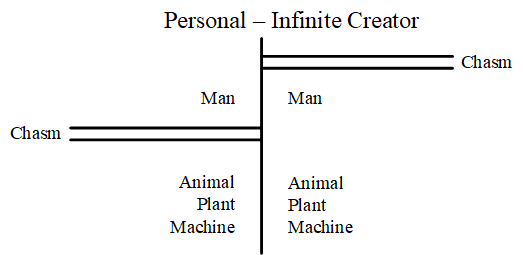
God alone is infinite in all the universe. Man, on the other hand, is finite—like the rest of creation. He is part of God’s creation. This is shown by placing the chasm on the right side of the diagram between God and all His creation. God is love. He created creation out of love; one must experience love to understand it. God made man in His image and likeness, intending for man to have a relationship with Him so man could experience His love. He gave man the free will to choose whether he accepts God’s love and that relationship. This is shown on the diagram’s left side by placing the chasm between man and the rest of creation.
As God is infinite, and man is not, man requires something greater than himself to accomplish the purpose for his creation. He requires God. Our relationship with God is the bridge allowing us to fulfill the purpose for which God created us. And God left it to each and every one of us to choose whether we enter into that relationship or not. When we turn away from a relationship with God, we end up with only the right side of the diagram—with man alone.
The Difference
Only the Biblical Principles governance model allows for recognizing that relationship with God. He is sovereign. The natural rights man possesses are recognized, and God’s law followed—it supersedes man’s law. This model is individualistic as each individual shares the same common nature and dominion. It relies primarily on negative rights aimed at avoiding evil. Man requires morality to exercise his free will appropriately. All other governance forms are collective in nature. They rely on classes or groups within society. Each group possesses its own set of privileges. Persuasion enforces harmony, and force used when persuasion fails. Islam falls into this latter category, as discussed in earlier articles. According to tradition, Allah is inscrutable—unknowable. Several groups exist within it that have their own rights and differing law.
The diagram below reflects some of the differences, differences derived through ideas about who God and man are—if society acknowledges God at all.
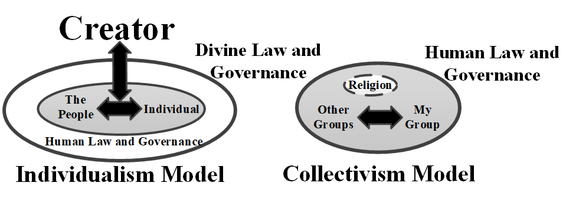
The differences in positive and negative rights are shown again below. It comes down to having the ability to choose from among many options, or a yes/no decision concerning a single alternative.
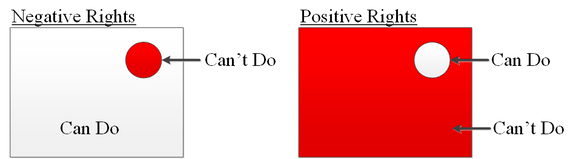
The above differences also impact law. America began with common law. Common law derives from applying God’s divine and natural law. God is sovereign. This law comes from man’s God given nature and the natural rights inherent in it. Other law begins with man as sovereign, granting privileges passing as rights to society’s groups. The difference could not be more stark or profound.
Applying to Islam
Within Islam, everything is already laid out for you. All that’s required is obedience. The requirements are many, so many that not even those who faithfully try to carry them all out can do so. Take religious freedom as an example. Within America, one is free to choose from any religion—or no religion at all. Yes, there will be constraints on some, if they violate other individual’s rights or attempt to harm them. But compare that to religious freedom as it exists within an Islamic society. There your religious freedom comes down to a simple choice. One can choose Islam any time they want.
America is not Exempt
This is where we pause for a moment to discuss America. While our country began as a republic base upon the Biblical Principles model, it has morphed into a collectivist governance form. Major milestones in that process occurred in 1938’s Erie Railroad v. Tompkins decision and implementing the Rules of Civil Procedure. These effectively ended common law’s recognition. Then, in the 1960’s, the state’s adopted the Uniform Commercial Code. A return to a type of Roman civil law where just about everything is a contract, but not a common law contract.
Think that is not true? How often does one need to get permission to do something? How many applications do you need to complete? Are licenses or permits needed before an action can take place, or you can even work? Are certificates needed to prove some action has already been performed? Do these papers require two party’s signatures, or only yours? The latter are adhesion contracts, a form of Roman civil law contract. As a reminder, the table below lists some of the significant differences between the two primary governance models.
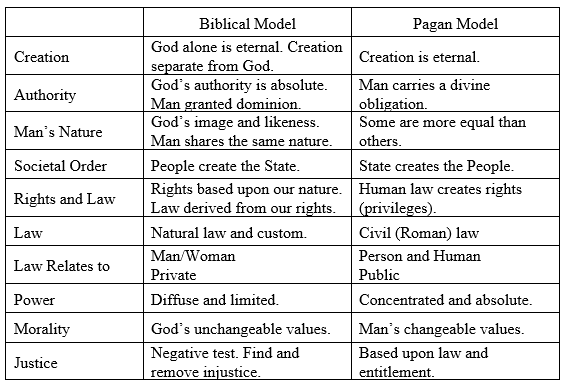
At the end of this post is a table listing some of the differences between the constitutional republic of America’s founding, and the administrative democracy it became. When someone says an action is a threat to our democracy, they mean just that. They wish to preserve the democracy they’ve created. We moved from a system where government created public law for private purposes to one where it created private law for public policy. The change was slow over a long period of time.
The best slaves are the one’s who think they are free. Thankfully, things began to change in 2017. While we have much work yet to do in America, I believe things have recently been heading in the right direction. That all begins with recognizing and understanding the problem.
Footnotes:
[1] Webster, Noah, American Dictionary of the English Language, Foundation for American Christian Education, 1820, 2021 printing.
[2] Evans, M. Stanton, p. 23, The Theme is Freedom, Regnery Publishing, Inc. 1994.
[3] Schaeffer, Francis, A., p. 26, Escape from Reason, InterVarsity Press, 1968.