

Parts of this and the next article come from a series about Christian Nationalism. The more I write, the more I realize there are only two sides in this war. Even though one side tries to make it seem like more choices exist. We must each make a choice, and realize not making a choice is still a choice. However, one must understand the choices they face, before they choose. I do my best to provide that in this series. My purpose is to educate. (Eph. 4:13-5)
Biblical Governance
I’ve written about this model many times before. This time, I’m going to start with its source and an implication. Then move on to the second model. This first model originates from two places within the Old Testament, and its use confirmed in the New. The first passage is Genesis 1:26-8 and the second Deuteronomy 1:13-7. In Genesis 1, God created everything ever created; He is therefore sovereign over all creation. It belongs to Him.
Other ideas from the Gensis passage include God’s;
- Making man in His own image and likeness.
- Granting man dominion over the things of the earth, but not the earth (land) itself. Dominion is the lawful granting of authority by a sovereign to someone else.
- Placing trust in man by granting him dominion over the things of the earth. This granting of trust created the first trust, and is the beginning of all law. More on this when discussing rights and law.
From the Deuteronomy passage;
- Leadership is through service to others. The judge’s were to exercise righteous judgement without prejudice. Within the New Testament, see Mark 10:42-5.
- Leaders were to come from the people, be elected by the people, in order to support the common good. New Testament examples include; Acts 1:23-6 and Acts 6:1-6.
Israel rejected God’s governance in under this model.
- And the Lord said to Samuel, “Listen to the voice of the people regarding all that they say to you, because they have not rejected you, but they have rejected Me from being King over them.” (1 Sam. 8:7, NASB)
Governance and Religion
God appointed Moses Israel’s first judge. The rest were to come from the above process. God also appointed Aaron and his tribe to serve as priests. (Exodus 28) The Levite’s service ended with the second temple’s destruction. People today voluntarily choose serving God, as the disciples did in the Gospels. They learned and then taught God’s commands; the knowing and doing depicted in Matt. 7:24-5. Judges have continued to judge law violations. These institutions, the powers of governance and religion, were separate—but related. Religion teaching the people God’s law; governance enacting justice when individuals violate the law. Both serving God as these authorities, or powers, were created by Him.
- “Let everie soule be subject unto the higher powers: for there is no power but of God: & the powers that be are ordeined of God.” (Rom. 13:1, 1560 Geneva Bible)
The Model Itself
So what does the model look like? See the diagram below.
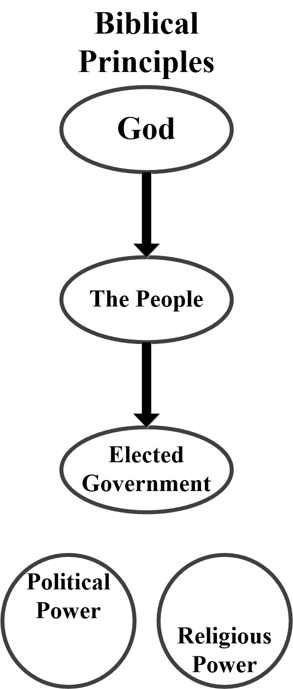
Within this model, God created the people. God gave the people His image and likeness, and dominion over the things of the earth. The people are sovereign through God’s granted authority. They elect their leaders, who are to serve the common good. Within this model, religious and political power are separate, and both serve society in different ways as noted above. While those with political power (the judges) were separate from those with religious power, they were all still subject to God’s law.
One law applied to all, as all belonged to one class—man. The individual is the basis for rights and law within this single class. Further, man as part of creation, belongs to God. However, man alone possesses the free will to accept or reject that belonging. America adopted this governance model. I’ll pick up the principles inherent in this model, with their sources, next time. Now, on to the second model.
Man’s Governance
This model begins with man. It is pagan, and I’ve referred to it in the past as the State Religion model. It is the general governance model used by most kingdoms we’ve studied in history; Babylonia, Persia, Assyria, Egypt, Greece, Rome, Maya, Aztec, etc. Each city had its own god(s). They had a religious and/or secular ruler, and they ruled the people. Religious and political power within these societies were not the same, but they were very closely related. Rule here concerns the exercise of power, not service.
Political power provided the means for creating policy and statutes. It also had the ability to enforce them via military and legal systems. However, a moral people is easier to govern. Religion provides the moral underpinning enabling the state to create policies and statutes in its own best interest. Within these societies, it was the ruler, and those to whom the ruler granted dominion, who were sovereign. The people existed to see this societal structure was successfully preserved and carried into the future. These societies all had class structures. Rather than all being equal; some were more equal than others. This is the society structure written about by the Greek philosophers, such as Plato and Aristotle.
The two models could not be more different. The second model’s diagram is below.
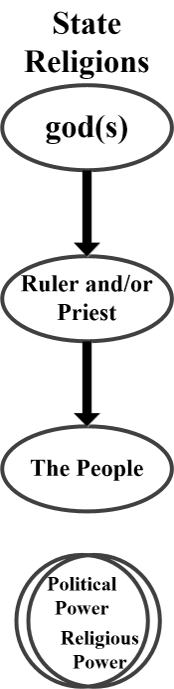
I’ll also look at the principles inherent in this model next time. There are two variations today of this last model. One represents Islam, and the other our modern democracies created through ideas adopted from the French Revolution. Even the Greek philosophers recognized a democracy was the corruption of a republican form of governance. I’ll just cover the Islamic governance variation here.
Islam’s Governance
From Islam’s tenets, we can derive the following regarding its governance form.
- Allah is creation’s creator, but unknowable by man— What man can know is Allah’s revelations. While these come from Allah, they are separate and distinct from him.
- Man’s natural state is that of a slave. Man is the slave of his Creator, and his sole purpose is worshipping his Creator. Obedience is a cornerstone of Islam.
- Divine (revealed) and human law are one and the same. Obedience to the law is governance’s primary objective, one enabled through Shri’a. As revealed and human law are one, there is no separation between the church and state as we understand it.
- The Umma (brotherhood) is the lowest level that matters. Obligations exists only for those who belong to the Umma. One within this brotherhood may extend courtesies to others as a form of piety, but that is optional.
- Revealed law within the Qur’an and hadith defines one’s rights and obligations, as interpreted by the clergy and administered by the state. These are group rights and at a very high level include the following distinctions:
- Muslim men possess more rights than Muslim women, but both possess relatively more rights than any other group and both belong to the Umma.
- The rights of the Peoples of the Book (Jews, Christians, and Zoroastrians) are fewer and less in scope (see examples below) than those of Muslims.
- Non-believers have very few rights, if any.
- There are limitations within society based upon your belief. Jews and Christians cannot hold political office, own certain types of businesses, or enter certain professions within Islamic societies.
- There are limitations within society based upon ones gender. Women generally cannot drive, vote, receive an education, or be in public without a male escort who is a family member.
- Once a Muslim purchases property, it becomes part of dar al-Islam and can only be sold to another Muslim.
- Muslim charities can only extend benefits to Muslims.
- The common good becomes what is good for Islam, as expounded by the example set by Muhammad. Expediency in spreading Islam trumps morality. In other words, the ends justify the means.
These societies have the following governance structure.

Take Aways
We can see Islamic society is another form of collectivism as defined within these discussions. Its most significant difference from the State Religion model is that human law and divine law are one and the same – and only one’s Creator can change divine law.
Collectivist and individualistic societies are mutually exclusive. Only one form or the other can exist within a society, therefore any Islamic form of governance is contradictory to our founding principles and structure. Shri’ a attempts not so much to diminish non-Muslims rights (at least initially), but rather to elevate Muslims rights above all others within a society. There is no self-governance within Islam; everything down to the smallest details of life have already been dictated for you. You are only called to obedience. This structure too is both contradictory and incompatible with America’s founding principles.