
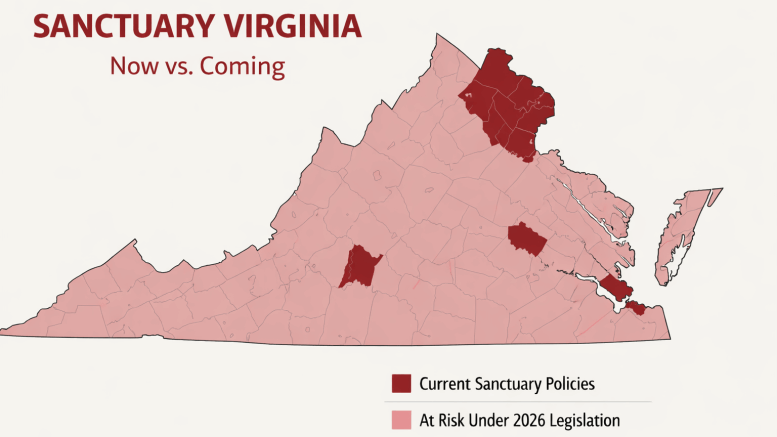
A Coordinated National Campaign Is Targeting the Commonwealth
Part 2 of a 3-part investigative series: Virginia’s sanctuary transformation — happening while you weren’t watching
This is not grassroots advocacy. Virginia’s sanctuary playbook follows a documented national pattern—one developed by policy organizations, funded by major foundations, and already deployed in California, Oregon, Illinois, and Colorado. Our investigation reveals the coordinated campaign now targeting the Commonwealth.
In Part 1, we examined what sanctuary jurisdictions are and the architecture already built across Virginia. Now we expose how this happened—and who made it happen.
The Sanctuary Playbook Virginia Is Following
Over the last decade, national advocacy groups have developed a repeatable pattern for sanctuary policy. Their strategy starts by limiting local participation in enforcement. Next comes building out local “trust” policies. Finally, they lock restrictions into state law. Their own materials describe how this approach has spread from early states like California and Oregon to newer targets.
The Immigrant Legal Resource Center states openly that it “continues to craft, support, and advocate for sanctuary policies nationwide.” They showcase how states have enacted laws that “disentangle local law enforcement from ICE.” This isn’t hidden. They publish it on their website. (MAP and National Map of Local Entanglement ICE)
Virginia’s path tracks this pattern with striking precision.
Virginia’s Sanctuary Playbook Step-by-Step Progression
Step 1: Restrict Status Inquiries (Complete)
The first move prohibits officials from asking about immigration status. Virginia completed this step in 2020 with HB 262 and HB 1150. These laws passed during the first session of unified Democratic control in Richmond.
Step 2: Local “Trust Policies” (Complete)
Progressive localities then adopt formal policies refusing cooperation with federal enforcement. Arlington County, Fairfax County, and Alexandria have all implemented such policies. These create islands of non-cooperation that normalize resistance to federal law.
Step 3: Sheriff and Jail Non-Cooperation (Complete)
Next comes systematic refusal to honor ICE detainers. According to the Legal Aid Justice Center’s FOIA investigation, at least nine Virginia jails now refuse to cooperate with ICE. Another fifteen offer only limited cooperation. Convicted criminals in these jurisdictions get released back into communities rather than transferred to federal custody.
Step 4: Governor Rescinds Cooperation (Complete)
On February 4, 2026, Governor Spanberger signed Executive Directive 1. This directive ordered all participating Virginia state law‑enforcement agencies to terminate their 287(g) agreements with ICE, effectively ending state‑level participation in the program, even though federal law still commissions ICE to enforce immigration in every state. Under Governor Youngkin’s Executive Order 47, these partnerships had resulted in over 6,200 detentions; Spanberger shut them down with a stroke of her pen.
Step 5: Statewide Legislative Ban (Pending)
Executive action can be reversed. The permanent solution is legislation. SB 783 and HB 1441 would codify the end of 287(g) agreements statewide. These bills are currently pending in the 2026 General Assembly.
Step 6: Courthouse Restrictions (Pending)
HB 650 would prohibit civil immigration arrests in or around Virginia courthouses. This follows models pioneered in California and New York. The provisions include judicial warrant requirements and defined courthouse zones—the same framework used elsewhere.
Step 7: Data-Sharing Restrictions (Emerging)
Provisions in SB 783 move Virginia toward limiting when state databases can be accessed for immigration enforcement. This represents the final stage of the sanctuary playbook that Virginia advocates are executing.
This sequence isn’t a coincidence. It’s a campaign — and in Virginia, a small set of organizations is executing it.
The Organizations Executing the Campaign
In Virginia, the day-to-day work of turning this pattern into law falls to a small set of organizations. Their own statements show that they are lobbying, litigating, and pressuring the state to cut every visible tie with ICE.
CASA (We Are CASA)
CASA operates across Maryland, Virginia, and Pennsylvania. Their Virginia offices are in Woodbridge and Falls Church. On January 22, 2026, CASA organized a “TRUST Agenda” lobbying day in Richmond. They brought partner organizations, including Indivisible NoVA and NAKASEC to the General Assembly.
When HB 1441 advanced, CASA celebrated publicly: “Virginia Bills Limiting Local Role in Federal Immigration Enforcement Headed to House Floor.” Their goal is explicit—end all cooperation between Virginia law enforcement and federal immigration authorities.
Legal Aid Justice Center (LAJC)
The Legal Aid Justice Center provides much of the factual infrastructure for Virginia’s sanctuary push. Their Director of Litigation, Alex Kornya, conducted the FOIA investigation, uncovering 32 active 287(g) agreements across Virginia. Every allied organization now cites this finding.
LAJC has stated openly: “Legal Aid Justice Center is supporting legislation calling for the end of all 287(g) agreements in Virginia.” Kornya characterized 287(g) as merely “the most visible” form of cooperation—suggesting their advocacy extends further.
Virginia Coalition for Immigrant Rights (VACIR)
VACIR functions as a coalition hub, amplifying messaging from CASA, LAJC, and ACLU-VA. Executive Director Monica Sarmiento issued a press release on February 4, 2026. That was the same day Spanberger signed Executive Directive 1. She called it “a powerful step toward restoring basic constitutional protections.”
Press releases don’t write themselves in hours. The timing reveals advance coordination.
ACLU of Virginia
The Virginia state chapter of the national ACLU provides legal expertise and national connections. Their statement on Spanberger’s executive order was revealing: “Gov. Spanberger’s executive order is the first step to make sure Virginia law enforcement is not a tool for ICE.”
First step. Not the destination—the beginning. They’re telling you more is coming.
The Coordination Is Visible
Their coordination is not speculation. It’s visible in their own calendars and press releases.
CASA’s “TRUST Agenda” lobbying day brought partner groups to Richmond together on January 22. Within days of Spanberger’s directive, VACIR, CASA, and ACLU-VA all issued statements citing the same LAJC 287(g) investigation. They urged passage of the same bills. They used similar language.
That’s how professional advocacy campaigns operate. There is nothing illegal about it. Organizations coordinate across the political spectrum. But Virginians deserve to know this isn’t spontaneous local activism. It’s an aligned strategy executed by connected groups.
Part of a National Network
Virginia’s groups aren’t operating in isolation. They are part of a national ecosystem.
The Immigrant Legal Resource Center develops model policies for states and localities. The National Immigration Law Center provides legal frameworks and advocacy toolkits. The national ACLU coordinates litigation strategies across state chapters. ACLU-VA is part of that structure.
Virginia’s bills don’t exist in a vacuum.
HB 650’s courthouse arrest limits echo earlier bills and settlements in California and New York. The provisions match warrant requirements, defined courthouse zones, and contempt penalties. Similarly, SB 783 and HB 1441 adopt the same toolkit promoted by national sanctuary advocates: judicial warrant standards, bans on using local resources for civil enforcement, and detailed reporting requirements.
The framework is national. The implementation is local. That’s the model. But does it serve Virginians?
What the Opposition Says
Proponents of sanctuary policies argue they make communities safer. If people fear deportation, they won’t report crimes or serve as witnesses. Sanctuary policies, supporters claim, build trust between immigrant communities and law enforcement.
This concern deserves serious consideration. Community policing does depend on cooperation. Fear can inhibit reporting.
However, this argument fails to address key realities.
- First, 287(g) agreements primarily affect individuals already arrested and convicted of crimes, not crime victims or witnesses. The population being shielded isn’t the vulnerable immigrant family. It’s the convicted criminal.
- Second, the “trust” framing sets up a false choice. Cooperation can be calibrated: law enforcement could honor detainers for violent offenders while using discretion in minor cases—a middle ground that sanctuary advocates refuse to entertain.
- Third, each time a convicted criminal is released rather than transferred to federal custody, there’s a potential victim. Aggregate statistics don’t capture the specific preventable crimes that result from non-cooperation.
A Biblical Perspective
Scripture speaks directly to the government’s proper function. Romans 13:3-4 teaches: “For rulers are not a terror to good conduct, but to bad. Would you have no fear of the one who is in authority? Then do what is good, and you will receive his approval, for he is God’s servant for your good. But if you do wrong, be afraid, for he does not bear the sword in vain. For he is the servant of God, an avenger who carries out God’s wrath on the wrongdoer.”
God established government to restrain evil and protect the innocent. When sanctuary policies shield convicted criminals from lawful enforcement, they invert this purpose. They protect wrongdoers while leaving potential victims exposed.
The prophet Isaiah warned against such inversion: “Woe to those who call evil good and good evil, who put darkness for light and light for darkness” (Isaiah 5:20). Policies that frame cooperation with lawful authority as the problem—and protection of convicted criminals as compassion—embody this moral confusion.
The Picture Comes Into Focus
Taken together, the sanctuary playbook Virginia is experiencing looks far less like isolated local decisions. It looks far more like a coordinated campaign.
The pattern mirrors earlier sanctuary states. A small set of well-connected advocacy groups drives the effort. They draw on national policy frameworks. Major foundations fund those frameworks. The documents are public. The question is whether Virginians see this as their agenda—or someone else’s.
Part 3 of this series will follow the money. We’ll trace the funding flows from national foundations through policy organizations to Virginia’s advocacy groups. Understanding the financial infrastructure reveals how a coordinated national movement transforms state policy in just a few years.
Action Steps
Contact your state legislators about SB 783, HB 650, and HB 1441. Find your representatives at whosmy.virginiageneralassembly.gov.
Verify the claims in this article. Visit the source links. Read the organizations’ own statements. The documentation is public—we’ve simply gathered it in one place.
Share this information with your church, neighbors, and community groups. Virginia’s sanctuary playbook is experiencing success partly because most citizens don’t know it’s happening.
Pray for Virginia’s leaders. Ask that they would govern according to the biblical purpose of government—rewarding good and restraining evil.
A Word of Hope
The battle is real, but so is our God. Daniel reminded us that the Most High “removes kings and sets up kings” (Daniel 2:21). He is sovereign over Virginia, over America, over all nations.
Our calling is not to despair but to faithful witness. We speak truth. We engage the process. We trust the One who holds all things in His hands. Whatever happens in Richmond, Christ remains King. And one day, He will return to make all things right.
Read the Series
Part 1: Sanctuary Virginia: How Our Leaders Are Undermining Law, Borders, and Justice
Part 2: Virginia’s Sanctuary Playbook: By Design?
Part 3: Virginia Sanctuary Funding: Following the Money Trail
Sources
CASA: Virginia Bills Limiting Local Role in Federal Immigration Enforcement
VPM: Virginia Immigration Legislation and 287(g)
ACLU-VA Statement on Spanberger’s Executive Order
Immigrant Legal Resource Center: Sanctuary Policies Overview

It is bad when whacko leftist judges do not run fair trials of criminals. Why is Stabbed her trying to eliminate MINIMUM Sentencing guidelines. Giving Felons the automatic right to vote again. I think before VA Law requires convicts to write a paragraph that they are reformed citizens. Spanberger is attacking the standards of the VA University system. Pandering to minorities with (downgrading) DEI system.