
For years the Episcopal Church called it pastoral care, listening, a wider welcome — the wool still on. Then it amended its marriage canon, and the redline shows, in the church’s own hand, the exact words struck out: “a man and a woman,” gone. The covering drops. The wolf was there all along.
The Church and the Christian Church • Part Two • By the Virginia Christian Alliance Editorial Board
The Big Three
- The Episcopal Church’s 2015 marriage-canon change survives as a redline — the old law and the new law on one page, with the deletions still visible.
- The floor record shows bishops bringing amendments, one at a time, that would trade “husband and wife” for “two people” and other gender-neutral terms — proposals weighed and decided long before the final vote.
- This is how a church falls: not at the microphone, but in the editing. Watch the committee, not just the count.
Here is what a church looks like at the moment it changes its mind. Not a sermon. Not a press release. A page.
It is a single document from the 2015 General Convention, and on it two versions of the same law sit on top of each other. There is the old marriage canon of the Episcopal Church — the words that body had held, in one form or another, for four centuries. And running straight through those words is a thin line. Beside them stand the new words that would take their place. You do not have to be told what happened. You can see it. The deletions are right there on the page.
Look at the Page
“A physical and spiritual union of a man and a woman” — a line drawn through it. “We hold marriage to be a lifelong union of husband and wife as it is set forth in the Book of Common Prayer” — a line drawn through it. The title itself, “Of the Solemnization of Holy Matrimony” — struck, and “Of the Celebration and Blessing of Marriage” written in over the wound. You are looking at the exact instant the man and the woman were removed from the definition of marriage.
The 2015 redline, in the church’s own hand:
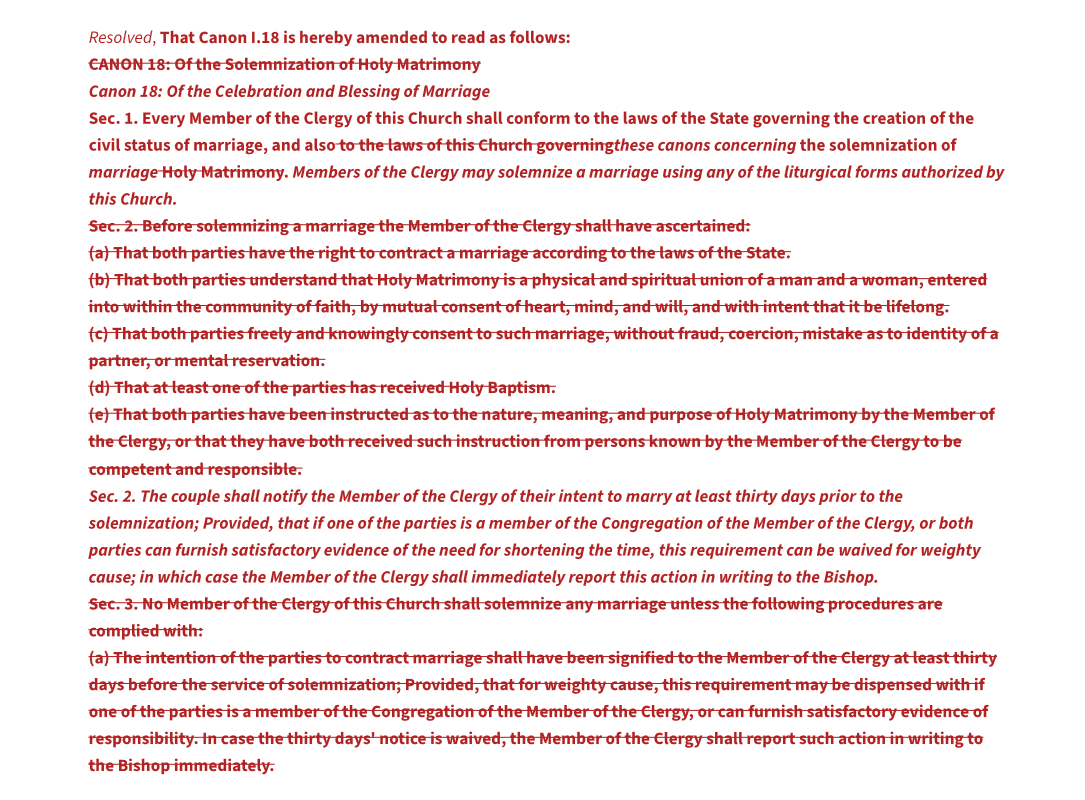
Click the image above to read the original in full.
The Skin Comes Off
In Part One, we read the receipts at a distance — a list of dated votes, each one a step down. This is one of those votes brought up close, opened, and laid flat so you can see how it was actually done. And what it shows is the thing the whole series has promised: the disguise coming off.
For years, the direction of this change was denied, or softened, or given gentler names. It was pastoral care. It was listening. It was a wider welcome. It was a conversation the church was still having. The wolf, you might say, was still wearing the wool. But a redline does not do euphemism. A redline is the wool pulled back. On this page there is no “conversation” and no “welcome” — there is a verb, and the verb is struck. The words that confined marriage to a man and a woman were located, marked, and removed. That is not drift. That is editing. Somebody sat with the text of the law and deliberately took the man and the woman out of it.
Scripture has a name for the moment the disguise fails. “Beware of false prophets, who come to you in sheep’s clothing but inwardly are ravenous wolves. You will recognize them by their fruits” (Matthew 7:15–16, ESV). The fruit is the page. Here is how you recognize what something is: you watch what it removes.
What Was Struck, and What Replaced It
Read slowly, because the precision is the point. Three things were taken out of the marriage canon, and each one mattered.
- The man and the woman. The canon had said marriage is “a physical and spiritual union of a man and a woman.” Those five words — a man and a woman — were struck. Not debated in the text, not footnoted. Removed.
- Husband and wife. The couple’s own declaration had read, “we hold marriage to be a lifelong union of husband and wife.” Struck, and rewritten so that no gendered word remains: the new pledge speaks only of “our marriage” and the comfort “we will give to each other.”
- The tie to the Prayer Book. The old declaration anchored marriage to its definition “as it is set forth in the Book of Common Prayer.” That anchor was cut, loosing the word from the very text that had defined it.
And one thing was added: a new section permitting a member of the clergy to “pronounce a blessing upon a civil marriage.” The canon did not merely fall silent about who may marry. It was rebuilt to bless what the State now allowed. The church’s own summary of the change says it plainly — the amendment was written “to permit the union of any couple so long as the marriage shall conform to civil and canon law.” Any couple. In their words, not ours.
And still the plumb line hangs straight.
Watch the Floor, Not the Vote
Here is the part most people never see, and it is the part that matters most. The redline is the result. But the document also preserves the making of it — the floor of the House of Bishops, motion by motion, where the words were actually chosen. Open the legislative history and you can watch it happen.
One bishop moved to replace the couple’s declaration with a vow to “a lifelong union of two people.” Another moved to strike the words “Holy Matrimony” and put plain “marriage” in their place. Amendment was stacked on amendment, each one taking a weightier, older, more sacred word and filing it down to something neutral. Some passed; some failed; that is not the point. The point is that a room full of bishops spent its hours choosing which words to remove — and the minutes wrote down every motion.
By the time the roll was finally called, the bishops passed it 129 to 26, and the deputies concurred. But the vote decided nothing that had not already been decided in those amendments. The headline was the count. The substance was the editing that came before it — and that editing is a matter of public record, sitting in an archive anyone can open tonight.
The Bereans Were Watching
This is the discipline the Christian in the pew most needs to recover. “Now the Bereans were more noble than those in Thessalonica; they received the word with all eagerness, examining the Scriptures daily to see if these things were so” (Acts 17:11, ESV). The Bereans did not wait for the final vote and then react. They examined — checked the claim against the Word while it was still being made. A church does not fall in a day; it falls in a hundred small motions that no one was watching. The remedy is not anxiety, nor is it turning every parish meeting into a war. It is wakefulness with a sense of proportion — knowing which votes are the grave ones, and being awake in the room when they come.
And still the plumb line hangs straight.
The Wall Fell Before the Vote
So set down the lesson of this page. The Episcopal Church did not lose marriage on the day it counted the ballots in 2015. It lost it earlier — in the task forces, the committees, the amendments, the slow trade of one word for another, while the great majority of its members assumed the wall was holding because no alarm had sounded. The vote was the funeral. The death came in the editing.
That is why this series keeps insisting the headline is never the whole story. A church that drifts does its real work quietly, in rooms most people never enter, on documents most people never read. The mercy of this particular case is that they wrote it all down — and the redline they left behind is, without meaning to be, the clearest sermon against itself.
The Word They Could Not Strike
But hear the hope in it too, because it is real. The words they struck from their canon were never theirs to strike. “Have you not read that he who created them from the beginning made them male and female, and said, ‘Therefore a man shall leave his father and his mother and hold fast to his wife, and the two shall become one flesh’?” (Matthew 19:4–5, ESV). A church can draw a line through that sentence in its own book. It cannot draw a line through the One who spoke it. The definition the Episcopal Church removed from its page still stands, unstruck, in the mouth of Christ — and a thing that still stands is a thing a church can still return to.
No page of red ink ever saved a soul, and no argument ever raised the dead. Only the Spirit who breathed out the Word can do that. The Board’s task is the smaller one: to hold the page up to the light, to read what was struck without flinching, and to leave the door of repentance standing open for everyone who helped strike it. In the next article, we stop tracing what they did and ask the older question — what does Scripture itself say, and does their case survive it?
Unless otherwise noted, Scripture quotations are from the English Standard Version (ESV). The text of Resolution 2015-A036, its redline, and its legislative history are drawn from the Acts of Convention and the Journal of the General Convention of the Episcopal Church (Salt Lake City, 2015), pp. 781–783, archived at the Archives of the Episcopal Church.
For Further Study
- The Receipts Condemn the Episcopal Church — Part One: the full dated record, wall by wall.
- The Church and the Christian Church — the series introduction and the plumb line.
- The Pulpit Is Responsible — what happens when the watchman posted to guard the walls falls silent.