They did not stumble into this, and they have never hidden it. The Episcopal Church voted for every step, recorded each one in its own hand, and published the file for anyone to read. That record is now the evidence against it — and in the courts of heaven, the verdict is already entered. There is only one door left out of a sentence like this, and its name is repentance.
The Church and the Christian Church • Part One • By the Virginia Christian Alliance Editorial Board
The Big Three
- The Episcopal Church did not drift quietly; it voted, recorded, and published each step — the descent is a dated, numbered public record anyone can pull tonight.
- Read against God’s three walls — marriage, our nature as male and female, and the sanctity of life — that record shows a steady lean away from true, in the church’s own words.
- We bring no accusation the church has not already signed. We only hold up the line and read the wall.
A church that abandons the faith usually leaves no paper trail. It does not announce a departure. It simply stops believing what it once preached, one quiet heart at a time, until a generation looks up and finds the building full of strangers. There is rarely a document to point to. There is only an absence where conviction used to be.
The Episcopal Church is the rare exception. The story of Episcopal Church same-sex marriage — and much else besides — did not unfold quietly. It unfolded on the record — in convention, by resolution, with numbers and votes and tallies, every motion archived and page-numbered and posted online for anyone to read. Where most churches drift in silence, this one kept the minutes. It wrote down each step of its own descent and filed the paperwork.
That spares us the hardest part of an indictment. We do not have to characterize this church, or guess at its heart, or assemble a case from rumor. The case is already written, and the church wrote it. Our task is only to read it back — slowly, in order, against the line.
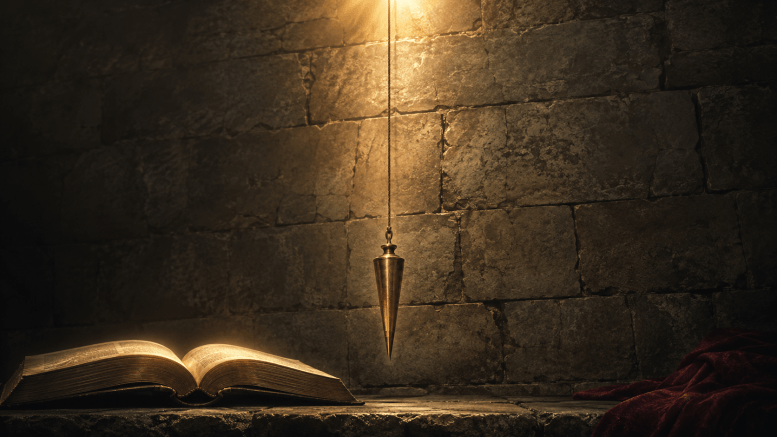
So we begin where the last article promised: with the plumb line. God hangs it — we do not. Ours is the smaller task of holding it up where it can be seen and reading the wall against it. And the walls we measure are not theirs but God’s. He built three of them plumb and named them in the opening pages of Scripture, and against each one the record speaks for itself.
The Cornerstone: 1976
None of what follows began in this century. The first stone was laid in 1976, and everything after was built on top of it.
That year, the 65th General Convention resolved that homosexual persons are “children of God who have a full and equal claim with all other persons upon the love, acceptance, and pastoral concern and care of the Church” (Resolution A069). Read in isolation, the sentence sounds like ordinary Christian charity — every sinner has a full claim on the love and care of the Church, and so do we all. But it was not left in isolation. It became the cornerstone, the verse cited at the foundation of every change that came after, the thing each later resolution was built to honor. The church will gather in Minneapolis in September 2026 to celebrate that 1976 vote by name — “Full & Equal: 50 Years in the Making.” They are not hiding the cornerstone. They are throwing it a fiftieth birthday.
And still the plumb line hangs straight.
The First Wall: Marriage
God built the first wall before He built a nation, a temple, or a single law. He built it in a garden. “Therefore a man shall leave his father and his mother and hold fast to his wife, and they shall become one flesh” (Genesis 2:24, ESV). One man, one woman, one flesh — the oldest institution on earth, and Christ Himself returned to this exact verse when He was asked about marriage, citing it as settled from the beginning (Matthew 19:4–6). That is the wall. Here is the record beside it.
2009. The 76th General Convention directed its Standing Commission on Liturgy and Music to “collect and develop theological and liturgical resources” for the blessing of same-gender relationships (Resolution C056, Journal p. 780). The minutes show the first draft asked for more — immediate authorization for any diocese to begin blessing such unions at once — and the convention sanded that down to a study commission to get it passed. Even softened, the wall had started to lean.
2012. The 77th General Convention authorized a rite — “The Witnessing and Blessing of a Lifelong Covenant” — for provisional use beginning the First Sunday of Advent, under the bishop’s permission (Resolution A049, Journal pp. 565–567). The study had become a service.
2015. The 78th General Convention amended Canon I.18, the marriage canon itself. The convention reached into it and struck the heart out, one phrase at a time:
- “a man and a woman” — struck.
- “husband and wife” — struck.
- the clause binding marriage to its definition “as it is set forth in the Book of Common Prayer” — struck.
In their place stood a genderless canon (Resolution A036, Journal pp. 781–783). A companion measure authorized marriage rites offering the options “husband,” “wife,” “person,” or “spouse” (Resolution A054). How that erasure was actually done — line by line, in the church’s own redline — is the subject of the next article. For now it is enough to note the date the man and the woman were removed from the wall: the First Sunday of Advent, 2015.
And still the plumb line hangs straight.
The Second Wall: Male and Female
The second wall is older than marriage, because it is the thing marriage is built from. “So God created man in his own image, in the image of God he created him; male and female he created him” (Genesis 1:27, ESV). Male and female is not a cultural arrangement the church is free to update. It is the image of God, stamped on us at creation. To blur it is not to expand a category. It is to deface the stamp.
2003. The Diocese of New Hampshire elected, and the General Convention confirmed, a bishop living openly in a same-sex relationship — consecrated that November, the first in the church’s history. The office that exists to guard the teaching became the place the teaching was set aside.
2012. The 77th General Convention amended Canon III.1.2, which governs access to ordination. To the list of categories that may not bar a person from the discernment process — race, color, national origin, sex, marital status — it added “gender identity and expression” (Resolution D002, Journal p. 512). The canon that protects who may stand in the pulpit was rewritten to protect the very confusion the second wall was built to prevent.
And this is not a distant story for Virginians. It has a local address. Here in Richmond, a historic parish of the Diocese of Virginia is led by a member of the clergy who is married to a person of the same sex — a fact the parish publishes plainly on its own website, with no embarrassment, because under the canons above it is no longer an irregularity. It is the system working as designed. We name no individual and impugn no soul; we note only what the institution has made ordinary. The national record is not happening somewhere else. It is happening on Grove Avenue.
And still the plumb line hangs straight.
The Third Wall: The Sanctity of Life
The third wall guards the image-bearer himself, from the womb to the last breath. “For you formed my inward parts; you knitted me together in my mother’s womb” (Psalm 139:13, ESV). The life God knits, no one is free to unmake or remake. The body He gives is not raw material awaiting our improvement. It is His workmanship, and it is good.
2022. The 80th General Convention resolved that the Episcopal Church should advocate for access to gender-affirming care “in all forms (social, medical, or any other) and at all ages,” and affirmed that members should be able to obtain it “with no restriction on movement, autonomy, or timing” (Resolution D066, Journal p. 883). The resolution frames this as part of the Baptismal call to “respect the dignity of every human being.” Read the three words that matter most slowly: at all ages. A church that once knit its theology to the God who knits children in the womb had resolved, in writing, to advocate for altering that same body — at any age, without restriction. The wall around the child did not crack. It was voted through.
And still the plumb line hangs straight.
Beyond the Walls
A structure built against God’s order does not stay inside the sanctuary. By 2024 the 81st General Convention had turned outward, directing advocacy for access to LGBTQIA+ materials in public schools and libraries (Resolution D039). What was once a private theology of a single denomination is now a program for the public square — the same lean, pressed outward onto the wider culture and the next generation.
And so the receipts run from 1976 to the present in an unbroken line: a cornerstone, three walls breached, and a campaign carried out the front door into the street. Not one item on this list is our characterization. Every date, every quotation, every page number belongs to the church’s own archive. We did not build the case. We only read it aloud.
The Line Still Hangs
Set the whole record beside the plumb line of Amos — the weight on the cord that God said He would set “in the midst of my people” (Amos 7:8) — and notice what the line has done through every vote in this article. Nothing. It has not moved. It did not bend in 1976 or 2003 or 2015 or 2022. It cannot be amended by resolution, voted down in committee, or struck from a canon. The church passed motion after motion; the line simply hung there, straight and silent, measuring. That stillness is both the judgment and the mercy. The judgment, because the wall is shown bent against a standard that will not flatter it. The mercy, because a line that never moves is a line a church can always be rebuilt against.
And churches have been. When the Episcopal Church crossed these lines, thousands did not drift with it; they left to form the Anglican Church in North America, holding the old confession at the cost of their buildings and their pensions. The drift was never a fate. It was always a choice — which means another choice is always open.
We hold no illusion that a page of dates will turn a single heart. It cannot. No argument on a page has ever raised the dead, and no list of receipts ever saved a soul — but the God who knit the image-bearer in the womb can yet make the crooked wall straight. Our task is the smaller one: to hold up the plumb line where every eye can see it, to read the record without flinching or gloating, and to leave the door of repentance standing open for every reader, every pulpit, and every church still able to walk back through it. The line is hung — by God, not by us. In the next article, we watch the wall come down — one struck word at a time.
For Further Study
- The Church and the Christian Church — the series introduction, where the plumb line is laid down before any wall is measured.
- The Pulpit Is Responsible — what happens when the watchman posted to guard these walls falls silent.
- Wolves Among Us — false teaching weighed, name by name, against the Word of God.
Unless otherwise noted, Scripture quotations are from the English Standard Version (ESV). Resolution texts and page numbers are drawn from the Acts of Convention and the Journals of the General Convention of the Episcopal Church, published by the General Convention and archived at the Archives of the Episcopal Church.