Why the Bible Is the Most Political Book on the Planet
The Bible is the most political book on the planet.
That sentence makes good people flinch. The flinch is not foolish, and it is not really about the Bible. It is about a single word — one that was taken, narrowed, and turned against the people who most need it. The word is politics. It was stolen. It can be recovered.
“We Don’t Do Politics in Church”
Nearly every pastor has said it. Nearly every faithful one has meant it well. The church does not gather on Sunday to rerun Tuesday’s argument. Every pastor has seen what party loyalty can do to a congregation — the cold pew, the friendship that cooled after an election, the family that left over a yard sign. A shepherd who guards his flock from that is not a coward. He is doing his job.
The instinct is sound. The fear is not foolish. This is not a call to turn the pulpit into a campaign booth. It is a call to test one assumption buried inside the fear — that the word politics still means what the instinct takes it to mean. It does not. The word changed under the church’s feet.
A Word With a History
The word has a history, and the history settles the matter. Politics comes from the Greek polis — the city, the community, the shared life of a people. From polis came politikos: “of the citizens, pertaining to the common life.” Through Latin and French it became our English word. Aristotle’s great work on the subject carried the plain Greek title Politiká — “the affairs of the city.”
The root meaning is not “parties.” It is not “campaigns.” It is this: how a people orders its common life — what neighbors owe one another, what they will honor, what they will forbid. By “politics” we do not mean party platforms or campaign ads. We mean what Aristotle and the Bible both mean: how a people orders its life under what is right. Hold that definition. Everything turns on it.
The Most Political Book on the Planet
Read the opening sentence again, the real definition in hand. How does a people order its common life under what is right? That is not a footnote in Scripture. That is Scripture.
The Bible is saturated with it — kings crowned and kings condemned, courts and judges, boundary stones and inheritance laws, the wage owed the laborer and the gleanings left for the poor, the cause of the widow, the orphan, and the stranger. It opens with a marriage in a garden (Genesis 2:24) and closes with a city coming down out of heaven. Between those pages it tells what marriage is, when a life begins (Psalm 139:13), what a just weight and a just court require, and what the Lord asks of a people: “to do justice, and to love kindness, and to walk humbly with your God” (Micah 6:8). By the true meaning of the word, the Bible is the most political book on the planet. No other book has said more about how a people should live together under God.
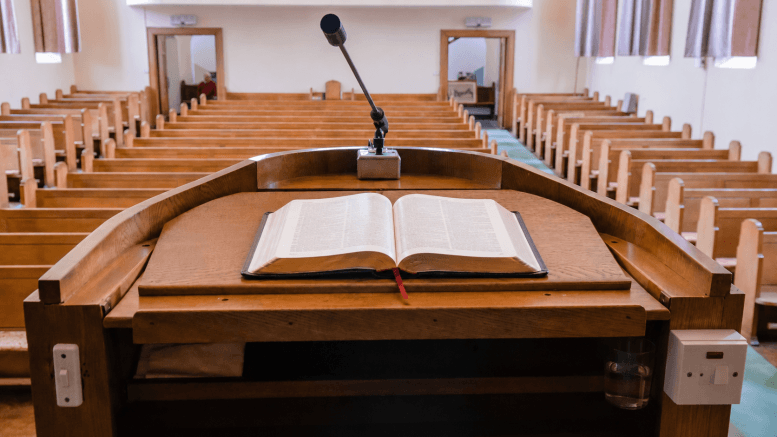
That is not a clever line. It is the plain truth, once the word is defined. The pulpit was built to speak it.
How the Word Was Stolen
Why does the sentence still feel dangerous? Because the word was robbed.
Somewhere along the way politics was narrowed. It shrank from “the ordering of a people’s common life” to “which team wins the next election.” The dictionaries record when the rot set in. The sense of “taking sides in party politics” arrives late, and the lexicographers mark it as a usually pejorative meaning. A wide and honorable word was crowded out by a small and quarrelsome one. The counterfeit took the name of the real thing. This is a loss, and the church has not mourned it.
The cost falls on the pulpit. When a pastor hears “political” and thinks only of parties and polls, the theft is already complete — the word has been taken from Scripture and handed to the pundits. He hears “don’t be political.” Because the counterfeit now holds the word, he obeys the warning about the counterfeit and falls silent about the real thing. He keeps the trumpet in the closet. Not because he fears God’s truth — because a stolen word convinced him God’s truth was a campaign slogan.
There are now two different things wearing one name. They must be told apart:
- Biblical politics asks: how should a people live together under God’s law and His justice?
- Partisan politics asks: how does my side win the next fight?
The first is the older, higher thing the word was made to carry. The second is the counterfeit that stole its name. The first belongs in every pulpit in Virginia. The second never did.
The Honest Objection
The other side deserves an honest hearing. There is a real one to give. A thoughtful believer answers this way:
Even your ‘biblical politics’ turns partisan the moment it touches a ballot. The gospel is for all people. The pulpit should lift up Christ, not legislation. History is full of churches that traded their witness for a political program and lost both. Better to preach the kingdom and let changed hearts change the city.
That is not a foolish objection. It is the hard-won caution of pastors who watched the church get used. It deserves more than a wave of the hand.
The answer is a distinction, not a denial. The Board does not ask the pulpit to descend into partisanship. It asks the pulpit to refuse the partisan theft of its own vocabulary. A pastor who teaches what marriage is, when life begins, and what justice God requires is not picking a party. He is doing what the most political book on earth does on nearly every page. The danger the objection names is real, and the guardrail against it is the distinction already drawn. Define the word first, and the line between defending God’s order and serving a campaign stays visible. Lose the distinction, and silence becomes the only safe move left. That silence is exactly what the theft was built to produce.
Taking the Word Back
There are two ways to answer a stolen word. Only one of them works.
The first is to surrender it — to stop saying “politics” and reach for safer ground: “we don’t do politics, we do God’s justice.” The appeal is obvious. The move is fatal. It hands over the very ground in dispute. It concedes that “politics” belongs to the partisans, and it leaves the pew believing the Bible has nothing to say about how a people lives together. That is the theft, ratified by its victim.
The second way takes the word back — not by emptying it, but by refilling it. The Board does not replace “politics” with “God’s justice.” It pours God’s justice back into “politics,” where it lived all along, until the word means again what it was built to mean. Then a pastor can stand, define his terms in one honest sentence, and say it plainly: the Bible is the most political book on the planet, and this pulpit was built to preach it. Define first; then deploy. Said in that order, the sentence cannot be misheard.
Which Politics Is on the Ballot
This is not an abstract word game. It reaches Virginia on November 3.
God’s politics is the order He built into the world. He set it before any nation existed to vote on it: that life is His from the womb, that marriage is the union He made, that He made us male and female. This November, Virginians will vote on amendments to the Bill of Rights that move against that order. One would strike the definition of marriage as the union of one man and one woman and install the marriage of two adult persons “regardless of sex, gender, or race.” Another would write a right to abortion into the Bill of Rights behind a legal standard so demanding that few meaningful limits could survive it — even late-term restrictions giving way to broad exceptions for health and viability. These are not new questions. The most political book on earth answered them long before any ballot was printed.
See what that does to the pastor’s dilemma. When he teaches the marriage wall and the life wall against what is on that ballot, he is not “getting political.” The amendments are not the pastor getting political. The amendments are the partisanship. His job is to defend the older, higher politics they are attacking. The assault came first. The answer is not a campaign. It is biblical politics doing what it was always meant to do.
The Board refers our readers to this companion piece A Warning to the Watchmen — on the trumpet that must now sound, and why this vote, unlike an ordinary law, is meant to be permanent. This essay has one job, and it comes first: to hand the word back, so that when the trumpet sounds, it is not mistaken for a campaign jingle. A watchman cannot warn the city in a language the city has been trained to ignore.
The Word Was Always His
The verdict is not despair. The most political book on earth has not changed; only the church’s nerve to read it has. The word politics was stolen, but the thing it names was never in doubt. God has always governed His people. He governs them still. He has never once lost a battle in the history of the world. To reclaim a word is a small thing beside that — and no small thing beside silence.
No argument of men has ever given a word back its meaning, and no essay has ever taught a silent church to speak. But the God who set His order into the world still governs His house — and the church He finds mute, He can teach to speak plainly again.
Where This Comes From
- The history of the word “politics”: Online Etymology Dictionary, entries for “politics” and “polis.”
- Aristotle, Politics (Politiká), Book I — on the polis and man as a “political animal” (politikon zōon).
- The November amendments and official voter explanations: Virginia Department of Elections, Ballotpedia, and the bill text at lis.virginia.gov. See the companion article, A Warning to the Watchmen, for both walls in full.
Scripture quotation is from the English Standard Version (ESV).