
Thirty-first in a series
The last several articles examined some inconsistencies within Islam. We followed that up with material about unsupported ideas expressed at interfaith meetings. This article applies historical criticism (or critique) to Islam. As this approach may be new to you, a little background is in order before beginning.
What is Historical Critique
Historical critique became a prominent form of investigation during the 19th and 20th centuries, and came out of the Reformation and European Enlightenment. Bible scholars and theologians were those primarily applying this method to Christianity. They studied documents, such as scripture texts, from a human historical orientation rather than a divinely inspired one. So, what exactly is historical critique/criticism? It examines a set of believes about an historical event, and asks for evidence supporting those beliefs. Those questions boil down to the following.
- A particular person (or group),
- Performed a particular act,
- At a particular place,
- And a particular time.
An example. Christ was crucified in Jerusalem during 33 AD. Historical criticism asked the above questions seeking evidence about the man, the thing, the place, and the time.
The goal behind historical criticism was destroying Christianity’s faith base. But it failed. People began digging (in some cases literally) to find support for the people, places, events, and times mentioned in the Bible. The more they dug, the more they found—and are still finding today. Christianity is stronger today as a result.
However, the questioning and arguments during the battle turned many people away from faith. This change also coincides with the adoption of today’s public education system within America. Both secularly oriented. The change is one reason why many churches today in Europe sit empty or almost empty, and why many Americans today no longer go to church. Much damage was done. Many Christians today are what I would call cultural Christians. They are Christians in name, but know very little about Christianity itself.
What Has This to do with Islam?
Plenty. German academics began applying historical criticism to Islam about a century ago. However, it’s only been within the last ten years or so that this work began being translated into English. German academics were threatened with the loss of their position (or more) if they openly vocalized their findings. The most they could do was mention those findings in books, but never with any conclusion.
Missionaries have been the most vocal in presenting this work within the English speaking world. In addition, the work begun by German academics has been expanded. Others are following up on the German study’s findings. Academics here would also likely lose their position if they were vocal about any findings using historical criticism. However, maybe that is beginning to finally change. The truth is, and must, come to light. Much of the material in these articles comes through Jay Smith.[1]
Islam’s traditional claims include;
- Muhammad was the last and greatest of the line of prophets that began with Moses. He was born in Mecca about 580 AD, moved to Medina in 622, and died ten years later in 632.
- He modeled ‘Islam’ as the paradigm for the world to follow.
- He received the Qur’an as the ‘final’ revelation to all mankind.
- The Qur’an was sent down to him by revelation between 610 and 632 AD. Its verses were collected and put into codex form in about 651 AD.
- These revelations are the greatest, and correct all previous revelations.
- These are God’s final revelations to man, and the only ones perfectly preserved.
- Islam is the final religion, based upon Muhammad’s life and sayings (Sunna), and the Qur’an’s teachings.
What Questions Exist for Islam?
What are the person, place, thing, and time used to critique Islam’s traditional claims? They include;
- The Qur’an,
- Muhammad, and
- Mecca
- All existing by 651 AD, but certainly by the end of the seventh century.
The area under Islam at Muhammad’s death in 632 is shown in red below.
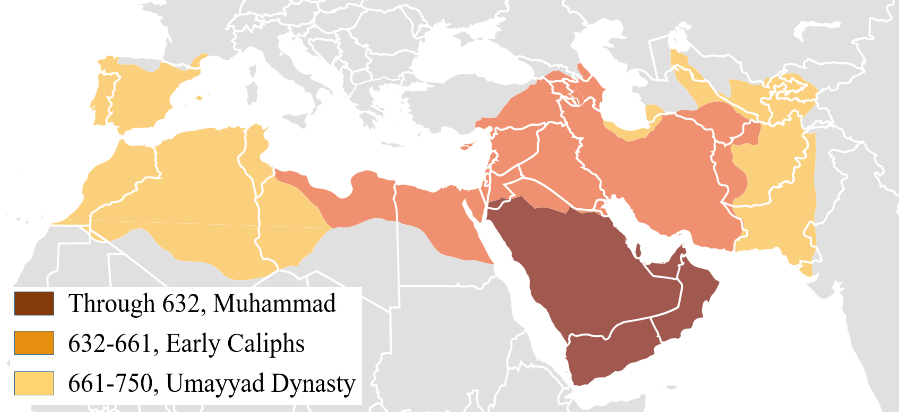
Early Islamic Expansion[2]
We’ll start with Mecca, as it is foundational to all Islam’s claims. Even if one finds a Muhammad or Qur’an, but they are not from Mecca, then can they be the Muhammad or Qur’an claimed by Islam?
Mecca
To understand Mecca’s significance within Islam, we must go to the story of Adam and Eve in the Garden of Eden found in Surah 7. There Satan tricked them both into eating from the tree. Allah forgave them for their transgression, but both were cast down from Eden to the earth. (S7.24) Tradition says Eve landed in Mecca and Adam in Sri Lanka. Adam joined Eve in Mecca. Mecca must therefore be the oldest city on the earth, and one of the most important.
Other Muslim claims about Mecca include;
- Mecca is the place where Abram lived, and cast out Haggar after giving birth to Ishmael. Abraham also destroyed the idols within the Kaaba located there (S 21.51-71)
- Mecca is the center of all trade.
- The prophets buried in Mecca include; Adam, Eve, Seth, Ishmael, Noah, the Queen of Sheba, and Daniel. Along with 70 to 300 other prophets. All buried in a kneeling position.
One note. The story above presents a couple more inconsistencies between the Bible and Islam. First, Eden had to be located in space for them to be cast down from it to the earth. Second, God walked with Adam in the cool of the evening within the Bible. This implies God had a relationship with Adam. However, Allah is pure will and therefore beyond having a relationship with man. How could Adam or Eve talk with Allah, let alone walk with him?
As Mecca is the oldest and one of the most important cities on the earth, there must be evidence of its existence in the seventh century. However, no evidence is yet presented for Mecca’s existence in the seventh century from maps, literature, documents, history, or excavations.
We’ll turn next to the results from each area investigated using historical criticism.
Linguistic Problems
- Mecca is mentioned only once by name in the entire Qur’an (S48.24). this suggests it was either not important, or the city did not yet exist when the Qur’an was written.
- Seventh century Arabs did not refer to themselves as Muslims. Instead, they used terms such as; Ishmaelite (line of Ishmael), Haggarene (line of the mother of Ishamel), Muhajiroun (place of Haggar), Haghraye (people of Haggar), or Saracen (Arab plunderers from the Arab Peninsula).
- The Arabic word endings within the Qur’an do not come from the language used in the area where Mecca is located, but is Nabataean Aramaic used in Jordan—600 miles to the north.
Location Problems
- Most of the Qur’an’s sixty five geographic references are located 600 – 1,000 miles north of Mecca. These include the tribes of Ad (23 times), Thamud (24 times), and Midian (7 times). The same is true for locations such as Sodom and Gomorrah.
- Before the war between Rome and Persia, the primary eastern trade route ran along India’s coast sailing through the Persian Gulf and then to Baghdad and Damascus. After that war began, the main trade route shifted from India over the sea to Yemen and the African coast. Trade could continue up the Red Sea or overland along the Hijaz, a plateau area along the western Arabian Peninsula, through small communities around oases or having usable aquifers. Mecca is located 3,000 feet below the plateau. Both off the trade route, and without water. No water, no food. No food, no people. No people, no town. No town, no empire. See Trade below.
- Soil samples from Mecca indicate it has not held life for thousands of years. Yet the Qur’an describes Mecca as a garden.
- The well of Zamzam is the same one God provided Haggar in the Bible. Only it is very near the Kaaba in Mecca. Would Haggar stay so close to Abram after being cast out? Tradition also says this well is inexhaustible. The well was dug deeper and enclosed within a concrete basement in the 20th century. Pipes now run into and out of the spring. The pipes going into the well can be traced back to 27 desalinization plants in Jeddah, along the Red Sea coast.
- Mosque qiblas (direction of prayer) should face Mecca. However, a study of 100 seventh century mosques found their qiblas all faced either Petra (in Jordan) or Jerusalem. No mosque faced Mecca until 715, suggesting Mecca was chosen in the 8th century.
Historical Problems
- Ptolemy’s 2nd century description of the Arabian Peninsula does not list Mecca, even though many smaller settlements are noted. None of Europe’s earliest maps of the area from the 15th and 16th centuries include Mecca either.
- References to Mecca do not appear in any 7th century documents from the Arabian Peninsula such as the Nabateans, Qedarites, Kindah, Azdi, Himyar, or Saba. Further, no references have been found in any documents from the Romans, Persians, Assyrians, or Babylonians to the north, nor the Nubia, Aksum, or Abyssinians along the African coast. Other smaller less important settlements such as Ma’rib, Najran, Taif, Yathrib (Medina), Khaybar, Petra, and Mamre are all mentioned, and all are located along the overland trade route. The first mention of Mecca comes from 741 and indicates it is located in Southern Turkey.
- Significant skyscrapers are being constructed in Mecca today. These require deep foundations. No graves or artifacts from the 7th century have yet been found. The earliest finding beneath Mecca is the remains of a 13th century Ottoman fort.
The Hajj
- The Hajj is one of Islam’s five pillars. A large part of its ritual comes from Jewish custom. Hajj pilgrims circle the Kaaba in a counter-clockwise direction seven times. This appears to be borrowed from the Jewish story of circling Jericho seven times before its walls fell.
- The pilgrims also run between the two hills of Sofa and Marwa as part of the Hajj. Marwah translates into Moriah, and Sofa to Scopus in Hebrew. Both are mountains on either side of the Kidron Valley around Jerusalem.
- Pilgrims are to kiss a black stone in one corner of the Kaaba. The stone is possibly a meteorite discovered by the Phoenicians between 300 and 400 BC, and worshipped as a ‘gift from God’. Romans brought it to their territory in the 1st century BC. The Roman Emperor Aurelius Antoninus moved it to Damascus before his assassination in 222 AD. It was moved to Petra in the 7th century. Ibn Zubair destroyed much of Petra in 687 and sent the stone to what became Mecca.
Trade Route Problems
- The trade route change mentioned above when the Romans and Persians warred against each other presents several difficulties..
- The trade route following the Hijaz plateau included the towns of; Ma’rib, Najran, Taif, Yathrib (Medina), Khaybar, Petra, and Mamre as noted above. For a caravan to leave the route and go to Mecca would require adding another 3,000 feet of descent and ascent to the route. This is not practical in an environment where there is little water, and none at Mecca’s site.
- More efficient was the Red Sea trade route. Most of the deeper Red Sea channels lay along the African coast. The African ports of Assab, Adults, Suakin, Berenice, and Safaga are each about a day’s travel apart, and all existed by the 2nd century AD. It would only take about six days to ship cargo by sea, rather than land.
- Only the port of Yanbu is known on the Arabian coast at this time, and it is a port city for Yathrib (Medina).
No one, at any time, or any place from within the 7th century appears to have known about Mecca. It is not found in maps or documents, there are no trade records for it, Mecca’s site has no water nor is its soil capable of growing food; the Qur’ans geographic references are 600 – 1,000 miles to the north; and linguistically it uses Aramaic from 600 miles to the north in Jordan. If Mecca did not exist in the 7th century, then to what Muhammad is Islam referring? We will pick up with that question next time.
Footnotes;
[1] Jay Smith’s work can be found on https:\\www.youtube.com . His work can be found through FOCL (Forum of Christian Leaders). Much of this article’s material came from his Dismantling Islam presentation on about May 1, 2026. https://www.youtube.com/watch?v=FHtr5wUMfo4
[2] Map from http://academic.udayton.edu/williamschuerman/Growth_of_Islamic_Caliphate.jpg