
Thirty-ninth in a series
The last two articles touched upon some of Islam’s general attitudes and views of extremism, politics, and freedom. This article continues that discussion using the same survey material,[1] examining some attitudes around law and culture.
Law
We’ll begin with survey results concerning some religion and law connections. Islamic law is encompassed within what is called shari’a, and derived from several of Islam’s sources as outlined earlier.[2]
Area 1 – Religion and Law
The table below shows the percentage of Muslims who say:
- Shari’a is the revealed word of God.
- Among shari’a supporters, the median % of Muslims who favor religious judges to oversee family law. All columns denoted with a ‘*’ reflect percentages of the Sharia Official Law column results.
- Median % of Muslims who favor enshrining shari’a as official law.
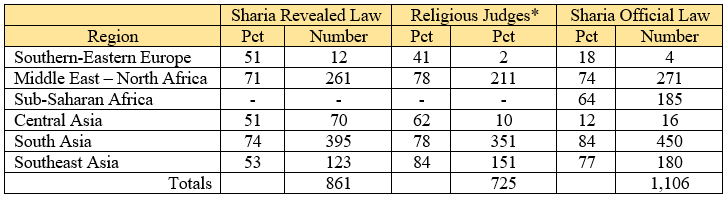
Even though the sub-Saharan African region was excluded from the first survey question, over 50% of Islam’s followers believe shari’a is a divinely revealed law, and almost 45% that religious judges should oversee family law within the courts. This climbs to two-thirds believing that shari’a should be official law, but there are regional differences within this last result. The areas formerly under control of the Soviet Union (Southern-Eastern Europe and Central Asia) are once again much lower than the rest of the Muslim world surveyed. These results demonstrate again that all is Islam, and another reason why Islam is not simply a religion but an ideology with a religious component.
Area 2 – What Do Shari’a Supporters Want in Law?
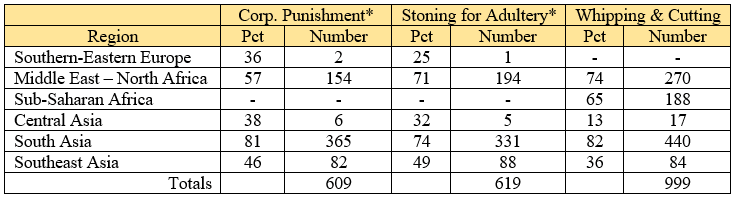
So what do shari’a supporters want? Some responses are shown in the following two tables.
- Median % of Muslims who favor severe corporal punishments for criminals. Remember these are punishments sanctioned by Islam’s tenets and embodied by shari’a — such as beheadings, amputations, stoning, and crucifixions.
- % of Muslims who favor stoning as a punishment for adultery.
- % of Muslims who favor whippings/cutting off of hands for theft and robbery.
- Median % of Muslims who favor executing those who leave Islam.
- Are honor killings permissible? The % of Muslims who say they are never justified when a male commits the offense.
- Are honor killings permissible? The % of Muslims who say they are never justified when a female commits the offense.
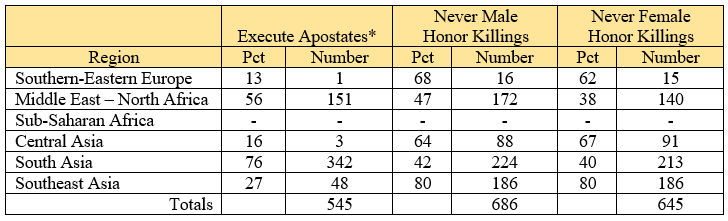
The numbers again speak for themselves. We see a general trend of lower acceptance within the former soviet-bloc countries. Note most of these results did not include the sub-Saharan African region (about 289 million followers of Islam). When adjusting for that exclusion, support for various forms of corporal punishment ranges between 40 – 60% of the surveyed regions. In addition, roughly 50% of surveyed Muslims believe honor killings are never justified — indicating that about half believe there are circumstances where honor killings are permissible.
Culture
We’ll turn next to some cultural behaviors, specifically Islamic views on some moral issues and the role/rights of women within society. Things considered morally wrong are likely to be subject to the harsh corporal punishment under shari’a noted in the previous section.
Area 1 – Morally Wrong Behaviors
The following tables show the median % of Muslims who say each of the following behaviors is morally wrong:
- Prostitution
- Sex outside marriage
- Homosexuality
- Drinking alcohol
- Abortion
The final column in the second table contains the % of Muslims who say polygamy is morally acceptable.
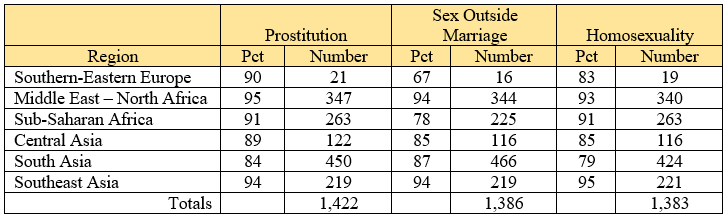
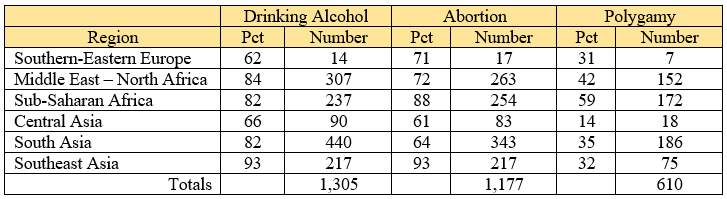
These results indicate that globally, 75% or more of Muslims believe the first five behaviors are morally wrong. In addition, questions regarding suicide and euthanasia showed similar results. All regions strongly support these behaviors as being morally wrong (a minimum of 61% in any region). Even if you agree that these behaviors are morally wrong, would you sanction the types of punishment advocated under shari’a?
Polygamy
Polygamy is interesting. Islam’s doctrines allow it, yet its support sits below 40% overall and again is lowest in Central Asia and Southern-Eastern Europe. Polygamy also has different interpretations within Islam. Some view it as having no more than four wives in one’s lifetime. Others view the numbers one, two, three, and four as simply the beginning of a numerical sequence. Therefore it does not matter how many wives you have over time — only whether you are limited to four at a time.
I heard a missionary performing Muslim outreach for over twenty years speak. His observations included what life was like in many Middle East Muslim families. Certainly not all families are like those he described, but they are not atypical. You would likely grow up in a household where your mother is beaten. For those who think otherwise, you should see one of the many videos on how to properly beat your wife. In many cases, your father is looking for his next wife. Divorce is very easy for men, so you may grow up without your mother’s presence for a significant part of your childhood. Women within Islam are property. They are always owned by a male, either a family member or their husband.
Area 2 – Women’s Rights
The following results related to women were presented within the surveys.
- Median % of Muslims who completely or mostly agree that a wife must obey her husband.
- Median % of Muslims who say that women have a right to divorce.
- Median % of Muslims who say that sons and daughters should have equal inheritance rights.
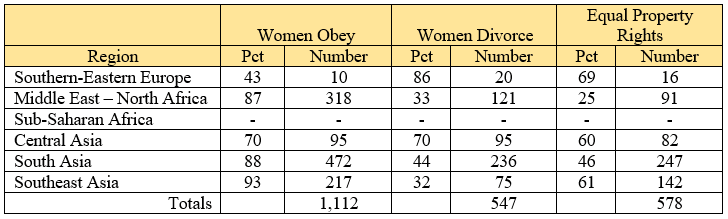
Over 80% of those in the regions surveyed say they agree that a woman should obey her husband, but less than 45% think that women have the right to divorce or should have equal inheritance property rights. Again, these results were supported less in the former soviet-bloc countries. It is difficult to justify giving a group such rights when they are viewed as being property themselves. It is no different for non-Muslims in these societies as they are dhimmis who are owned by the state. Such treatment is sanctioned by Islam’s source materials.
Summary
None of the survey items included in these articles represent a fringe element within Islam; instead, they represent its mainstream beliefs. Are these beliefs consistent with our values, or are they contrary to them?
Islam presents a tortured form of dualistic thought about life that is grounded in fatalism. Take the sanctioned forms of wife beating that are permitted. One does not have to perform these actions, but if they do it is because another is at fault. Their decisions forced me to do it. There is no accountability from within, as expediency and obedience become morality. Your actions are driven by outside behaviors — as is your freedom. How is this different from the “I was only following orders” defense offered by some accused of committing war crimes after WW II?
It is not my intent to denigrate Muslims, but instead to educate people about some of Islam’s prevailing ideas so that they can be understood by those of us in the west. The framework for the notions supported in these surveys is as foreign to us in the west and our values are to those following Islam. As I have said before, it is not Muslims that are the issue, but Islam’s tenets. Can anyone doubt the values cited within this series are both contradictory and incompatible with our most basic founding values and beliefs — beliefs also having their basis in living according to God’s commands? These include the separation of church and state, equality under the law, government’s primary role in protecting our Creator given rights, and promoting the virtue of justice. These two contradictory viewpoints cannot have come from the same source.
Closing
Three points in closing. First, the Muslim world claims our Constitution is of human origin, and therefore transitory. It does not know its principle’s godly source. One example presented last time concerned freedom. We should welcome those fleeing Islam’s ideology, but should we accept those as immigrants who cling to it? Would we have accepted as immigrants avowed communists during the height of the Cold War, or active Nazi supporters during World War II? Why is this ideology any different? Present and support the arguments if you believe otherwise. The proof of what I say is in this, consider what America has been able to achieve when turned toward God and His principles. Sadly today, and over the last fifty years, many no longer seek Him. But we make that choice every single day; each day we have the freedom to choose a different path.
Second, we need a national conversation and response to Islam’s ideas, but that requires having a developed understanding of both Islam’s ideology and our own faith. Sadly, our society often lacks both today. My intent through this material is to get you started along both paths. Third, we must reassert our national sovereignty, by once again controlling our immigration process. Immigration is one of the few powers granted to our federal government but, before the current administration, it abdicated much of its responsibility. Prior administrations’ irresponsible actions put we the people at risk. But a simple answer exists. Their power comes from us. All we have to do is say no more.
We must return to our founding values of faith, reason, virtue and morality, but that requires first understanding what those truly are. It isn’t found in the collectivist’s idea of social justice, nor their moral relativism — both inane forms of pretzel logic.
Footnotes:
[1] Pew Research Center, How Muslims See Themselves and Islam’s Role, July 14, 2005. Other Pew Research Center surveys used in this article include Most Embrace a Role for Islam in Politics: Muslim Publics Divided on Hamas and Hezbollah (December 2, 2010) and The World’s Muslims: Religion, Politics, and Society (April 30, 2013).
[2] Wolf, Dan, US Law and Shari’ a, Virginia Christian Alliance, https://vachristian.org/us-law-and-shari-a/ , June 7, 2026.