
Luther said his conscience was captive to the words of God. In 2009 this church said its conscience was free to conclude otherwise — and called that his legacy.
The Church and the Christian Church • Part Four: The Evangelical Lutheran Church in America • By the Virginia Christian Alliance Editorial Board
The Big Three:
- The doctrine that held the ELCA together in 2009 — “bound conscience,” the promise that both convictions could live in one church — is now under formal reconsideration by the church that built it.
- The 2022 Churchwide Assembly authorized two reconsiderations of the 2009 social statement. The first ELCA reconsideration was completed in 2025. The second, aimed at bound conscience itself, is underway now and goes to the 2028 Assembly.
- A second witness stands outside the walls: the bodies formed by those who left after 2009, still holding what the ELCA set aside.
The Hinge, Stated Plainly
There is one sentence at the center of this arc, and every reader who takes nothing else should take this.
At Worms in 1521, Martin Luther refused to recant. The ELCA’s own social statement quotes his reason in its endnotes: “Unless I am persuaded by the testimony of Scripture and by clear reason … I am conquered by the Scripture passages I have adduced and my conscience is captive to the words of God.” Conquered by Scripture. Captive to the words of God. Luther’s conscience was not liberated by his convictions; it was taken prisoner by a text he could not argue his way around.
In 2009 in Minneapolis, this church invoked that same word — conscience — and made it mean the opposite. It resolved that faithful Lutherans, reading the same Scripture, may reach contradictory conclusions about what God has said, and that the church would hold both as valid. Luther’s conscience was bound to the Word against the church. The ELCA’s was declared free to conclude otherwise, and Scripture became one voice in the room rather than the voice that binds.
That is the hinge. Part Three built the case for it slowly and answered the strongest form of the counterargument. Here we simply state it, because what follows is the weighing, and the scales need a fixed point to hang from.
The Writing on the Wall
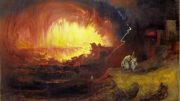
Belshazzar held a feast and drank from vessels taken out of the house of God, and while he drank a hand appeared and wrote on the plaster of the wall. The king’s face changed. His counselors could not read it. Daniel could: “Tekel, you have been weighed in the balances and found wanting” (Daniel 5:27, ESV).
The word matters. Weighed. Not slandered, not opposed, not out-argued. Set on a scale against a standard and found light. Belshazzar’s offense was not ignorance — Daniel says plainly that he knew what had happened to Nebuchadnezzar before him and “you have not humbled your heart, though you knew all this” (Daniel 5:22, ESV). The vessels he drank from had been consecrated for one use and were being used for another. That was the whole indictment: holy things repurposed by a man who knew better.
We do not write this to pronounce a sentence on any person. God alone weighs a soul. But a church body publishes its acts, records its votes, and asks the world to receive them as the teaching of Christ’s church. Those acts can be set on the scale. That is what this series has done at four denominations now, and what we do here a final time with the ELCA — not against the sincerity of her people, but against the line.
The ELCA Reconsideration Since 2009
Sixteen years of record are now available, and they do not show a church that settled.
In 2022, the Churchwide Assembly authorized two reconsiderations of Human Sexuality: Gift and Trust. The first was editorial — updating the statement’s language in light of changed civil law and public acceptance of same-gender marriage. That work was completed at the 2025 Churchwide Assembly in Phoenix, where edits to Section IV were amended and adopted by a two-thirds vote, 724 to 46.
Compare that number to 2009. The social statement passed 676 to 338 — exactly two-thirds, not one vote to spare. Sixteen years later the amendments cleared 724 to 46. In 2009 the church was split down the middle and knew it. By 2025 the opposition had thinned to under six percent of the assembly. Something happened in between, and it was not persuasion. Those who held the historic position largely stopped being in the room.
The second ELCA reconsideration is the one that matters, and it is underway now. Its subject, in the ELCA’s own words, is “a fresh consideration of the church’s current concept of the four positions of bound conscience.” The task force seated in 2024 has begun the work; a draft goes out for churchwide review in 2027 and to the 2028 Churchwide Assembly for a vote. As we write, the task force has a study circulating through congregations, titled Conscience and Conversation, gathering feedback from across the church.
The Compromise That Could Not Hold
Read that carefully, because it is the ending this arc was always moving toward.
The doctrine of bound conscience was the load-bearing beam of the 2009 settlement. It was what allowed the ELCA to change its ministry policy and still tell traditionalists they had a home. Four positions, all honored, none coerced. That promise is the reason many who disagreed stayed.
Sixteen years later, the ELCA reconsideration process is asking whether to keep it.
The ELCA is careful to say that the authorization sets an ELCA reconsideration in motion and does not determine the outcome, and that is fair; we make no prediction here. But the direction of the pressure is on the record. At the 2025 Assembly, the Southwest California Synod memorialized the church to “clarify that bound conscience can only apply to individual clergy who decide not to perform a marriage rite and not to ELCA churches” — that is, to shrink the shelter to a single act by a single pastor and remove it from congregations altogether. The same memorial asked for pastoral care materials for people in “polyamorous, non-monogamous” relationships. The Assembly declined some requests and referred that one to the Conference of Bishops to develop.
This is what happens to a compromise that suspends the authority of Scripture rather than submitting to it. It does not hold still. Having no fixed point, it drifts toward whoever pushes hardest, and the ones who pushed hardest in 2009 are still pushing. “A double-minded man” is “unstable in all his ways” (James 1:8, ESV). What is true of a man is true of a house built the same way.
The Second Witness
Scripture does not convict on one testimony. “Only on the evidence of two witnesses or of three witnesses shall a charge be established” (Deuteronomy 19:15, ESV). The first witness in this case is the ELCA’s own record — its minutes, its votes, its published statements. The second witness walked out.
After 2009, congregations and pastors who could not accept the change left. Many joined Lutheran Congregations in Mission for Christ, a body already in existence that received hundreds of departing ELCA congregations; others formed the North American Lutheran Church in 2010. They did not leave to invent something. They left to keep something — the same confessions, the same Scriptures, the same teaching on marriage the ELCA had held until that August. Their existence is testimony that the 2009 change was not an inevitable development of Lutheran doctrine but a departure that faithful Lutherans could recognize and refuse.
The same pattern has appeared at every wall this series has measured: the Anglican Church in North America out of the Episcopal collapse, ECO out of the Presbyterian one, the Global Methodist Church out of the United Methodist. Different centuries, different polities, one story. When a body sets the plumb line aside, the plumb line does not disappear. It walks out the door in the hands of those who still believe it.
Luther Against the House
There is a particular weight to this verdict that the other three arcs did not carry, and it belongs to Luther.
Every denomination in this series has a founder who would not recognize what the institution has become. But the ELCA did not merely depart from Luther. It cited him. It put his words in its endnotes and built the departure on his name, and the words it printed are the very words that condemn the construction. Conquered by the Scripture passages I have adduced. A man conquered by a text does not then declare the text open to contradictory readings and call the result freedom.
Luther’s entire life turned on the conviction that Scripture stands over the church and not under it — that councils and popes had erred and could err again, and that the only sure ground was the Word itself. That is sola scriptura, and it is not a footnote to Lutheranism. It is the hinge on which the whole Reformation swung. A church that keeps his name and reverses his rule has not extended him. It has spent his inheritance and kept his signature.
“To the teaching and to the testimony! If they will not speak according to this word, it is because they have no dawn” (Isaiah 8:20, ESV).
A Word to Those Still Inside
This is written for the person in an ELCA pew who has read this far and feels something between grief and anger. You did not vote for this. Many of you fought it, and some of you have spent sixteen years hoping the promise of 2009 would be honored. It is now under reconsideration.
Scripture speaks to your situation without softening it. “Therefore go out from their midst, and be separate from them, says the Lord” (2 Corinthians 6:17, ESV). “Come out of her, my people, lest you take part in her sins” (Revelation 18:4, ESV). We do not say those verses lightly, and we do not say them for you; that discernment belongs to you, your family, and the Lord you answer to. But we would be false witnesses if we told you the question is not being asked.
What we can say plainly is that faithfulness is not loneliness. The confessions you hold are held by others. The Scriptures you believe are believed in congregations near you. If the day comes when you must choose between the house and the Word that built it, you will not be walking out into nothing. Others went first and are still standing.
The Only Door
The scales have been read. Four denominations, four arcs, one pattern — and at each one the same finding: not a church that never knew, but a church that knew and voted otherwise. Weighed in the balances and found wanting.
But Belshazzar’s story is not the last word Scripture speaks on the matter, and it must not be the last word here. Nineveh was weighed too, and warned, and given forty days — and Nineveh repented, and God relented. The prophet who carried that message was furious about the mercy. He had wanted the sentence carried out. God had wanted the city.
That is our position exactly. We have no appetite for a verdict against the ELCA. We would trade every word of this series for one Churchwide Assembly that opened the Book and submitted to it. Institutions have repented before. Councils have been reversed. A church that changed its teaching by a vote can change it back by a vote, and the God who raises the dead is not troubled by parliamentary procedure.
No argument on this page will accomplish that. Only the Holy Spirit convicts, and only He gives a heart the courage Luther had — to stand before every authority that demands you yield and say that your conscience is captive to the words of God, and that you neither can nor desire to recant. That courage is not a Lutheran heirloom. It is a gift, still given.
The door out of a verdict like this has one name. Luther found it before he found anything else, when he read that the righteous shall live by faith and the whole world turned over. It has not moved. It is open still.
This concludes the ELCA arc of Measured and Found Wanting.
For Further Study
- ELCA Reconsiderations of Human Sexuality: Gift and Trust — the church’s own page on both reconsiderations, including Reconsideration #2
- Human Sexuality: Gift and Trust — the social statement as amended in 2025
- 2009 ELCA Churchwide Assembly Minutes (cdn.elca.org)
- Measured and Found Wanting — series hub
- Part One: The Receipts Condemn the ELCA
- Part Two: The Redline Runs Through the ELCA
- Part Three: The Verdict of Scripture on the ELCA
Scripture quotations are from the English Standard Version (ESV).