
Civic Engagement and Responsibility
By J. Jeff Toler for Shenandoah Christian Alliance j.toler@sca4christ.org
- And He said to them, “Whose image and inscription is this?” They said to Him, “Caesar’s.” And He said to them, “Render therefore to Caesar the things that are Caesar’s, and to God the things that are God’s.” —Matthew 22:20-21
This week, I am exploring some important questions to determine how well the “American Experiment” appears to be functioning at this point in time. For me at least, the first question should be, “Do political rights and economic liberty have the same importance, and is liberty itself merely a political right?” The answer would depend heavily on the intellectual tradition you and I have adopted.
In the classical liberal tradition associated with thinkers like John Locke and reflected in the American founding, political rights (speech, voting, assembly) and economic liberties (property, contract, enterprise) were not treated as separate categories. They were understood as different expressions of the same underlying natural liberty. Secured property made independent political judgment possible, freedom of speech and due process protected property from arbitrary confiscation. From this point of view, the two are coequal and mutually reinforcing.
Now contrast this with the modern progressive tradition, which often distinguishes between political and economic rights. Political rights—voting, representation, freedom of expression—are treated as fundamental to democratic legitimacy. Economic liberties, by comparison, are to be regulated in the interest of equality, welfare, or social stability.
A third perspective, associated with libertarian thought, tends to reverse the hierarchy: property rights and voluntary exchange are foundational, while political rights function primarily as safeguards for individual autonomy. Each of these frameworks arrange the relationship differently, but the divergence reveals a deeper philosophical disagreement about the nature of freedom itself.
Liberty is not merely a political right within the American founding framework; it is the only condition that can make political rights meaningful.
The Declaration of Independence declares “Life, Liberty, and the pursuit of Happiness” as natural rights—pre-political claims that governments are instituted to secure. Political rights such as voting, representation, and due process are therefore best understood as institutional mechanisms designed to protect liberty, not as liberty’s source. Liberty is the principle and political rights are essentially among the tools at its disposal.
While all but purely philosophical by most metrics, these answers describe the developing tensions over the past 80 to 90 years in American political thought and practice.
American political thought is more than philosophy, although philosophy was once highly regarded in the late 18th and early 19th centuries. Political philosophy was believed by many living in these epochs to be all but indestructible—even though Benjamin Franklin appears to have been skeptical about codifying it. At the close of the 1787 Constitutional Convention, Franklin was asked by Elizabeth Willing Powel if they had created a republic or a monarchy. He famously replied, “A republic, if you can keep it,” highlighting that the nation’s future relied on the vigilance of its citizens. The quote was recorded by Dr. James McHenry, a Maryland delegate, in his notes regarding the final day of the Convention.
Franklin emphasized that while Congress established a representative government, its survival depended on the people maintaining it through civic engagement and responsibility. A republic does not preserve itself. It endures only insofar as its people sustain it. The question is whether we are doing that or not.

James Madison
It can be said that free speech is one of the most important rights afforded an active citizenry—to anyone, anywhere. Written by James Madison in response to calls from several states for greater constitutional protection for individual liberties, the Bill of Rights lists specific prohibitions on governmental power. The Virginia Declaration of Rights, written by George Mason, strongly influenced Madison.
Amendment I
“Congress shall make no law respecting an establishment of religion, or prohibiting the free exercise thereof; or abridging the freedom of speech, or of the press; or the right of the people peaceably to assemble, and to petition the government for a redress of grievances.”
The First Amendment presumes something deeper than legal restraint. It presumes a people capable of using liberty responsibly. Laws may prohibit Congress from abridging speech, but they cannot generate the moral framework that sustains free expression. Constitutional liberty requires cultural formation. The question, then, is not merely whether the state protects speech, but whether the institutions that shape conscience and character still understand liberty in principled terms. Among those institutions, the church has historically played a pivotal role.
Now, sociological data suggest that younger Christians—including many evangelicals—exhibit lower confidence in institutions than previous generations. Many prioritize community, identity, and belonging over constitutional theory or abstract political philosophy. Political theology is frequently mediated through contemporary media channels rather than developed through structured theological inquiry. This dynamic can create the perception that questions of liberty are under-theorized in contemporary churches. Yet this pattern is not unique to orthodox or Reformed Protestants; it reflects a wider cultural shift marked by declining civic literacy, institutional fragmentation, and reactive political engagement.
At the same time, the core theological premises of the biblical meta-narrative provide a substantial framework for liberty. The biblical vision insists that authority originates in God, that civil government exercises only delegated power, that conscience is accountable to divine judgment, and that truth is objective rather than a creation of political force. Properly developed, these commitments support a robust defense of liberty of conscience and speech—not because autonomy is supreme, but because no earthly authority is absolute. The tension lies not in theology itself but in whether believers consciously connect these doctrinal convictions to political structures. In many congregations, that connection appears to have weakened, less from theological abandonment than from educational drift and institutional decentralization.
The historical Reformed tradition illustrates the point. John Calvin emphasized that magistrates are ministers under God, not autonomous rulers, planting the seeds of limited government. Samuel Rutherford, in Lex, Rex, argued that the king is under the law and authority is covenantal and conditional—ideas resonant with later constitutionalism. The doctrine of sphere sovereignty by Abraham Kuyper insists that the state must not absorb society, but instead, preserve distinct domains of authority. None of these theologians argued for modern expressive absolutism, yet all sharply advocated limited political absolutism.
The “American experiment” depends upon liberty properly understood. The real question is not whether the First Amendment still remains viable, but whether the philosophical and theological foundations that created it remain firmly in our grasp. Political rights and economic liberty were not originally conceived as competing claims, but as complementary expressions of a deeper natural freedom. That freedom required structure, discipline, and moral formation. These concepts flowed from a biblical, Christian tradition.
The church does not exist to preserve constitutional theory. Yet for generations before us it supplied a lexis: an authority under God, limits on power, the authority of conscience—that reinforced the logic of limited government. If these connections show signs of weakening, we are in danger of losing liberty. Already it is becoming thinner, more procedural, and less anchored.
The tensions we see today are not evidence of indifference, but of a disconnect, even though the resources are still available, and certainly within reach. The question now is whether we retrieve them intentionally rather than assume they will just endure on their own.
The challenge today is resolving a lack of concern for liberty and overcoming the disconnect between theological depth and its disciplined application.
- But Peter and the apostles answered, “We must obey God rather than men.” —Acts 5:29
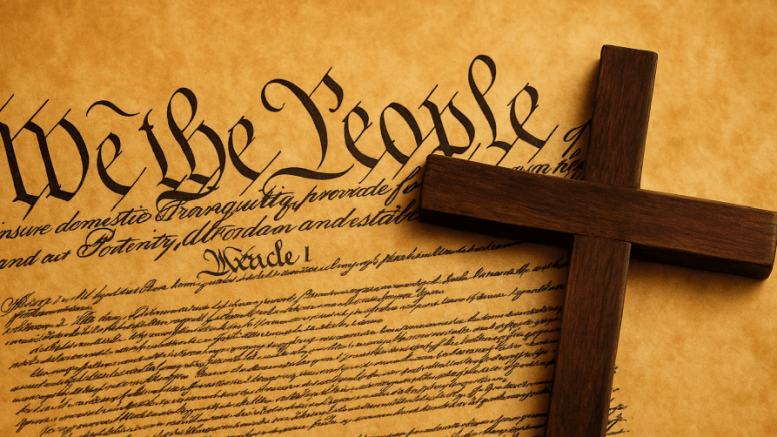
Photo: The US Constitution