
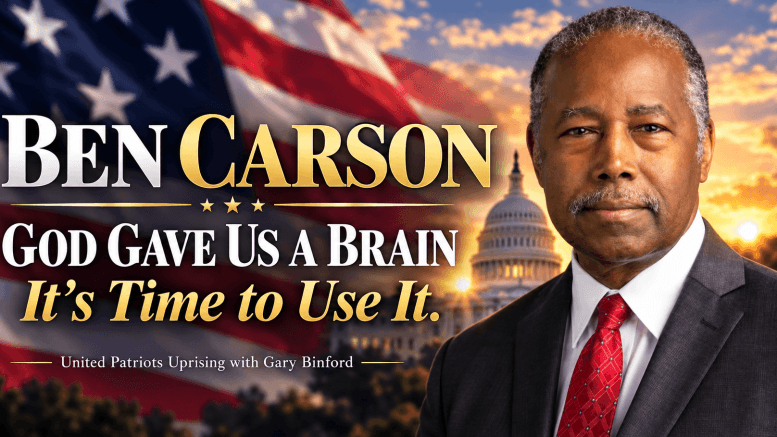
This Ben Carson interview begins with a man who spent nearly three decades working with the most complicated organ God created: the human brain.
So when Carson tells Americans they need to start using the brains God gave them, the observation carries a certain weight.
Returning to United Patriots Uprising with Gary Binford, the renowned pediatric neurosurgeon, former presidential candidate and former U.S. Secretary of Housing and Urban Development tackles some of the most contentious issues facing America: socialism, communism, the breakdown of the family, media manipulation, election integrity and the responsibility of citizens to protect liberty.
Yet a single theme runs beneath nearly everything Carson says.
Think.
Know history. Examine what you are being told. Test arguments rather than slogans. Understand what earlier generations learned. And above all, do not surrender the mind God gave you to someone else.
That may be one of the simplest prescriptions Dr. Carson has ever written.
It may also be one of the most important.
Watch the Full Interview
Gary Binford welcomes Dr. Ben Carson back to United Patriots Uprising for a wide-ranging conversation about America’s culture, family, liberty and future.
Carson is founder and chairman of the American Cornerstone Institute, which identifies faith, liberty, community and life as its four guiding principles. He previously served as the 17th U.S. Secretary of Housing and Urban Development and was director of pediatric neurosurgery at Johns Hopkins for nearly 30 years.
What Happens When Someone Else Does Your Thinking?
That question sits at the heart of this Ben Carson interview.
Gary begins by asking Carson what happened to America.
Carson’s answer reaches beyond any single election or administration.
He argues that Americans have become increasingly vulnerable to manipulation because too many people do not know history, understand their government or critically evaluate what they hear.
Carson points to street interviews in which citizens cannot answer basic questions about American government. His larger concern is not whether everyone can pass a civics examination.
It is whether citizens know enough to recognize when someone is trying to manipulate them.
Scripture places tremendous value on acquiring knowledge and exercising discernment:
“The heart of the prudent getteth knowledge; and the ear of the wise seeketh knowledge.” — Proverbs 18:15, KJV
Biblical discernment is not cynicism.
It does not mean automatically rejecting whatever comes from a newspaper, politician, professor, pastor or television network.
Nor does it mean automatically believing the source we happen to prefer.
It means listening, examining, comparing and seeking truth.
That responsibility belongs to every Christian.
Carson repeatedly returns to what he calls common sense. God created human beings with extraordinary mental capacity, he says, and failing to use it leaves people vulnerable to those who would gladly do their thinking for them.
That warning applies across political lines.
If we stop asking whether something is true because someone on “our side” said it, we have not developed discernment.
We have merely changed whom we allow to think for us.
And that makes history especially important, because ideas rarely arrive without a past.
The 45 Communist Goals Carson Wants Americans to Remember
Carson points listeners back to January 10, 1963, when Florida Congressman A. S. Herlong entered a list titled “Current Communist Goals” into the Congressional Record.
The historical context matters.
Herlong did not present the list as a newly discovered Communist Party document or an official congressional finding. At the request of a constituent, he entered what she identified as an excerpt from W. Cleon Skousen’s 1958 book, The Naked Communist.
That distinction should be preserved.
Still, Carson argues that several items on the list sound strikingly familiar today.
The list includes goals calling for influence over schools and teachers’ associations, infiltration of the press, control of key positions in radio, television and motion pictures, the normalization of pornography, homosexuality and promiscuity, discrediting the family as an institution, weakening parental influence, and replacing “revealed religion” with “social” religion.
Carson believes Americans should consider those ideas in light of subsequent cultural changes.
The larger lesson is not that every development in modern America can be traced to a document from 1963.
The more useful question is this:
What ideas are shaping us now?
Every generation is discipled by something.
Children absorb ideas about human nature, morality, sexuality, authority, freedom and responsibility from somewhere.
If parents do not teach them, someone else will.
If churches do not teach biblical truth, another worldview will fill the vacuum.
If citizens do not learn their history, they become dependent on whoever explains that history to them.
Carson’s prescription remains the same.
Learn.
Think.
Then decide whether the ideas being offered actually produce what their advocates promise.
That test becomes especially important when political promises sound compassionate but rest on ideas history has already tested.
Socialism Sounds Different When You Read the Tenth Commandment
Carson does not begin his economic argument with a spreadsheet.
He begins with Scripture.
Carson and Gary spend significant time discussing socialism and capitalism, and Carson’s critique ultimately turns to the Tenth Commandment:
“Thou shalt not covet thy neighbour’s house, thou shalt not covet thy neighbour’s wife… nor any thing that is thy neighbour’s.” — Exodus 20:17, KJV
Carson argues that resentment toward another person simply because he possesses more can become politically destructive.
His point deserves careful distinction.
Scripture repeatedly commands generosity.
It commands concern for the poor.
It condemns oppression, dishonest gain and the exploitation of workers.
Wealth itself does not establish righteousness, and poverty does not indicate moral failure.
But neither does Scripture teach that possessing less gives one an automatic moral claim to whatever another person possesses.
That is where Carson invokes covetousness.
For him, the traditional American dream was not a promise that everyone would receive the same outcome. It was the opportunity to develop one’s God-given abilities, work, build, invent, create and improve one’s circumstances.
He worries that this understanding has gradually been replaced by an expectation that government should guarantee an expanding list of material outcomes.
Carson therefore urges Americans to examine economic systems not merely by their promises but by their histories and results.
In classical Marxist-Leninist theory, socialism was understood as the lower or transitional phase preceding full communism. That does not mean every form of socialism inevitably becomes communism, but it accurately describes the role socialism played within the Marxist-Leninist framework.
That does not mean every form of socialism inevitably becomes communism. Socialism includes competing traditions, some of which reject Leninist communism entirely.
But Carson’s warning is historically grounded when applied to Marxist-Leninist theory: socialism was understood as a stage on the path toward communism.
Again, the larger lesson is simple.
Study what happened before.
Do not assume that an appealing promise necessarily produces an appealing result.
And do not separate economic ideas from the moral assumptions underneath them.
The Family Is Still the Battlefield
That moral question leads naturally to the institution Carson believes is among the most threatened in America: the family.
The conversation turns to the subject at the heart of Carson’s 2024 book, The Perilous Fight: Overcoming Our Culture’s War on the American Family, co-written with his wife, Candy Carson.
Gary asks whether the American family is winning that fight.
Carson’s answer is sobering.
He points to fewer marriages, declining family formation and America’s low birth rate.
The broad direction of Carson’s observation is supported by federal data. The U.S. total fertility rate was approximately 3.65 births per woman in 1960. Today it is around 1.6, well below the commonly cited replacement level of approximately 2.1 births per woman.
Carson gives a higher replacement figure during the interview, but the conventional demographic benchmark is about 2.1.
His larger concern remains: Americans are marrying less and having fewer children.
That question matters far beyond economics.
The family is the first institution a child encounters.
Before government, school or employer, there is home.
It is where a child first learns authority, sacrifice, forgiveness, responsibility, loyalty and love.
Gary approaches the issue biblically, noting that conflict entered the first family almost immediately after the Fall.
Genesis moves quickly from Adam and Eve’s rebellion to Cain murdering Abel.
Sin attacks relationships because relationships matter to God.
That is why Christians cannot treat marriage and family as merely private lifestyle arrangements.
God created the family.
And the strength or weakness of families eventually affects churches, neighborhoods, schools and nations.
Carson’s American Cornerstone Institute has made educating children one of its central projects. Its Little Patriots initiative provides civics and American-history resources aimed at younger students. In September 2026, the organization also announced its inaugural Little Patriots Civics Bee.
That approach recognizes something politicians sometimes forget:
Culture is not rebuilt every four years.
It is rebuilt one child at a time.
But children are not the only people being shaped. Adults are being discipled by the information they consume every day.
Can Americans Still Tell Propaganda From Truth?
One of Carson’s sharpest warnings concerns information.
He argues that people can be controlled not only by what they are told but by what they never hear.
He refers to propaganda techniques built around repetition: repeat a claim often enough, restrict competing information, and eventually people begin treating the claim as settled truth.
Christians should recognize the deeper spiritual principle.
Repeated exposure is powerful.
But repetition does not transform falsehood into truth.
That is why Paul writes:
“And be not conformed to this world: but be ye transformed by the renewing of your mind…” — Romans 12:2, KJV
The Christian mind is not supposed to operate on autopilot.
We are commanded to renew it.
That requires effort.
Read primary sources when possible.
Listen to opposing arguments before dismissing them.
Distinguish reporting from commentary.
Check the quotation.
Read beyond the headline.
Ask what evidence would change your mind.
And apply the same standards to people you agree with that you apply to people you oppose.
That last requirement may be the hardest.
Partisanship tempts us to scrutinize the other side while excusing our own.
Biblical truth allows no such luxury.
Truth remains truth when it hurts our argument.
Falsehood remains false when it helps it.
Carson’s call to use our brains therefore needs to begin with humility.
None of us is immune to manipulation.
That includes the way we interpret our own national history.
America’s Imperfect History Does Not Require Self-Hatred
Carson does not deny America’s sins.
Indeed, he specifically acknowledges slavery as a profound moral failure and says Americans sometimes violated their own constitutional ideals because economic interests overwhelmed moral judgment.
But Carson rejects the conclusion that America’s failures make the nation uniquely evil.
He points instead to Americans who opposed slavery, the sacrifices of abolitionists and the Underground Railroad, and ultimately the enormous bloodshed of the Civil War.
That distinction is worth preserving.
Patriotism does not require pretending America has never sinned.
And repentance does not require despising the country.
Mature historical understanding should be able to say both:
This was wrong.
And:
This was worth preserving and improving.
If we teach only national triumph, children receive mythology.
If we teach only national guilt, they receive distortion of a different kind.
History should tell the truth.
Carson believes Americans are increasingly encouraged to view one another primarily through categories of race, politics and grievance.
He instead emphasizes what citizens share.
He tells Gary that Americans may disagree loudly about a portion of political life while agreeing about much more than the national conversation suggests.
That does not eliminate genuine disagreement.
It does challenge the idea that every disagreement must create an enemy.
And once citizens understand what they share, the next question becomes unavoidable: what are they going to do about it?
Liberty Will Not Defend Itself
Eventually, Gary brings the conversation to elections.
Carson considers the 2026 midterms highly consequential and argues that citizens cannot simply remain home assuming events will take care of themselves.
His broader statement is more important than any election prediction:
Everyone has a sphere of influence.
Carson urges people to use it.
Talk to people.
Teach history.
Explain principles.
Become informed.
Participate.
That is a healthy civic principle regardless of political affiliation.
Christians should not surrender citizenship merely because politics can become ugly.
Nor should politics become our religion.
Our citizenship in heaven does not erase our responsibilities on earth.
Carson also discusses election monitoring and says Republicans initially sought 100,000 volunteers for the 2024 election. The Republican National Committee later said it recruited more than 230,000 poll watchers, poll workers and attorneys across 18 states.
That figure comes from the RNC itself and should be understood as the organization’s reported count.
Carson then makes stronger claims.
He argues that opposition to the SAVE Act reflects a desire to cheat and suggests that lengthy ballot-counting periods in California indicate that ballots are being manufactured.
Those are Carson’s conclusions, not established facts.
There are documented reasons California counts ballots more slowly than some states. California mails ballots to registered voters, accepts qualifying ballots that arrive after Election Day if they were postmarked on time, verifies signatures and allows voters an opportunity to cure certain signature problems.
Longer counting periods therefore do not, by themselves, establish fraud.
That does not mean election procedures should escape scrutiny.
Citizens are entitled to demand lawful, transparent and trustworthy elections.
The SAVE America Act currently under debate would require documentary proof of citizenship for federal voter registration and photo identification for voting in federal elections. Supporters argue those requirements strengthen election security. Opponents argue they could create documentation barriers for some eligible citizens.
The legislation has passed the House but has not cleared the Senate.
This is precisely where Carson’s larger principle should govern the discussion.
Use your brain.
Ask questions.
Examine evidence.
Apply the standard consistently.
Carson’s answer to national decline is not merely another policy proposal. It rests on a deeper set of principles.
Four Cornerstones America Cannot Afford to Lose
Near the end of the interview, Gary asks Carson about the American Cornerstone Institute.
Carson gives four words:
Faith. Liberty. Community. Life.
Those are ACI’s four stated cornerstones.
They also provide a useful summary of the interview.
Faith reminds us that man is not ultimate. God is.
Liberty recognizes that human beings should not be needlessly controlled by government or ideology.
Community reminds us that freedom does not mean isolation. We belong to families, churches, neighborhoods and a nation.
Life begins with the truth that human beings possess dignity because God created them.
Carson’s organization applies those principles through children’s civics education, leadership training, policy work, prayer initiatives and programs such as Executive Branch for America.
But programs alone cannot preserve those principles.
People have to believe them.
Teach them.
Live them.
And pass them on.
That brings us back to the brain.
God did not give us minds merely to accumulate information.
He gave us minds capable of recognizing truth and acting upon it.
The Christian life requires more than intelligence.
Brilliant people can believe foolish things.
Educated people can rationalize sin.
Knowledge without wisdom can produce arrogance.
What we need is a mind submitted to God.
Romans 12 does not tell Christians merely to become better informed.
It tells us to be transformed by the renewing of our minds.
That transformation changes what we love, how we reason and whom we ultimately obey.
Dr. Ben Carson spent a career studying and operating on the physical brain.
His challenge to America now is much simpler.
Do not waste the one God gave you.
Think.
Learn.
Discern.
And then have the courage to act on what is true.
What You Can Do
- Learn your history. Do not outsource your understanding of America to slogans from either political side.
- Read beyond headlines. Examine primary sources and verify strong claims before repeating them.
- Teach your children and grandchildren. Biblical truth, American history and civic responsibility must be intentionally passed down.
- Strengthen your family. National renewal ultimately depends on healthy homes, churches and communities.
- Use your sphere of influence. Participate thoughtfully in civic life, speak truthfully and encourage others to become informed citizens.
- Renew your mind in Scripture. Political discernment without biblical discernment is not enough.
Key Takeaways
- Carson says Americans are increasingly vulnerable to manipulation because too many lack historical and civic knowledge.
- He urges citizens to think critically rather than allowing media or political movements to think for them.
- The “45 Communist Goals” Carson mentions were entered into the 1963 Congressional Record from W. Cleon Skousen’s The Naked Communist.
- The list calls for discrediting the family and weakening parental influence but does not contain a separate goal about denigrating fathers.
- Carson connects resentment-driven economic thinking with the biblical prohibition against covetousness.
- In Marxist-Leninist theory, socialism was treated as a transitional phase preceding full communism.
- Carson identifies family decline as one of America’s most serious cultural problems.
- U.S. fertility is about 1.6 births per woman, below the roughly 2.1 replacement level.
- Carson acknowledges America’s historical failures while rejecting the idea that those failures define the entire nation.
- He urges citizens to use their individual spheres of influence rather than remaining passive.
- Some of Carson’s election-integrity assertions are his own conclusions and require clear attribution.
- American Cornerstone Institute organizes its work around faith, liberty, community and life.
- Carson’s larger challenge is simple: learn, think, discern and act responsibly.
Resources
- Watch the Full Interview: Dr. Ben Carson Surgically Dissects Hot-Button Issues Critical To Our Freedom/Liberty
- American Cornerstone Institute: AmericanCornerstone.org
- Little Patriots: LittlePatriotsLearning.com
- Book: The Perilous Fight: Overcoming Our Culture’s War on the American Family
- United Patriots Uprising Archive: Radio Influence
Find Gary Binford Online
- YouTube Channel: @garybinford1969
- Podcast Archive: United Patriots Uprising
- X (Twitter): @united_gary
- Facebook: Gary Binford
- Truth Social: @GaryBinford
Find Dr. Ben Carson Online
- American Cornerstone Institute: AmericanCornerstone.org
- Little Patriots: LittlePatriotsLearning.com
- Carson Scholars Fund: CarsonScholars.org
America does not suffer from a shortage of information.
We are drowning in it.
The greater shortage may be wisdom.
God has given us minds capable of seeking truth.
The question is whether we will use them.