

Thirty-eighth in a series
In the last article, we began looking at what extremism means and some general attitudes within the Islamic world. This article turns that discussion to focusing on politics. Law and culture will be covered next time. We use the same source information as before. But first, we’ll look at another general question asked of Muslims. It is, “Do you consider yourself a national citizen first or a Muslim first.” Responses from six countries representing most of the regions in the survey are shown below.
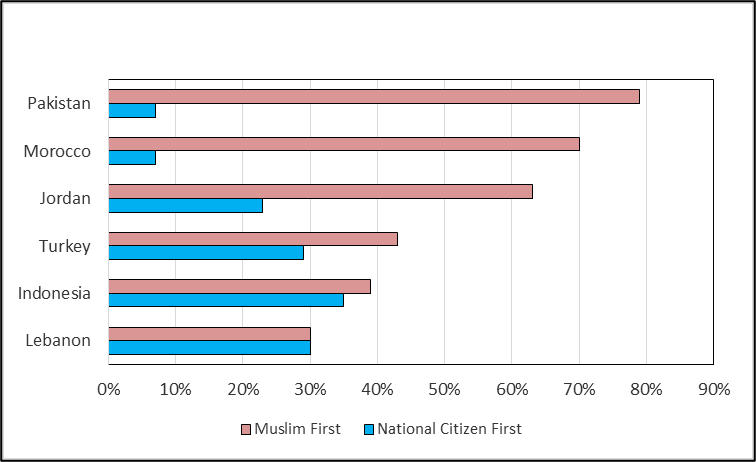
Figure 1: Percentage of Muslims who consider themselves[1]
Not a single country in this survey put national citizenship ahead of being a Muslim. This should surprise no one. Muhammad’s teachings put the ties of religion above those of blood in tribal Arabia. Muslims are called to be followers of Islam first, and that is why Islam’s tenets matter. Within an Islamic country, there is little if any difference between being a Muslim or a national citizen as governance is based on Islamic principles. These principles matter, however, if you extrapolate this position to non-Muslim majority countries, as Islamic governance is not only contrary to, but incompatible with, America’s original governance form.[2]
But we can go further. In this respect, Islam is little different from Christianity. Remember Jonathan Edwards’ sermon mentioned in an earlier article. We are God’s ambassadors while on the earth. Heaven is our native country, and we live in a foreign land. So what’s different? The ideas held by Christianity and Islam.[3]
Area 1 – Religion and Leadership
Relevant survey results related to politics and religion include:
- Median % of Muslims who believe religious leaders should have a political influence.
- % of Muslims who say religious leaders should have a large or some influence.
- Median % of Muslims who prefer democracy over a strong leader.
Those results are shown below.
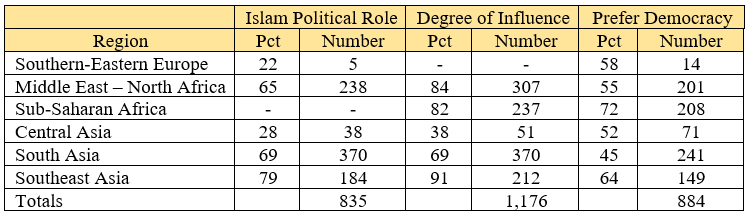
Even though not all regions were surveyed, the results still represent the attitudes of roughly 50 to 70% of the world’s Islamic population. This should surprise no one either. Within Islam, the church and state are one. All is Islam, therefore religious leaders should have an influence over all society’s aspects; including not only politics, but law, governance, civics, culture, the military, etc. as well. More about this later with culture.
The Illusion of Democracy and Freedom
The democracy question result is interesting. Generally, when I have had a political discussion with a Muslim, the line of reasoning goes something like this: they do not have freedom in (insert a country here) because the leader at the top is corrupt. We need to replace the leader with someone who is not corrupt, then that country will have freedom. We use the same word, freedom, but it does not have the same meaning. It does not represent the same idea.
Within Judeo-Christian beliefs, freedom is a gift from God and necessary in fulfilling our purpose. We cannot be put into motion like inanimate objects and still fulfill our purpose of becoming good — like God is good. Within Islam, the concept of Allah borrows from the works of Plotinus, particularly his Enneads. Allah has no being, no essence, no nature, but is instead nothing but pure will. Within this framework, there is no relationship possible between man and his Creator, as Allah is inscrutable — unknowable. Replacing someone “corrupt” at the top with another who shares the same ideas—whether that person is corrupt or not—will change nothing. It is an illusion. Change the ideas, and then you can change the result.
What is Freedom?
According to Plotinus, freedom is the negation of a negative. It is what you have when you are not being coerced, because your normal state is not to be free, but instead to be coerced, by your Creator. A slave of His representatives on earth (the state and/or church), or whoever’s earthly power you lie under. Verses from the Qur’an support this position, and two of those are shown below. This same notion of freedom is shared by all other forms of collectivism. The only difference is that with these other governance forms (communism, fascism, progressivism, socialism, etc.) this form of freedom comes solely from the state, rather than our Creator.
“I created the jinn and humankind only that they might worship Me.” (S 52.56)
“There is none in the heavens and the earth but comes unto the Beneficent as a slave.” (S19.93)[4]
Both of the above are Meccan surahs, indicating this view of Allah was part of Islam from early on.
In western culture, places like America rely on a Judeo-Christian governance philosophy, our freedom comes from within – from man’s nature and not the state. Within Islamic culture, freedom comes from without. This is one reason why creating a republic within an Islamic country will never work; its ideology is incompatible with freedom as we know it. While we can use the same word, it doesn’t mean the same thing.
It is also one reason why western culture is viewed as a threat to Islam. The morals expressed by much of today’s music, television programming, etc. in the west are also a threat to Islamic culture, as these same sources are a threat to us who live in the west. These cultural artistic expressions have become perversions of what should reflect our core values.
Area 2 – Religious Freedom
Another example of this last point comes from the survey. The median % of Muslims who say religious freedom is a good thing is shown in the table below.
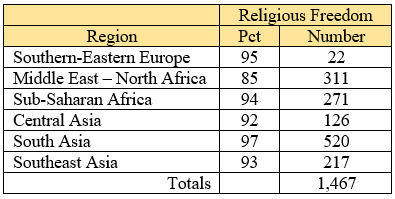
The survey goes further to say, “Medians (percentages) show Muslims who say non-Muslims in their country are very free to practice their religion and consider this a good thing.”[5] The numbers are very high across all regions. But is this true? Consider, non-Muslims are not free to build new churches/synagogues, repair existing ones, ring bells, or perform other overt acts of worship within these countries. In some instances it is even illegal to possess a Bible. Non-Muslim populations have dwindled to non-existence in many of these countries, and continue to grow smaller. In addition, non-Muslims do not share the same legal status as Muslims.
Instead, non-Muslims are subjected to laws and cultural norms intended to humiliate them in an effort to force them to convert. Think this is not true? You might want to see the following video from an Islamic cleric on conversion to Islam. But the idea he expresses is not new, it comes from the dhimmitude practices developed during the Umayyad and Abbasid Dynasties, over a thousand years ago (See The Abbasid Dynasty Part III, Dhimmitude). The non-Muslims living in these countries must possess a level of devotion that we can only imagine.
Area 3 – The Freedom to Choose
What is more correct to say is that within western culture, religious freedom means one is free to choose what religion they will follow — even if their choice is no religion at all. That last portion is still a religion; a faith in no God. Within Islam, religious freedom is synonymous with a non-Muslim being free to choose Islam any time they wish. To support that point, we can look at one final result from these surveys. The table below contains the % of Muslims who say they would be very/somewhat comfortable with a son or daughter marrying a Christian.
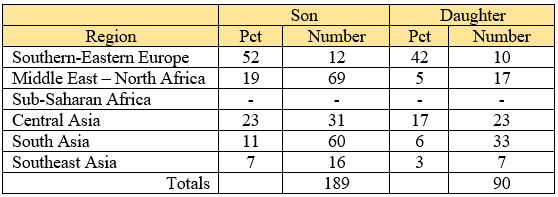
While over 90% of Muslims say religious freedom is a good thing, only a little over 10% would be comfortable with a son marrying someone from outside of Islam — specifically a Christian — and less than half that figure would be comfortable if it were a daughter. In this case, freedom is not the freedom to choose from all things, but instead the freedom to choose one thing alone. The numbers speak for themselves.
We will pick next time with law and culture.
Footnotes:
[1] Pew Research Center, How Muslims See Themselves and Islam’s Role, July 14, 2005. Other Pew Research Center surveys used in this article include Most Embrace a Role for Islam in Politics: Muslim Publics Divided on Hamas and Hezbollah (December 2, 2010) and The World’s Muslims: Religion, Politics, and Society (April 30, 2013).
[2] For more, see the following articles;
- Wolf, Dan, Governance Model Principles, Virginia Christian Alliance, https://vachristian.org/governance-model-principles/ , May 28, 2026, and
- Wolf, Dan, US Law and Shari’a, Virginia Christian Alliance, https://vachristian.org/us-law-and-shari-a/ , June 7, 2026.
[3] For more, see the following articles;
- Wolf, Dan, Ideas have Consequences, Virginia Christian Alliance, https://vachristian.org/ideas-have-consequences-2/ , Sept. 10, 2024 and
- Wolf, Dan, The New Jihad, Virginia Christian Alliance, https://vachristian.org/the-new-jihad/ , July 29, 2026.
[4] Pickthall, M. M., The Meaning of the Glorious Qur’an, amana publications, 1999.
[5] Pew Research Center, The World’s Muslims: Religion, Politics, and Society, p.32, April 30, 2013.