

Twentieth in a Series
In this article we look at Islam’s philosophical basis. We’ve stated several times that Islamic clerics applied reasoning and consensus to: (1) the creation of the Sunna, (2) the creation of the rules limiting the number of variant readings of the Qur’an, and (3) the identification of the trustworthy hadith. But what philosophical underpinnings and basis of reasoning did they apply? Do they matter?
We can go to Raphael’s painting of the Schools of Athens. The center of that painting contains the two figures below – Plato and his student Aristotle. Plato is pointing toward heaven and God while Aristotle has his hand extended over the earth. They represent two separate threads of thought about existence, morality, and knowledge. Ideas about First Cause—God.
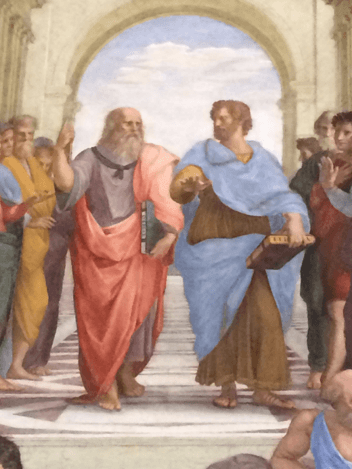
The Two Threads
Clement of Alexandria stated that none of the Greek philosophers ever fully understood God. But Plato came closer to that understanding than any of those other philosophers. Aristotle professed a more traditional pagan view centering on man and the earth. We can see the development of each thread through the timeline below. This timeline, of course, does not cover all of the writings within each of them, but it does cover subject matter relevant to this article’s topic.
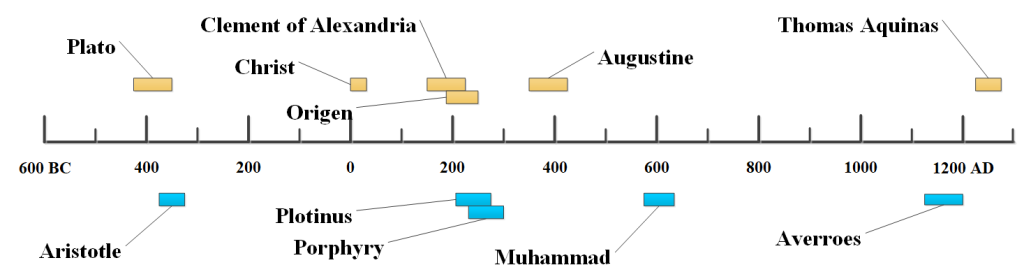
The writings of those following Plato’s thoughts balanced The One and The Many with transcendence and immanence. In Middle Platonism, to which Clement was responding, philosophers blended the two issues, with single unity being transcendent and complex unity being immanent. However, within the neo-platonic line of thought represented by Plotinus a single simple unity is supreme. Any complex unity must have a higher simple unity. To Plotinus, The One was a transcendent simple unity beyond all being, essence, and thought. A side note, for those who do not know, Averroes was a Moorish (Islamic) philosopher.
Free Will
One relevant concept is that of free-will, the freedom of choice serving as a basis of America’s society. Within the thread of theology/philosophy developed by Clement, Augustine, and Thomas, free-will is a positive. It is necessary, enabling us to fulfill our purpose of coming to know our Creator and becoming like him to the extent we are able. We’ve been given a mind and reason in order to come to know something about God. This is possible because our mind and reason are our likeness to Him. “For it is not possible to attain it (faith) without the exercise of free choice.” Neither is knowledge without faith, nor faith without knowledge. As God is Good, we come to know him and become like Him, to the extent we are able, by acquiring and exercising virtue. And all “virtue should be the object of voluntary choice.”[1]
Compare this to the other thread, exemplified by Plotinus. In his writings, free-will is not a positive, but rather the negation of a negative. In other words, free-will is what you have when you are not coerced. This implies that man’s natural state is one of being coerced, that of being controlled – a slave either to another or to one’s own desires. Augustine spent several chapters in his work, The City of God, refuting the arguments of Plotinus and his student Porphyry.
Relation to Islam
Why does all of this matter? Plotinus philosophy was generally known during Augustine’s lifetime, and as indicated by Goldziher, it had a significant influence on Islam’s development.
“The dogmatic development of Islam took place under the sign of Hellenistic [Greek] thought; in its legal system the influence of Roman law is unmistakable; the organization of the Islamic state as it took shape during the Abbasid caliphate shows the adaptation of Persian political ideas; Islamic mysticism made use of Neoplatonic and Hindu habits of thought. In each of these areas Islam demonstrates its ability to absorb and assimilate foreign elements so thoroughly that their foreign character can be detected only by the exact analysis of critical research.
‘With this receptive character Islam was stamped at its birth. Its founder, Muhammad, did not proclaim new ideas. He did not enrich earlier conceptions of man’s relation to the transcendental and infinite…. The Arab Prophet’s message was an eclectic composite of religious ideas and regulations. The ideas were suggested to him by contacts, which had stirred him deeply, with Jewish, Christian, and other elements, and they seemed to him suited to awaken an earnest religious mood among his fellow Arabs. The regulations too were derived from foreign sources; he recognized them as needed to institute life according to the will of God.”[2]
As unity is superior to the many, the many must be bound by a single simple unity. The One is a single absolute power, without being, essence, or thought. It is pure will and the only power which is capable of creation. It is inscrutable and extrinsic; only known through those things it causes – but none of those things are a part of its nature. Further, it is the only force that can cause anything as it is the source of everything. This concept became Allah. And as we can see from the above arguments related to free-will, Islam presents a notion of man’s nature and purpose that is contradictory to the one America is founded upon.
How can one be free if they do not have the ability to make their own choices, if they were created merely a slave?
A Christian Perspective
Compare this to the following passage on creation and the logic Clement of Alexandria uses to demonstrate the type of relationship that must exist between God and man.
“For assuredly He [God] does not hate anything, and yet wish that which He hates to exist. Nor does He wish anything not to exist, and yet become the cause of existence to that which he wishes not to exist. Nor does He wish anything not to exist which yet exists. If, then, the Word hates anything, He does not wish it to exist. But nothing exits, that cause of whose existence is not supplied by God. Nothing, then, is hated by God, nor yet by the Word. For both are one – that is, God. … If then He hates none of the things which He has made, it follows that He loves them. Much more than the rest, and with reason, will He love man, the noblest of all objects created by Him, and a God-loving being. Therefore God is loving; consequently the Word is loving.
‘But he who loves anything wishes to do it good. But nothing is better than the Good. The Good, then, does good. And God is admitted to be good. God therefore does good. And the Good, in virtue of its being good, does nothing else than do good. Consequently God does all good. And He does no good to man without caring for him, and He does not care for him without taking care of him. For that which does good purposefully, is better than what does no good purposely. But nothing is better than God. And to do good purposely, is nothing else than to take care of man. God therefore cares for man, and takes care of him. . . But the good is not said to be good, on account of its being possessed of virtue . . . but on account of its being in itself and by itself good.”[3]
God’s Gift
Our Creator gave the gift of free will to Man as it is essential to his purpose. Through God’s absolute foreknowledge of the choices each and every one of us would make, and the love He has for each one of us, even our bad choices God turns toward His good. Clement said the following about Providence. “For the Providence which extends to us form God is not ministerial, as that service which proceeds from inferiors to superiors. But in pity for our weakness, the continual dispensations of Providence work. As the care of shepherds towards the sheep, and of a king towards his subjects.”[4] Further, “It is accordingly the greatest achievement of divine Providence, not to allow the evil, which has sprung from voluntary apostasy, to remain useless, and for no good . . . but especially to ensure that what happens through the evils hatched by any, may come to a good and useful issue, and to use to advantage those things which appear to be evils, as also the testimony which accrues from temptation.”[5]
Footnotes:
[1] For more on free will, see Wolf, Dan, pp. 60-3, The Light & The Rod: Why Biblical Governance Works, Living Rightly Publications, 2020.
[2] Goldziher, Ignaz, Introduction to Islamic Theology and Law, pp.4-5, University of Princeton Press, 1981.
[3] Rev. Alexander Roberts and James Donaldson, The Ante-Nicene Fathers, Fathers of the Second Century: Hermas, Tatian, Athenagora, Theophilus, and Clement of Alexandria (Entire), Vol. 2, p. 375, Wm. B Eerdmans Publishing Co. The Stromata, II, XXII.
[4] Ibid, p. 535, The Stromata, VII, VII.
[5] Ibid, pp.319-20, The Stromata, I, XVII.