
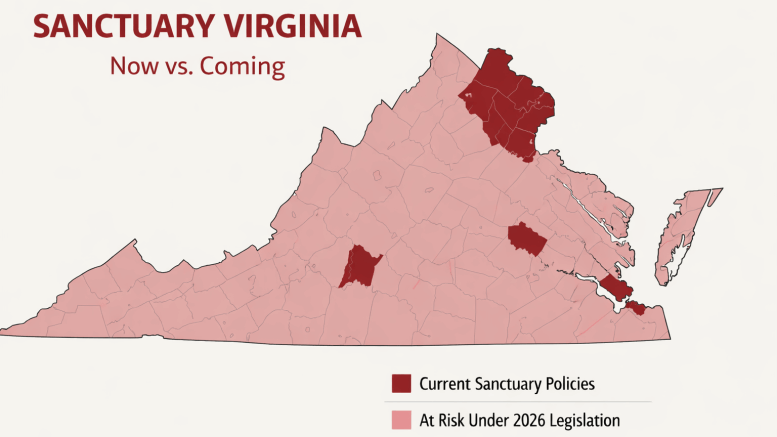
Sanctuary policies in Virginia are expanding rapidly—and almost no one is asking how we got here. In Part 2 of this series, we will follow the trail to understand who is orchestrating this transformation. But first, citizens must understand what is actually happening in the Commonwealth—what’s already here, what’s coming, and who will pay the price.
Introduction: A Question Every Virginian Should Ask
Is Virginia becoming a sanctuary state? The honest answer is yes—and it is happening faster than most citizens realize.
Since January 2026, Governor Abigail Spanberger has signed executive actions terminating Virginia’s cooperation with federal immigration enforcement. Meanwhile, the General Assembly is advancing bills that would prohibit local police and sheriffs from assisting Immigration and Customs Enforcement (ICE) in any meaningful way. Furthermore, across Northern Virginia, local governments have adopted “trust policies” that shield illegal immigrants from federal authorities.
This is not merely an abstract policy debate. Instead, it raises concrete questions that affect every Virginia taxpayer, every community, and every family: What happens when state and local government refuses to cooperate with federal law enforcement? Who bears the cost—financial and otherwise—when authorities release criminal illegal immigrants back into our communities instead of handing them to ICE? And what lessons should Virginia learn from states like Minnesota, California, and Illinois that have gone further down this road?
This analysis examines the facts. We will look at Virginia’s statewide laws, local sanctuary policies, the 2026 legislative push, what the data actually shows about costs and consequences, and what other states’ experiences tell us about Virginia’s likely future.
The goal is not to stir fear but to equip citizens with truth so they can hold their elected officials accountable.
The Constitutional Reality: Immigration Is Federal Law
Before examining Virginia’s sanctuary policies, citizens need to understand a basic constitutional fact: immigration enforcement is exclusively federal jurisdiction. Article I, Section 8 of the Constitution grants Congress the power to establish immigration and naturalization law. The Supreme Court has repeatedly affirmed this as a plenary federal power that states cannot override.
In Arizona v. United States (2012), the Court stated plainly: “The Government of the United States has broad, undoubted power over the subject of immigration and the status of aliens.” Additionally, the Supremacy Clause (Article VI) makes federal law “the supreme Law of the Land.”
This means ICE agents do not need state permission or a state-issued warrant to enforce federal immigration law. They are federal officers operating under federal authority. The “judicial warrant” requirements in Virginia’s 2026 bills are designed to create friction with federal enforcement—not because the Constitution requires them, but because sanctuary advocates want to obstruct ICE without openly defying federal law.
Localities may decline to actively participate in federal enforcement. However, policies that prohibit communication with ICE, penalize cooperation, or actively shield illegal immigrants from federal authorities cross a line—moving from non-participation into obstruction, a form of nullification the Constitution does not permit.
With that constitutional foundation established, let us examine what “sanctuary” actually means in practice.
What Is a Sanctuary Jurisdiction?
The phrase “sanctuary city” or “sanctuary state” has no single legal definition. Politicians often exploit this ambiguity, claiming their jurisdiction “complies with all federal laws” while simultaneously refusing to cooperate with federal immigration enforcement.
In practical terms, sanctuary policies generally do four things: they prohibit local law enforcement from asking about immigration status; they refuse to honor ICE detainers—requests to hold an individual so ICE can take custody; they bar local jails from notifying ICE when an illegal immigrant is about to be released; and they prohibit participation in 287(g) agreements that deputize local officers for federal enforcement.
Supporters argue that sanctuary policies build “trust” between immigrant communities and police. They claim immigrants who fear deportation will not report crimes. This argument deserves consideration; however, it fails on closer examination. Sanctuary policies do not merely protect crime victims. They protect criminals. For example, when a sheriff refuses to honor an ICE detainer for someone arrested for assault or drug trafficking, he releases a criminal back into the community. Consequently, the victims of repeat offenses are often immigrants themselves.
Additionally, the “trust” argument assumes local police would otherwise conduct immigration raids. They would not. Federal enforcement is ICE’s job. What sanctuary policies actually prevent is cooperation after someone has already been arrested and is already in custody. Therefore, the choice is not between raids and sanctuary policies. The choice is between handing a criminal to ICE or releasing him onto the street.
Sanctuary Policies in Virginia: The Architecture Already Built
Virginia’s sanctuary infrastructure has been built layer by layer over the past decade. Specifically, it includes statewide laws passed in 2020, local “trust policies” adopted by Northern Virginia jurisdictions, and jail policies that limit or refuse cooperation with ICE detainers. As a result, most of Virginia’s major population centers now have some form of sanctuary policy in place.
Statewide Laws (2020)
In 2020, when Democrats controlled both chambers of the General Assembly, Virginia passed two laws that created a sanctuary-leaning framework:
HB 262 prohibits state and local officials from inquiring about the immigration status of any person who claims to be a victim of a crime. It also prohibits status inquiries of the parent or guardian of a minor child who is a crime victim, unless that parent is arrested for a crime against the child.
HB 1150 prohibits reporting juveniles to immigration authorities without prior adjudication of delinquency or guilt. Additionally, it prohibits immigration status inquiries of anyone in custody, except those in custody for a felony.
These laws do not declare Virginia a “sanctuary state” in name. However, they restrict when officials can ask about or report immigration status—thereby creating gaps that shield illegal immigrants from federal enforcement.
Local Sanctuary Policies
The most aggressive sanctuary policies are found at the local level, particularly in Northern Virginia. According to the Federation for American Immigration Reform (FAIR), which tracks sanctuary jurisdictions nationwide:
Alexandria: Resolution 2246 (2007) prohibits immigration status inquiries of those seeking city services. The city pledges no participation in ICE raids, no provision of office space or equipment to ICE, and no compliance with ICE detainers without a formal arrest warrant. Sheriff Sean Casey has stated he will not participate in any type of immigration enforcement “under any circumstances.” In January 2025, Mayor Alyia Gaskins declared Alexandria “will always be a welcoming city” that will not participate in federal immigration enforcement. City of Alexandria Memorandum
Arlington County: The County Jail is classified as “non-cooperative” with ICE. Arlington’s Trust Policy, updated in November 2024, prohibits immigration status inquiries, declares use of county resources for federal immigration enforcement “inappropriate,” and prohibits detainer compliance without a judicial warrant. The County Board recently voted to further restrict police from contacting ICE even for known gang members, human traffickers, or suspected terrorists.
Fairfax County: Sheriff Stacey Kincaid terminated the county’s intergovernmental service agreement with ICE in 2018 and does not honor ICE detainers. The county’s Trust Policy (2021) prohibits collecting or maintaining immigration status information, prohibits using county funds for civil immigration enforcement, and bars facilitation of enforcement except under court order. Commonwealth’s Attorney Steve Descano has a written policy prohibiting his staff from assisting federal agents with civil immigration enforcement.
Other Virginia localities with documented sanctuary-type policies or limited ICE cooperation include: Albemarle County, Charlottesville, Chesterfield County, Harrisonburg, Henrico County, Loudoun County, Lynchburg, Prince William County, Richmond, and Virginia Beach.
According to a June 2024 House report tracking detainer acceptance, Virginia has at least nine jail facilities classified as “non-cooperative” and more than fifteen classified as “limited cooperation.” The majority of Virginia’s major population centers have some form of sanctuary policy in place.
Governor Spanberger’s Executive Actions (2026)
The sanctuary architecture accelerated dramatically when Governor Abigail Spanberger took office in January 2026. On her first day, she signed an executive order rescinding former Governor Glenn Youngkin’s Executive Order 47, which had required Virginia State Police and the Department of Corrections to enter into 287(g) agreements with ICE.
Then, on February 4, 2026, Spanberger signed Executive Directive 1, formally directing all state law enforcement agencies—including Virginia State Police, the Department of Corrections, the Department of Wildlife Resources, and the Virginia Marine Resources Commission—to terminate their 287(g) agreements with ICE. She stated that these agreements “improperly cede accountability and discretion over Virginia law enforcement to the federal government.”
According to ICE data compiled by the Legal Aid Justice Center and reported by outlets including the Virginia Mercury and InsideNova, Virginia had 32 active 287(g) agreements as of January 2026—five with state agencies and the rest with local law enforcement. Moreover, according to numbers obtained by The Virginian-Pilot and reported by WVTF, ICE had detained over 6,200 people in Virginia since Youngkin entered into the 287(g) agreement in early 2025.
House Republican Leader Terry Kilgore responded bluntly: “She made Virginia a sanctuary state… She’s making Virginia less safe.”
Importantly, Spanberger’s directive applies only to state agencies. Local 287(g) agreements remain in effect—for now. But the General Assembly is working to change that.
What’s Coming: The 2026 Legislative Push
The General Assembly is now considering bills that would codify sanctuary policies into Virginia law and extend them to localities that have not yet adopted them:
SB 783, sponsored by Senator Saddam Azlan Salim (D-Fairfax), would impose new conditions and reporting requirements on any agreement between state or local law enforcement and federal immigration authorities, including limits on duration, scope, and oversight. The bill also expands data-collection requirements under the Virginia Community Policing Act to track federal immigration officers’ presence and actions. Supporters say it brings transparency and accountability; critics argue the conditions are designed to make 287(g) cooperation practically impossible. The bill passed the Senate 21-19 on a party-line vote and is now pending in the House.
HB 650, sponsored by Delegate Katrina Callsen (D-Albemarle), prohibits civil immigration arrests in courthouses without a judicial warrant. Anyone conducting such an arrest in violation of the bill “shall be punished with contempt of court.” The bill passed the House 63-35 and is now pending in the Senate.
HB 1441, sponsored by Delegate Alfonso Lopez (D-Arlington), would sharply restrict when state and local officers may assist in federal civil immigration enforcement, generally requiring a judicial warrant, subpoena, or qualifying detainer before they can use Virginia resources to help ICE. On February 6, 2026, the House Public Safety Committee incorporated HB 1438 (originally patroned by Delegate Elizabeth Guzman, D-Prince William) into HB 1441—meaning the provisions requiring all existing 287(g) agreements to be terminated by September 1, 2026 now live inside Lopez’s bill.
If these bills become law, Virginia will move toward the same statutory sanctuary model used in Oregon, Illinois, and California—states with broad restrictions on cooperation with federal immigration enforcement.
What the Data Actually Shows
Before examining costs and consequences, citizens deserve an honest look at what the data shows—including data that sanctuary supporters cite.
The “No Crime Wave” Argument
Multiple empirical studies find no overall increase in crime in sanctuary jurisdictions and, in some cases, small decreases in certain crimes. For instance, a University of New Mexico study reports no correlation between sanctuary policies and higher violent or property crime rates overall. Similarly, a Cato Institute review told Congress that “sanctuary cities, broadly defined, do not appear to experience higher violent or property crime than comparable non-sanctuary jurisdictions.”
Sanctuary defenders point to these studies and say, “See, no crime wave.”
However, those aggregate statistics hide something important: specific, preventable crimes committed by people we already had in custody and chose to release instead of handing to ICE. When a sheriff releases a criminal illegal immigrant who then commits robbery, assault, or murder, that crime does not show up as a “sanctuary policy effect” in academic studies. Instead, it shows up as one more data point in the overall crime rate—indistinguishable from any other crime.
Therefore, the question is not whether sanctuary policies cause a measurable crime wave. The question is whether specific crimes could have been prevented if local law enforcement had cooperated with ICE. And the answer, in case after case, is yes.
Who Is ICE Actually Arresting?
Here is where the data becomes uncomfortable for both sides.
By mid-2025, ICE had made 4,264 arrests in Virginia since January of that year—about three times the combined total for the same period in 2021-2024. However, according to ICE’s own data, only about 29% of those arrested had prior criminal convictions. Less than 16% had pending criminal charges. In other words, the majority had no criminal record beyond their immigration status.
This raises a legitimate question: If we’re not targeting the worst offenders, who exactly are we protecting with sanctuary policies—and who is left exposed?
The answer cuts both ways. On one hand, sanctuary policies that release violent criminals back into communities are indefensible. On the other hand, aggressive enforcement that sweeps up workers with no criminal record while missing actual criminals is also a failure. Virginia citizens deserve a policy that prioritizes public safety—not one that protects politicians from criticism by either side.
Who Pays? The Fiscal Reality
There is no single “sanctuary Virginia price tag” in one spreadsheet. Nevertheless, we know enough to understand the direction of fiscal travel.
The National Baseline
FAIR’s 2024 national report estimates illegal immigration costs U.S. taxpayers approximately $182 billion annually in gross costs. After subtracting taxes paid by illegal immigrants, the net cost is approximately $150.7 billion per year. Furthermore, the Manhattan Institute’s 2025 update on immigration’s fiscal impact confirms that while high-skilled immigrants tend to be net fiscal contributors, low-education immigrants (those without a high school diploma) are, on average, large net tax consumers—mainly through education, health, and welfare costs borne by state and local governments.
Virginia’s Coming Budget Crunch
Virginia’s own budget projections acknowledge that federal changes will shift more of the cost of immigrant care to the state. Specifically, a November 2025 Finance Secretariat outlook notes impending reductions in federal support for emergency Medicaid for undocumented immigrants starting October 1, 2026, which will “increase pressure on state and local safety-net spending.”
Additionally, the Commonwealth Institute’s analysis of the federal “One Big Beautiful Bill” warns that Virginia will face higher Medicaid and uncompensated-care costs related to undocumented immigrants over the next budget window.
Translation: The bill is coming. Virginia taxpayers will pay it.
The Hidden Cost of Non-Cooperation
When local jails decline ICE detainers or require full judicial warrants, several consequences follow:
First, ICE must commit more agents and money to arrest targets at large rather than simply taking custody in jails. This approach is more expensive, more dangerous, and more disruptive to communities.
Second, local sheriffs and courts deal with repeat offenders who could have been removed after their first serious offense. Each repeat offense brings victims, court costs, incarceration costs, and community impact.
Third, victims—many of whom are themselves immigrants—bear the public safety cost when authorities release known criminal aliens instead of handing them to federal authorities.
In short, the citizens of Fairfax, Arlington, and Alexandria are not saving money by refusing to cooperate with ICE. They are simply shifting costs—and risks—to other parts of the system.
What Other States Show Us
Virginia is not walking this path alone. Other states have gone further down the sanctuary road, and their experiences offer warnings that Virginia should heed.
Minnesota: The Cost of “Welcoming” Without Accountability
Minnesota has one of the largest Somali immigrant populations in the United States. According to the Center for Immigration Studies, roughly 90% of Somali households with children in Minnesota receive means-tested welfare benefits. Moreover, over two-thirds of Somali immigrants live in or near poverty; a large share lack a high school diploma and report limited English.
In November 2025, City Journal documented what federal prosecutors have called “one of the largest welfare-fraud waves in U.S. history”—involving daycare and feeding programs exploited by criminal networks. According to law enforcement sources cited in the investigation, untold millions in stolen funds were sent via hawala networks to Somalia, where some ended up with Al-Shabaab, an al-Qaeda-linked terrorist organization.
As a result, the Treasury Department and House Oversight Committee have both opened investigations.
This is what happens when a state prioritizes “welcoming” policies over accountability. Minnesota’s generous welfare system, combined with a political culture that treated any scrutiny of immigrant communities as racism, created the conditions for massive fraud and potential terror financing.
California and Illinois: Budget Strain
Similarly, sanctuary states like California and Illinois have faced surging costs tied to recent migrant influxes—emergency shelter systems, schooling, healthcare—leading to budget fights and service cuts. Attributing every dollar specifically to “sanctuary policy” is debated, but the pattern is clear: states that signal they will not cooperate with federal enforcement attract populations that strain state and local budgets.
The Warning for Virginia
Where enforcement is weak and political leaders are afraid to ask hard questions, you don’t just get “diversity”—you get language isolation, welfare dependency, and parallel communities that bad actors can exploit. Minnesota and California are the warning. Virginia is now building the same policy environment.
A Biblical Perspective
For Christians reading this analysis, Scripture speaks directly to the issues at stake.
The Apostle Paul declared in Acts 17:26-27 that God “has made from one blood every nation of men to dwell on all the face of the earth, and has determined their preappointed times and the boundaries of their dwellings.” National boundaries are not arbitrary human inventions—they are part of God’s providential ordering of human society.
Romans 13:3-4 teaches that civil government exists to be “a terror to evil”—to “execute wrath on him who practices evil.” When government refuses to cooperate with lawful federal authorities in identifying and removing criminal illegal immigrants, it inverts this divine purpose. Instead of being a terror to evildoers, it becomes a shield for them.
Christians should show compassion to immigrants. Scripture commands kindness to the stranger. But compassion does not require lawlessness. We can love our immigrant neighbors while insisting that immigration laws be enforced and that those who break the law face appropriate consequences.
What Virginia Citizens Should Do
The facts are available for anyone willing to look. Here is what you can do:
First, verify for yourself. Read the bills cited in this article. Examine the FAIR sanctuary map and the House Detainer Acceptance Tracker. Look at your own locality’s policies. The links are provided below.
Second, ask your local officials hard questions. Does your sheriff honor ICE detainers? Has your county adopted a “trust policy”? What is the cost to local taxpayers when repeat offenders are released instead of handed to federal authorities?
Third, contact your state legislators. SB 783 and HB 1441 are moving through the General Assembly right now. Let your delegate and senator know where you stand.
Fourth, hold the media accountable. Why are these policies being adopted with so little public scrutiny? Why do Virginia’s bills mirror legislation in Oregon and Illinois almost word-for-word? Citizens deserve investigative journalism, not press releases.
Conclusion: Warning and Choice
Virginia stands at a crossroads. The sanctuary architecture is nearly complete. If the 2026 bills become law, the Commonwealth will formally join the ranks of states that obstruct federal immigration enforcement as a matter of official policy.
This is not merely a policy debate. Rather, it is a question of accountability, public safety, and fiscal responsibility. Who will bear the cost when authorities release criminal illegal immigrants instead of removing them? Who will answer for the preventable crimes? Who will pay the bills that Richmond’s own budget analysts admit are coming?
The Prophet Isaiah warned: “Woe to those who call evil good, and good evil.” When government calls obstruction of justice “trust” and lawlessness “compassion,” citizens must not be deceived by such rhetoric.
Ultimately, this is still a democracy. Virginians can still choose a different path. The question is whether they will demand it.
In Part 2 of this series, we will examine the national network behind Virginia’s sanctuary transformation—and what citizens can do to push back.
Read the Complete Series
Part 1: Sanctuary Virginia: How Our Leaders Are Undermining Law, Borders, and Justice
Part 2: Virginia’s Sanctuary Playbook: By Design?
Part 3: Virginia Sanctuary Funding: Following the Money Trail
Resources for Further Research
Statewide Laws:
2026 Executive Actions:
2026 Legislation:
Fiscal and Research Data:
- FAIR: Annual Costs of Illegal Immigration
- Manhattan Institute: Fiscal Impact of Immigration (2025)
- VPM: Virginia ICE Arrests Data Project
Local Policies:

Why do church goers, gun owners, and common sense Virginia’s not vote, when it is seriously in their OWN interest? Very little downside to deporting All illegals. Especially high demand “moochers”. Releasing criminals is seriously Stupid. Any illegals who register to Vote, must be deported.