
Fourteenth in a series
Last time we covered the empires rising from the Abbasid Dynasty’s collapse, and their consolidation under the Ottoman Empire. By the early seventeenth century, the Ottoman reached its peak in power and territory. The Empire stretched across the North African coast and Egypt in the west, to the Persian Gulf and just beyond the Black Sea in the east. It also stretched up both sides of the Arabian Peninsula’s coast in the south, and into Eastern Europe as far as Vienna to the north. Interestingly, they didn’t conquer the Arabian desert country, nor the lands now comprising Yemen or Oman in the south. All that in a little less than 300 years.
There are a couple of things I want to remind you of as we enter this final article on Islam’s history. First the series is about ideas, and not people. Second, while Islam was successful, that success came from integrating social structures from all the cultures it encountered. They used those structures because they worked, and were consistent with Islam’s tenets.
This article closes the history portion of this series. We are going to look once again at governance and dhimmitude under the Ottomans, before closing with some observations about Islam and Christianity from our fifth President, John Quincy Adams.
Governance
As mentioned in an earlier article, Islam added the military as a third functional institution during the Abbasid Dynasty, in addition to the governance and religious functions. The Ottoman added a fourth functional institution of administration. This new function’s responsibilities included managing all the Empire’s revenue collection and expenditures. During Ottoman rule, the sultan required complete submission from all members of the military and governance institutions. Over time, this required administrators to also follow Islam; creating and using the janissary and ichoghlani ensured that shift occurred over time.
The attributes needed to enter the Ottoman ruling class included:
- Professing complete loyalty to the state.
- Acceptance of orthodox (Sunni) Islam.
- Knowing and practicing the Ottoman Way, a complicated system of customs, behaviors, and language.[1]
This ruling class’s function was preserving the Islamic state. Its main duties were enlarging, protecting, and exploiting the Empire’s wealth for the state’s benefit.
Balancing the Books
The Empire increased its territory through war. The Empire paid salaries rather than booty to the janissaries and mercenaries it employed. While this provided more control over the Empire’s wealth, it also resulted in much greater fixed expenses, whether revenue existed supporting those expenditures or not. The army size required to maintain the Empire proved to be a great weight on its economy. Large debts accumulated from its continuing wars. To maintain economic stability and order, several sultans took the following actions:
- Devaluing its coins by reducing the amount of precious metal they contained. This led to inflation and individuals hiding the older more valuable coins from tax collectors, which in turn led to policies forcing remittance of older coins or their confiscation.
- Creating government sanctioned monopolies. Monopoly sales provided a temporary increase in government revenue. However, this came at the cost of weaker economic conditions from inferior goods production sold at higher prices than were available outside the Empire.
- The state confiscated all revenue producing property. This reduced incentives to effectively manage the land’s production.
- As the army grew, the sultan gave land as timars and tax farms in lieu of wages. While this structure allowed revenue production for the Empire, it also created conflict between the local ruler’s and sultan’s interests.
The above were not new. Previous empires, such as Rome, took similar actions during its decline. The weakened economic conditions within the Ottoman Empire led to shortages and increased social unrest. The rise of nationalism in the eighteenth and nineteenth centuries led to many rebellions, particularly in the Balkan region. While the government was able to play the rebel factions against each other, this often resulted in food supply disruption—leading to widespread famines, and more social unrest.
The Sultan’s Authority
Shari’ a exemplified Islamic society’s fabric. It became the core of political, social, and moral regulations and principles. Shari’ a covers all aspects of Muslim life. Sultans created civil law where it did not conflict with Shari’ a. While civil law could be invalidated where it conflicted with Shari’ a, as we saw earlier, Islam often co-opted such conflicting rules and over time incorporated them into Islamic law. (Also see the next section on Dhimmitude.)
The sultans exercised great authority as the army backed them up. But in reality they were more like tribal chiefs. They received the extra fifth of booty advocated by Islamic law, but retaining the notables’ loyalty depended on conquering new territory and providing booty to their followers. However, when the Turkish notable’s power declined, the sultans no longer had a counter-weight to balance against the janissary’s power. Instead, the army (including the Mamluks) later began exercising control over the sultans and increasingly began using the government for its own benefit.
These changes led to creating innumerable factions within the ruling class, and each worked at reducing the sultan’s power. An incentive now existed for keeping the sultans uneducated and out of situations where they could learn how to exercise their power. Several later sultans attempted reforms, but factors hampering them included: (1) the factions themselves, (2) a decrease in centralized authority as power devolved to the factions, and (3) a sense of Ottoman superiority leading it to reject many changes occurring in the rest of the world.
The Final Blows
From the Ottoman’s view, their failure was not because the new changes were superior, but rather they were somehow failing to apply techniques that worked so well for them in the past. Back to more Islam is the answer. Part of this view arises from Islam itself. Islam is orthopraxic; meaning it’s primarily concerned with belief’s correct practice. Islam defines everything needed; therefore, Islam needs nothing outside itself. Such belief systems tend to look backward. Compliance and obedience are key. On the other hand, Christianity relies on orthodoxy, meaning it’s primarily concerned with correct belief. Such belief systems tend to look forward and naturally integrate relevant change over time. Innovation and service to others become key. We’ll come back to this topic later in this series.
The final blow came with the Ottoman Empire’s alliance with Central Powers during World War I. The surrender of Bulgaria in 1918 severed the direct links between the Ottoman Empire and Germany. The Empire signed an armistice later that year. After World War I, the war’s victors carved up its territory into the states we know today, with the addition of the State of Israel after World War II. These new stqtes were political creations, largely ignoring historic tribal areas or Islam’s mass movements of people within its empires. The map below shows the Ottoman Empire’s final years.
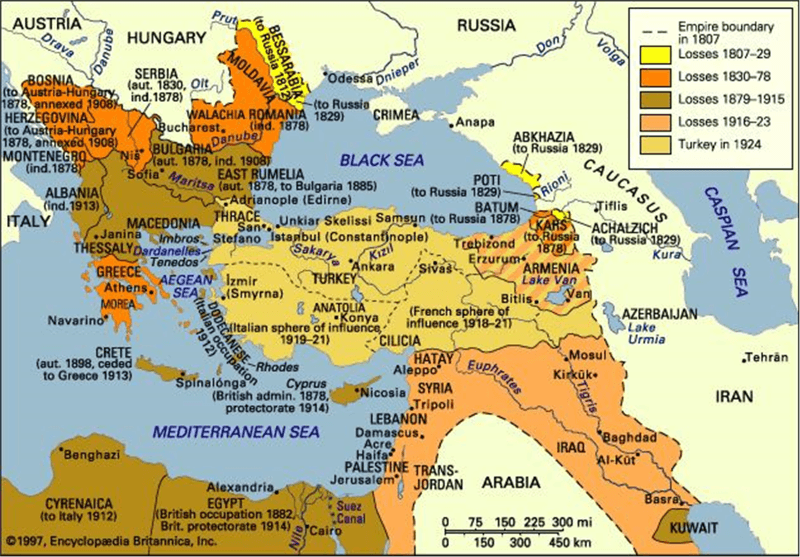
Figure 1: Ottoman Empire, 1800 – 1924[2]
Dhimmitude
A recent article noted the Ottoman continued the Abbasid’s dhimma policies, leading to the harsh treatment of peoples conquered under jihad until the seventeenth century. In addition, large forced relocations of both Muslim and non-Muslim populations occurred as they had during the Abbasid period. These correspond to the period where the Ottoman reached their peak territorial expansion. In regards to jihad and its aftermath;
“The holy war being the cornerstone of the Ottomans state and the source of its expansion, strength, and wealth, the government and administration of the empire was entirely dominated by militaristic imperatives. When resistance from the Habsburgs in central Europe and from Persia in the East halted Ottoman expansion in the sixteenth and seventeenth centuries, the war machine lost its external combat zones and imploded, devastating the territory of the empire itself. As in the Arab period when an anarchical phase followed a period of conquests, so the immigration of semi-nomadic tribes engendered uncontrollable disorders in Anatolia, Armenia, and the Balkans. Turkish immigrants, adventurers, fleeing slaves, and peasants, driven from their lands or deported, formed a floating, rootless population living from banditry, rebel chiefs recruited their troops and their liege men from such groups.”[3]
The Sultan’s Response
Ottoman sultans tried at times to help the conquered peoples, but local chief’s actions often undermined the sultan’s policies. Several actions during this period point to attempts at more humane non-Islamic population treatment. One is Constantinople’s conquest. The sultan spared the city from devastation during the siege. It had to be repopulated after its fall, as “fifty to sixty thousand people were enslaved and deported.”[4] Mehmed II had a goal of restoring the city’s industry and trade.
To do this he brought in people of all ethnicities and religions from within the Empire to the renamed Istanbul. He also extended an invitation to Jews living outside the Empire to come to Istanbul in particular and the Empire in general. Later, under Suleyman I, France was given special dispensations in trade and commerce in return for coordinating its efforts against their mutual enemy, the Hapsburgs. The French privileges later grew into allowing the Catholic Church’s creating schools and missions within the Empire aimed at converting non-Muslims to Catholicism.
The Mixing of State and Religion
We also noted in a previous article the Islamic Empire was sometimes welcomed as a religious liberator. The Christianization of the Roman Empire by Constantine resulted in the mixing of state and religious power, and institutionalizing persecution within Byzantine’s government and administration. These policies and laws “based on religious dogma, were henceforth integrated into Islamic legislation, [and] now justified by other theological principles. In an ironic twist of history, Islam found—in the countries which had come under its domination—an outstanding instrument of oppression for the destruction of Christians, already formulated and perfected by the Church itself.”[5]
“Similarity exists in the two sets of legislation [Byzantine and Islamic] concerning the possession of slaves, proselytism, blasphemy, apostasy, religious buildings, conversions, exclusion from public office, prohibition of mixed marriage, social segregation, and the refusal to accept testimony in court.”[6] Although there was great similarity between both sets of laws, it must be remembered that Islamic law developed within an entirely different culture and ideological structure. Within Islam, these laws were placed within the concept of religious war where the rights of non-Muslims depended on a relationship of protection borrowed from Arabic culture.
To this set of regulations the Muslims added the jizya: “the blood ransom in exchange for the right to life. Later, additional degrading legislation brought persecution to a level of refinement rarely attained. It decreed the form and color of the dhimmi’s clothing and shoes, their haircut and headgear. It specified the type of mounts and saddles permitted and the way in which they could be ridden, as well as greetings and behavior in the street.”[7]
The Results
Monophysites, Copts, Jacobites, Armenians, and Nestorians had all been persecuted and tortured at various times under the Byzantines. And all these different groups at times persecuted the Jews. The Persians had welcomed many of these same groups, and the Nestorians were the largest non-Zoroastrian group within Persia before its fall to the early caliphs. Religious persecution was a primary cause for many groups deserting the Byzantines and welcoming Islam during the early jihad.
Also, under the Ottomans many non-Muslims were allowed to live in self-governing communities called millets under their own religious laws, traditions, and language. A millet’s leader was both a religious and government leader—again a mixing of state and religion into a single function. With the institutionalized persecution noted above, religious intolerance was exacerbated within the millet system—and the Ottomans at times exploited these religious hostilities to maintain order. These schisms reignited again during the rebellions related to the nationalism movements of the nineteenth and twentieth centuries toward the Ottoman Empire’s end.
The dhimmis rebelled in order to restore their basic freedoms and recognize their nationality, culture, and languages. These actions brought reprisals from the umma. A few significant persecutions include:
- The 1822 taking of the Greek island of Chios where all but 1,800 of the 113,000 inhabitants were either massacred or sold into slavery.[8]
- The execution of 100,000 – 200,000 Armenians in eastern Anatolia during 1894 – 1896, that encouraged many Armenians to become Orthodox and seek Russia’s protection.[9]
- The execution of as many as 600,000 Armenians in eastern Anatolia during World War I, with others being deported.[10]
Some Observations from John Quincy Adams
John Quincy Adams wrote some pointed observations about the Ottoman Empire and Islam over one hundred and eighty five years ago. In addition to being the fifth President of the United States, he had a long experienced career serving on diplomatic missions that started with accompanying his father, John Adams, to France and the Netherlands when he was only twelve years old. Beginning at the age of fourteen he spent time in Russia, Finland, Sweden, and Denmark.
Washington appointed Adams minister to the Netherlands in 1793 at the age of 26, and Madison appointed him the first minister to Russia in 1809 where he served until 1814 when recalled to help negotiate the treaty ending the War of 1812 between the US and Great Britain. He served as Secretary of State from 1817 – 1825, and was one of the chief architects of the Monroe Doctrine. The House of Representatives selected Adams as President in 1825, after no candidate received the necessary number of electoral votes needed to win the election.
He witnessed the wars against the Barbary Pirates and the Greek War for Independence from the Ottomans. He opposed intervening in European affairs, and was very well acquainted with both the Ottoman Empire and Islam. Adams was also a long-time slavery opponent.
Christianity and Islam
The following extracts come from the 1830 of The American Annual Register.
“The Christian was taught, that the end of his being on earth, was the salvation of his soul hereafter. … THE ESSENCE OF THIS DOCTRINE IS, TO READY THE SPIRITUAL PART OF HIS NATURE. …
‘In the seventh century of the Christian era, a wandering Arab of the lineage of Hagar, the Egyptian, combining the powers of transcendent genius, with the preternatural energy of a fanatic, and the fraudulent spirit of an imposter, proclaimed himself as a messenger from Heaven, and spread desolation and delusion over an extensive portion of the earth.
‘Adopting from the sublime conception of the Mosaic law, the doctrine of one omnipotent God; he connected indissolubly with it, the audacious falsehood that he was himself his prophet and apostle. Adopting from the new Revelation of Jesus, the faith and hope of immortal life, and of future retribution, he humbled it to the dust, by adapting all the rewards and sanctions of his religion to the gratification of the sexual passion.
‘He poisoned the sources of human felicity at the fountain, by degrading the condition of the female sex, and the allowance of polygamy; and he declared undistinguishing and exterminating war, as a part of his religion, against all the rest of mankind. THE ESSENCE OF HIS DOCTRINE WAS VIOLENCE AND LUST: TO EXALT THE BRUTAL OVER THE SPIRITUAL PART OF HUMAN NATURE.
‘Between these two religions, thus contrasted in their characters, a war of twelve hundred years has already raged. That war is yet flagrant; nor can it cease but by the extinction of that imposture, which has been permitted by Providence to prolong the degeneracy of man. While the merciless and dissolute dogmas of the false prophet shall furnish motives to human action, there can never be peace upon earth, and good will towards men. The hand of Ishmael will be against every man, and every man’s hand against him. …
‘It [Islam] is the dominion of matter over mind; of darkness over light; of brutal force over righteousness and truth. But divine justice finds not its consummation upon earth. Individual virtue or vice, receives much of its retribution after its mortal career has closed; and the rewards and punishments of nations are adapted to measures of time, extending over numerous successive generations, and many centuries of years.”[11] (Emphasis in the original)
The Engines of Commerce and War
Adams contrasts the examples of the American War for Independence with the role of the East India Company in India.
“In the half century that has elapsed since the publication of that work [Gibbon’s Decline and Fall of the Roman Empire], this truth, which a philosophical historian ought then to have discerned and traced to its causes, has been manifested in broader light from year to year. While the whole power of the British empire has been signally baffled by inglorious defeat in the attempt to retain in subjugation three millions of their own countrymen and fellow Christians in North America; a company of London merchants, under the patronage, though with little aid, of their government, have subdued in the far more distant regions of Hindustan, ten times as many millions of the disciples of Mahomet, or their subjects, and, as if Providence had specially intended to mark the contrast of glory and shame between the crescent and the cross, the same Christian chieftain who surrendered his sword to Washington at Yorktown, afterwards received as captive hostages the sons of Tippoo Saib, seven years before the extinction of his life and empire at the storm of Seringapatam.”[12]
Christian and Islamic Obligations
Adams also cites Christianity’s obligations and contrasts those with Islam.
“The infidel denies it in vain – This system of ethics, and of religion, promulgated by ‘the Galilean,’ has raised the standard of human power, as well as of human virtue, higher than that of any other portion of the inhabitants of the globe. …
‘The first of his [Christian] obligations is to himself: to persevere in the program of self-improvement. … His next duties are to his fellow men: to those whom he only, of all the tribes and nations of the earth, is bound by the law of his God to consider as his brethren; as children of the same parent, doomed like him to a pilgrimage of probation here, but entitled, like himself, to look forward to a more joyful and glorious hereafter.
‘His superior acquirements have vested him with the privilege, and imposed upon him the obligation of becoming the teacher of his less enlightened fellow creatures; to make them acquainted with the blessings within their reach; and to lead them in the path of their own felicity. …
‘The precept of the koran is, perpetual war against all who deny, that Mahomet is the prophet of God. The vanquished may purchase their lives, by the payment of tribute; the victorious may be appeased by a false and delusive promise of peace; and the faithful follower of the prophet, may submit to the imperious necessities of defeat: but the command to propagate the Moslem creed by the sword is always obligatory, when it can be made effective. The commands of the prophet may be performed alike, by fraud, or by force.”[13]
An Example
Adams describes an incident after Decatur defeated the Barbary pirates. The United States drew up treaties in both English and Arabic whereby the Dey renounced all claims of tribute from the United States. The Dey signed both treaties, but unbeknownst to Decatur, inserted an unnegotiated clause into the Arabic copy. Per Adams,
“Within a year the Dey demands, under penalty of the renewal of the war, an indemnity in money for the frigate taken by Decatur … The arrival of Chauncey, with a squadron before Algiers, silenced the fraudulent claim of the Dey, and he signed a new treaty in which it was abandoned; but he disdained to conceal his intentions; my power, said he, has been wrested from my hands; draw ye the treaty at your pleasure, and I will sign it; but beware of the moment, when I shall recover my power, for with that moment, your treaty shall be waste paper. He avowed what they always practiced, and would without scruple have practiced himself.”[14]
Conclusions
One trend seen repeatedly throughout these articles is the mixing of religion and government leads to corrupting both, to society’s detriment—regardless of the religion. This is one reason our Constitution fulfills the Declaration’s promise by protecting religion from government. But while our Founding Documents protect religion from government, religion must have an indirect influence on government through the virtue and morality it instills in the people. For that virtue and morality to exist, an ethical moral basis must exist in any religion’s underlying beliefs and philosophy. Society must also continue promoting these values and teaching them to the next generation. Our public schools today do not teach such knowledge, but this is my work’s focus, including The Light & The Rod[15] and A Handbook of Natural Rights.[16]
This work’s objective was simply providing you some information about Islam’s basic tenets, and their development and application to society as seen from history. To state the facts using original source material wherever possible. While the portion about Islam’s history ends here, we’ve come far enough to begin discussing the tenets themselves, along with their compatibility or incompatibility, for a nation built upon Judeo-Christian principles. That is where we head next.
Even if you end your journey here, I hope you continue learning more about this subject. Truth can only be found in our Creator, and it is within the search for truth alone we find our freedom. May we all find and live in His truth.
Footnotes:
[1] Britannica Online Encyclopedia, Ottoman Empire, http://www.britannica.com/place/Ottoman-Empire, accessed January, 2016.
[2] Ibid.
[3] Ye’or, Bat, The Decline of Eastern Christianity under Islam, From Jihad to Dhimmitude, p. 120, Fairleigh Dickinson University Press, 2002
[4] Ibid, p. 132.
[5] Ibid, p. 147.
[6] Ibid.
[7] Ibid.
[8] Ibid, p. 187.
[9] Ibid, p. 195.
[10] Britannica Online Encyclopedia, Ottoman Empire, http://www.britannica.com/place/Ottoman-Empire, accessed January, 2016.
[11] Blunt, Joseph (1830), The American Annual Register for the Years 1827-8-9, Vol. 29, pp. 268-270, New York: E. & G.W. Blunt. [On-line], URL: http://www.archive.org/stream/p1americanannual29blunuoft
[12] Ibid, pp. 270-1.
[13] Ibid, pp. 273-4.
[14] Ibid, p. 274.
[15] Wolf, Dan, The Light & The Rod: Why Biblical Governance Works and Biblical Governance Corruptions, Living Rightly Publications, 2020.
[16] Wolf, Dan, A Handbook of Natural Rights, Living Rightly Publications, 2018.