
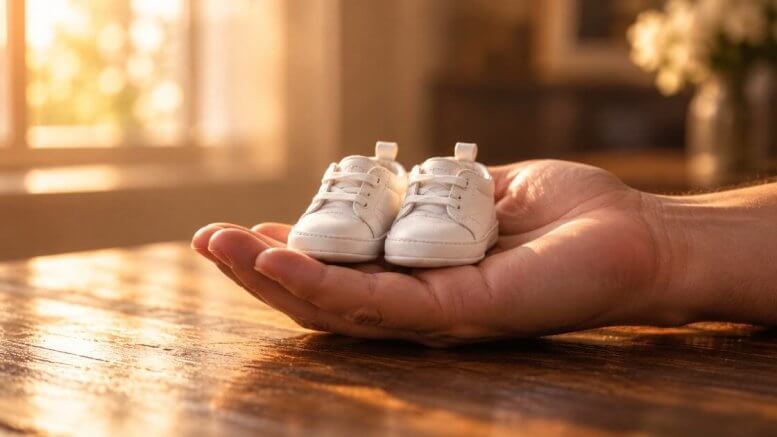
A child at eight weeks can be hidden in a closed fist. No one in the room would know he was there. In 1991, a geneticist told a New Jersey court exactly that, under oath.
Close your own hand and look at it. It looks empty. That is the point of his testimony.
In Part 1, we met the witness, Dr. Jérôme Lejeune. In Part 2, he testified that each child’s genetic “constitution” is spelled out at conception. In Part 3, he showed that the child is human, and one of a kind, from the first cell. Now the lawyer asked him to describe the child at eight weeks, the age of the child in this case.
Tom Thumb
Patrick Mullaney, Alex Loce’s attorney, asked a simple question: at eight weeks, how would you describe that being? (p. 67). Dr. Lejeune answered with a fairy tale.
Sworn Testimony · Transcript pp. 67–68
“I would describe that being indeed as a human being. But to tell the Court what it looks like, I would say it’s Tom thumb.” (pp. 67–68)
Tom Thumb is the boy in the old story who was no bigger than his father’s thumb. “Tom Thumb?” the lawyer asked. Dr. Lejeune explained:
Sworn Testimony · Transcript p. 68
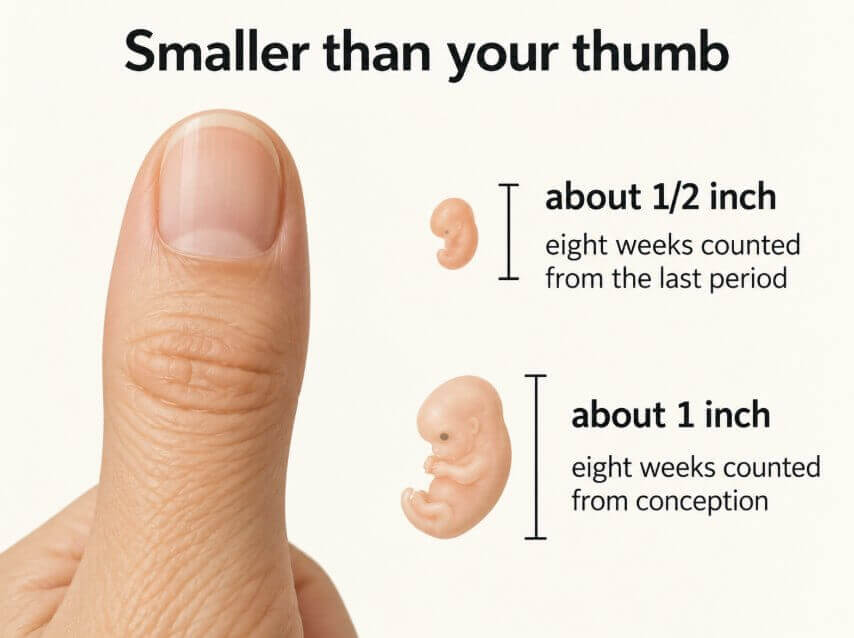
“Tom Thumb. Because the human being at eight weeks is the size of my thumb. That is from the head to the rump, he measure one inch.” (p. 68)
The Closed Fist
Then he made the point with his own hand:
Sworn Testimony · Transcript p. 68
“… if I had an eight weeks human being in my fist you would not see I had anything inside. But if I was opening my hand you would see a tiny human being with fingers, with toes, with a face …” (p. 68)
Closed, the hand looks empty. Open, it holds a child with a face. Nothing in the hand changed. Only what could be seen.
“Each of us has been a Tom Thumb in the womb of the mother,” he told the court (p. 68). Every voter in Virginia was once that small.
Smaller Than Your Thumb
How big is a child at eight weeks? It depends on how you count. Doctors usually count a pregnancy from the first day of the mother’s last period, about two weeks before conception. Scientists who study the child’s earliest growth often count from conception itself.
The court record says the mother was “eight weeks pregnant” (pp. 12, 14). It does not say which count was meant. One state health department guide puts the child at about half an inch by the first count. By the second, he is close to an inch, which fits Dr. Lejeune’s words. Either way, he is smaller than your thumb.
The names change, too. Doctors call him an embryo through about eight weeks after conception, and a fetus after that. “Fetus” comes from a Latin word for bearing young, or offspring. The name changes. The child doesn’t.
The Symphony of Two Hearts
In Part 2, Dr. Lejeune compared a human life to a symphony played from a tape. Here he heard music inside the womb itself. He described a “curious shelter” where only a “dim light comes in,” and where the mother’s heart sounds like a “deep hammering” (p. 68). Then he described the second heart:
Sworn Testimony · Transcript p. 69
“And the other would be a very rapid, like the maracas. And it will come from the heart of this tiny human being.” (p. 69)
Two hearts, two rhythms, two lives in one shelter. He called it “the symphony of two hearts” (p. 69). The old story of Tom Thumb, he said, was never only a story: “The poetry of our forerunner was based upon observation” (p. 69).
Then came the last question of his direct testimony. What does an abortion do to an eight-week human being?
Sworn Testimony · Transcript p. 69
“It kills a member of our species.” (p. 69)
That was the child in the Loce case, whose story Part 1 told.
The Strongest Case for Question 1
Supporters of the amendment say Virginians should make these decisions “without government interference.” They point to women facing a frightening diagnosis, a miscarriage, or a pregnancy at the hardest possible time. Those cases are real. The church owes those women real help, not only arguments.
But the argument assumes an answer to the question this series has put to the evidence: how many individuals are present? Part 3 showed there are two. Part 5 takes up the hardest form of the objection: even if he is human, may the law still allow it?
The Child at Eight Weeks and Question 1
Read the whole amendment. It names the child only once. It calls him “the fetus,” in a clause about the third trimester:
Question 1 · The Amendment’s Text
“in no circumstance shall the Commonwealth prohibit an abortion … (ii) when in the professional judgment of a physician the fetus is not viable.”
“The fetus” is the mother’s unborn child. That is the only time the text names him, and it is in a list of times the Commonwealth may never prohibit an abortion. A child at eight weeks is far from the third trimester. For him, the amendment counts a state interest as compelling only if it is “for the limited purpose of maintaining or improving the health of an individual seeking care.” Open the hand, and there are two.
Question 1 counts only one.
Not Hidden From God
Scripture
“For you formed my inward parts; you knitted me together in my mother’s womb…. My frame was not hidden from you, when I was being made in secret, intricately woven in the depths of the earth. Your eyes saw my unformed substance; in your book were written, every one of them, the days that were formed for me, when as yet there was none of them.” (Psalm 139:13, 15–16)
David wrote these words about his own beginning. God formed him in the womb, in secret, where no human eye could see. Yet his frame “was not hidden” from God. Before he was born, God saw him, and God had already written his days.
That is the closed fist. The womb hides the child from human sight. It does not hide him from God. A people who have now read the testimony cannot say they did not see.
Still to Come
In Part 5, the prosecutor cross-examines Dr. Lejeune. The hardest objection gets a direct answer, along with the gap between the law and the biology.
Read pages 67 through 69 of the original transcript for yourself. Share this with your pastor and your family. Early in-person voting runs through October 31.
Every voter was once small enough to hide in a closed hand. The child at eight weeks cannot speak for himself. The voter can. Vote No on Question 1.
No ballot has ever made a child less human, and no closed hand has ever hidden him from God. But the God who saw him in secret still sees Virginia, and He still holds out mercy to every heart and every pulpit that will open.
Previous: Part 3, Never a Chimpanzee
Start here: Part 1, The Child Who Cannot Vote
Next: Part 5, coming soon
Transcript: Read the original (PDF)
Sources
- Transcript, State of New Jersey v. Alexander Loce, et al., Morristown Municipal Court, April 13, 1991. Complete transcript (PDF); testimony of Dr. Jérôme Lejeune, pp. 36–83; stipulated facts, pp. 12–14.
- Virginia Department of Elections, Proposed Constitutional Amendment, Question 1, full text.
- Planned Parenthood Advocates of Virginia, “Constitutional Amendment for Reproductive Freedom.”
- MedlinePlus (U.S. National Library of Medicine), “Fetal development.”
- Michigan Department of Health and Human Services, “Fetal Development: Week 6” and “Week 8” (weeks after conception).
- Ronan O’Rahilly and Fabiola Müller, “Developmental stages in human embryos: revised and new measurements,” Cells Tissues Organs, 2010.
- Online Etymology Dictionary, “fetus.”
Unless otherwise noted, Scripture quotations are from the English Standard Version (ESV).