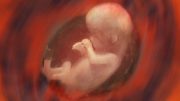
Is the child in the womb human from conception?
And is he an individual?
Most arguments about abortion come back to those two questions. They matter whether or not you ever cast a ballot. But this fall, they matter in a new way. On November 3, Virginians will decide Question 1, which would grant a new right to “every individual.”
In Part 2, Dr. Jérôme Lejeune testified that at conception, a child’s complete genetic makeup comes together for the first time. He called it a new “constitution,” in the old sense of the word, the way we say a man has a strong constitution. Today, his evidence that it belongs to a human being, and to someone who has never existed before.
The Exam
Dr. Lejeune taught genetics at the medical school in Paris. He told the court about an exam he was about to give his students. He would show them two chromosomes, one from a chimpanzee and one from a man:
Sworn Testimony · Transcript pp. 51–52
“And the one who could not tell me this one is a man, this one is a chimpanzee, would fail that examination. It is that simple.” (pp. 51–52)
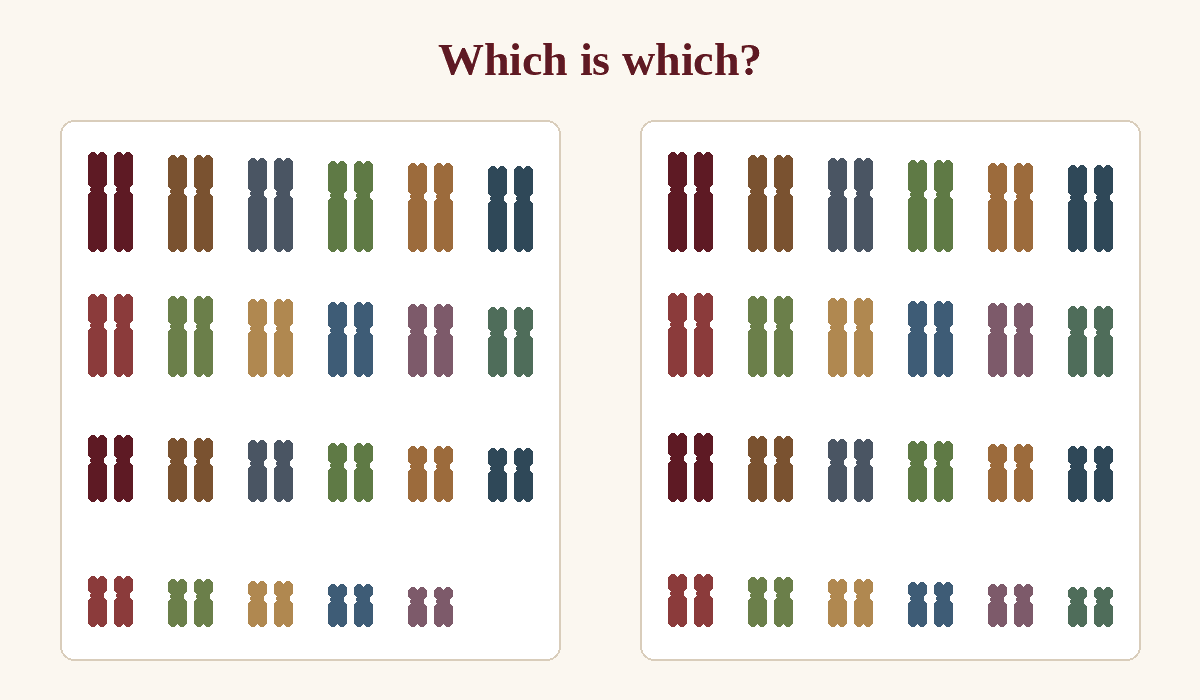
Every species, he testified, carries its own set of chromosomes that a trained eye can recognize. A chimpanzee’s set is a chimpanzee’s. A human being’s set is human (p. 52). When does that difference begin? “It exists at the beginning, that is the fecundation, at fertilization, at conception” (p. 52). In other words, the child is human from conception.
Not Inference. Observation.
Could anyone see this in a single cell? Yes, he said. Looking inside one cell, he explained, destroys it, so he would never do it to a human embryo (p. 53). But he testified that scientists had done it many times with the egg of a mouse, and the chromosomes showed a mouse, not a rat:
Sworn Testimony · Transcript p. 53
“So it’s not any longer inference, a deduction. It is just plain observation.” (p. 53)
Later he put it more simply still. “No baby goes through different species. It belongs to its own species from the very beginning” (p. 67). None of us, he said, was ever a chimpanzee, and none of us will become one (p. 67).
Two Different Species
Biologists classify human beings and chimpanzees as two different species. Even their chromosome counts differ: normally 46 for us, 48 for them. A human child is never, at any stage, a chimpanzee.
Now look back at the two sets above. The one with 23 pairs is human. The one with 24 pairs is a chimpanzee.
The Bar Code
A British scientist, Alec Jeffreys, had found a way to read a pattern in each person’s DNA. “It looks very much like the bar code that you have in a supermarket,” Dr. Lejeune said (p. 55). He explained that half of each person’s bands come from the father and half from the mother (p. 56).
When does that personal pattern appear? “Oh, that takes place at fecundation, at fertilization, at conception” (p. 56). Then came the line at the heart of his testimony:
Sworn Testimony · Transcript p. 57
“But the only thing that the biggest computer will never tell us will be the price of the human life.” (p. 57)
Science can read who he is. It cannot tell us what he is worth. That answer comes from somewhere else.
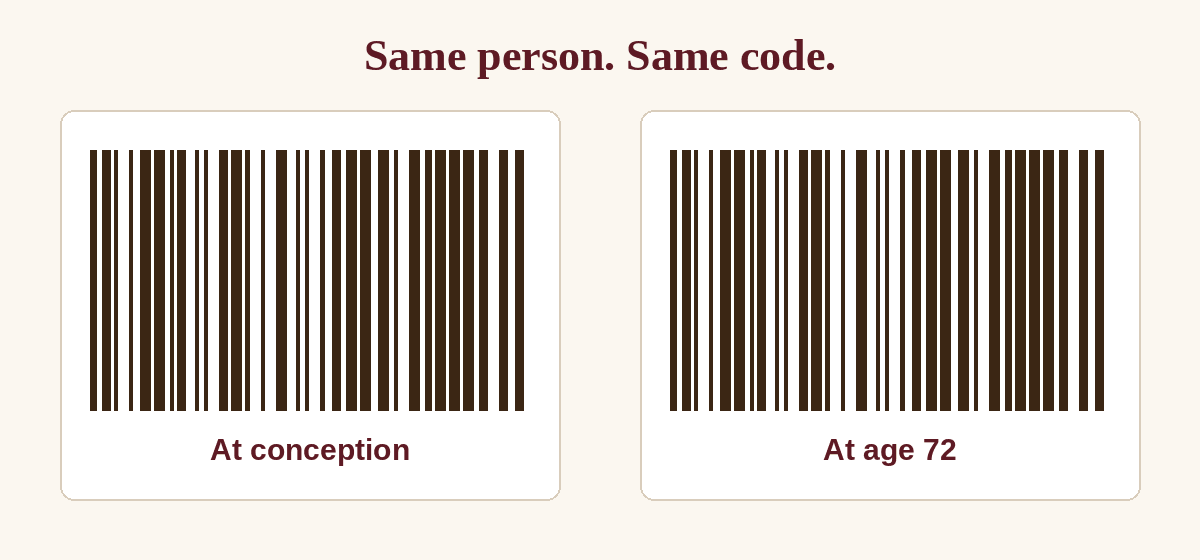
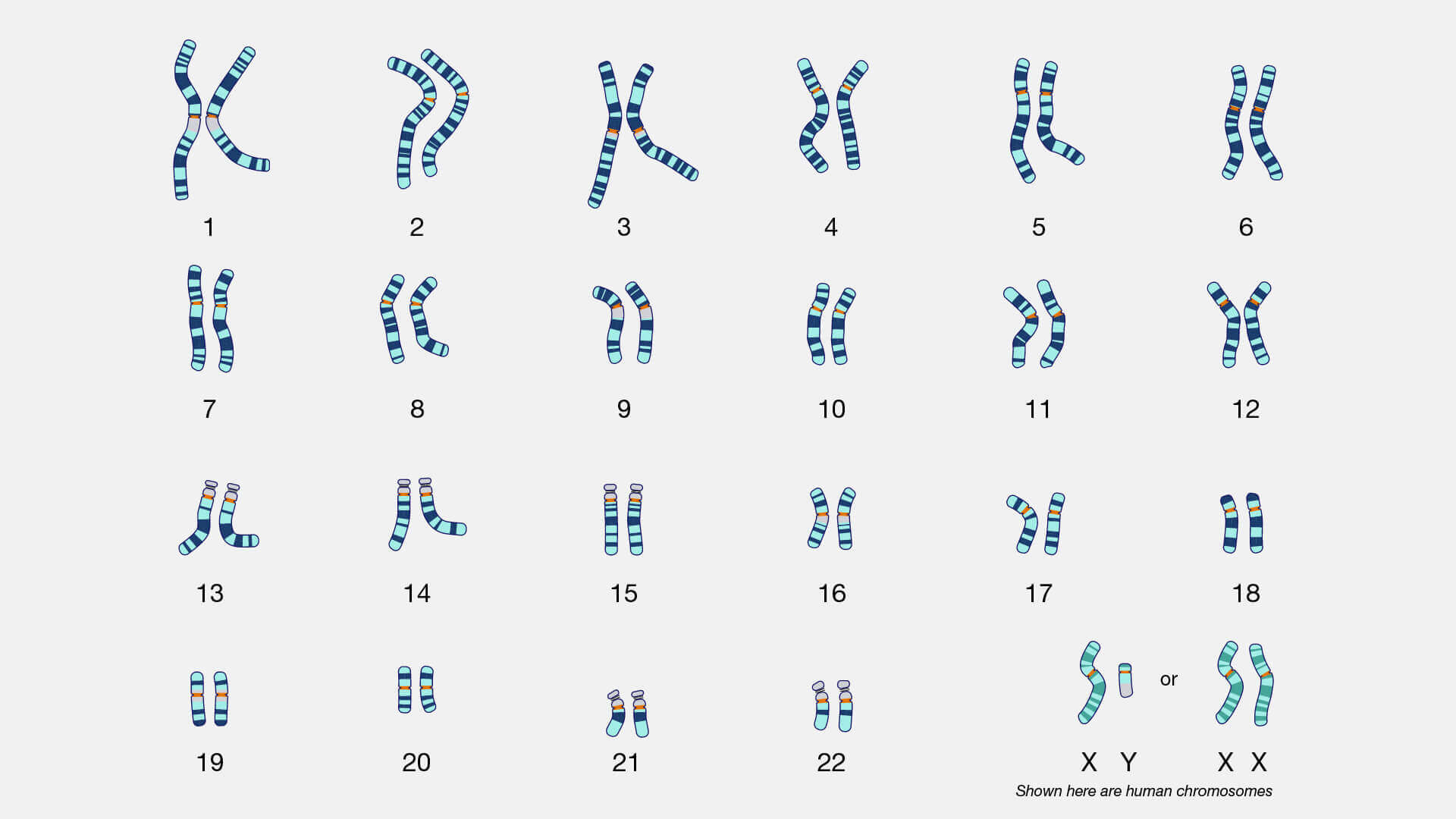
Why a bar code and not a photo? Chromosomes can be photographed, but only in a lab. A photo shows how many chromosomes there are and their shape. It cannot show which person they belong to. A DNA fingerprint compares small parts of your DNA, and it can tell one person from another, except identical twins. Dr. Lejeune compared it to a bar code at the grocery store (p. 55).
Want to go deeper? See the government’s chromosome guide and the very first DNA fingerprint, made in 1984.
What 35 Years Have Added
Dr. Lejeune testified in 1991, and genetics has advanced a great deal since. Later research has added much to his testimony, and refined some details.
The difference he showed his students, 46 chromosomes against 48, is settled science. Since 1997, scientists have known that the child’s own DNA, mostly shed by the placenta, circulates in his mother’s blood. Today it can be found weeks into pregnancy. And researchers have found a child’s cells still living in his mother decades after birth, cells medicine identifies as coming from a genetically different person.
Some details have been refined. Fertilization takes about a day, not an instant. The child’s own genes switch on gradually over the first few days. And in the earliest days, an embryo can split into identical twins.
None of this makes the child less human. Twinning shows that one fertilized egg can become two human embryos. It never shows that he was something less. One child or two, what exists is human from conception. A standard embryology textbook still opens its account of the first week with the words “Human development begins at fertilization.” And the child in the Loce case was eight weeks old, long past any of these early questions.
Human From Conception: What It Means for Question 1
Dr. Lejeune testified, without contradiction, that the child in the womb is human from conception and an individual from the first cell. Yet when the amendment defines the only interest strong enough to limit that right, it allows only one purpose: “maintaining or improving the health of an individual seeking care.”
Two individuals are present. Before the third trimester, the text protects only one.
Question 1 counts only one.
According to Their Kinds, and in His Image
Scripture
“And God made the beasts of the earth according to their kinds…. So God created man in his own image, in the image of God he created him; male and female he created them.” (Genesis 1:25, 27)
Genesis draws the same line Dr. Lejeune drew in his laboratory. Every creature comes into being according to its kind. Only one kind bears the image of God. The child is human from conception. He is human, and he bears that image.
Still to Come
What does that child look like at eight weeks, the age of the child in the Loce case? In Part 4, Dr. Lejeune introduces the court to Tom Thumb. And in Part 5, the hardest question of all: even if he is human, may the law still allow it?
Read pages 51 through 57 of the original transcript for yourself. Share this with your pastor and your family. Early in-person voting runs through October 31.
If he is an individual, he deserves to be represented. He cannot speak for himself before he is born. When you vote, you can. Vote No on Question 1.
No ballot can change his kind or make him less human. And the God who made man in His own image still calls His people to speak for the least of these.
Previous: Part 2, Virginia’s Constitution, and His
Start here: Part 1, The Child Who Cannot Vote
Next: Part 4, coming soon
Transcript: Read the original (PDF)
Sources
- Transcript, State of New Jersey v. Alexander Loce, et al., Morristown Municipal Court, April 13, 1991. Complete transcript (PDF); testimony of Dr. Jérôme Lejeune, pp. 36–83.
- Virginia Department of Elections, Proposed Constitutional Amendment, Question 1, full text.
- “Differences between human and chimpanzee genomes,” BMC Genomics, 2020 (PMC7488140).
- Lasker Foundation, “Noninvasive prenatal testing using fetal DNA,” 2022 award to Y. M. Dennis Lo, who first reported fetal DNA in maternal blood in 1997.
- “Novel insights into the link between fetal cell microchimerism and maternal cancers” (PMC11819148).
- “Dynamics and clinical relevance of maternal mRNA clearance during the oocyte-to-embryo transition in humans” (PMC7530992).
- “Twinning and Individuation: An Appraisal of the Current Model and Ethical Implications,” Biology, 2025.
- National Human Genome Research Institute, “Karyotype,” Talking Glossary of Genomic and Genetic Terms.
- Cold Spring Harbor Laboratory DNA Learning Center, “The first DNA fingerprint.”
- Keith L. Moore, T. V. N. Persaud, and Mark G. Torchia, The Developing Human: Clinically Oriented Embryology, 11th ed., p. 11.
Unless otherwise noted, Scripture quotations are from the English Standard Version (ESV).