
Equipping Christians to Answer with Confidence and Evidence
You’ve Heard the Claims—Now Get the Facts
Every December, you see them. The social media posts. The memes. The confident assertions that Christmas is really just warmed-over paganism. Your co-worker mentions it. Your skeptical uncle brings it up at dinner. Maybe even a fellow believer has shared their doubts.
And if you’re honest, you’ve felt that uncomfortable twinge. What if they’re right? What if everything you’ve celebrated your whole life has pagan origins? What if honoring Christ’s birth actually dishonors Him?
That concern is legitimate. No Christian wants to participate in idolatry—knowingly or unknowingly. But here’s what you need to know:
The claims about Christmas having pagan roots don’t hold up when examined against actual historical evidence.
This article will equip you with the facts, the timelines, and the responses you need to answer these claims with confidence. Not with emotion or tradition, but with documented history.
Because when you examine the primary sources, the archaeological record, and the actual dates, the pagan-Christmas narrative doesn’t just weaken—it collapses entirely.
Watch: The Historical Evidence in 28 Minutes
If you prefer an indepth visual walkthrough, this video presents the same historical evidence you’ll find in this article, but expanded and we highly recommend watching,includes timelines and primary sources displayed chronologically:
Why These Claims Sound So Convincing (And Why You Shouldn’t Feel Bad for Wondering)
First, let’s acknowledge something: if you’ve felt uncertain about these claims, you’re not being weak in your faith. You’re being thoughtful.
The pagan-Christmas narrative spreads so effectively because it follows a persuasive pattern:
- It appeals to superficial similarities (winter celebrations exist in many cultures)
- It uses confident, absolute language (“Christmas was stolen from…”)
- It rarely provides actual citations or dates
- It gets repeated so often it begins to feel true
But here’s the critical point: similarity is not evidence, and repetition is not proof.
History requires dates, sources, and context. When we bring those elements into the discussion, the accusations crumble. Let’s examine the three biggest myths one by one.
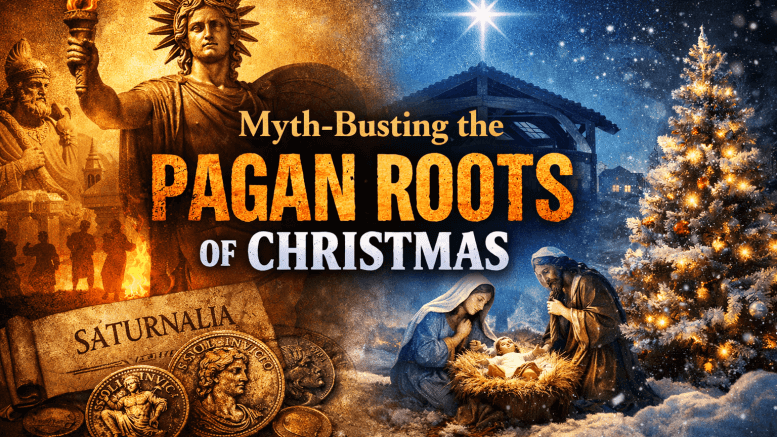
Myth #1: December 25 Was Stolen from Pagan Festivals
The Claim You’ll Hear
“Christians chose December 25 to compete with or absorb pagan festivals like Sol Invictus and Saturnalia. They basically baptized a pagan holiday.”
What the Historical Timeline Actually Shows
This claim sounds convincing until you ask one simple question: What are the actual dates?
Here’s what the documented historical record tells us:
- 195 AD – Clement of Alexandria records that Christians were already discussing and calculating Christ’s birth date
- 211 AD – Hippolytus of Rome explicitly identifies December 25 as Jesus’ birth
- 336 AD – A Roman Christian calendar lists December 25 as the feast of Christ’s birth in Bethlehem
- 354 AD – The FIRST possible reference to an ‘Invictus’ celebration on December 25 appears
Notice what this timeline reveals: Christians were already honoring Christ on December 25 for over a century before any documented pagan festival on that date.
As for Saturnalia? Ancient Roman sources consistently place it between December 17-23. Not December 25. The connection simply doesn’t exist in the primary sources.
📌 QUICK REFERENCE: When Someone Says “December 25 Is Pagan”
YOUR RESPONSE: “Actually, the historical timeline shows the opposite. Christians were documenting December 25 as Christ’s birth by 211 AD—over 140 years before any pagan festival appears on that date. The evidence suggests paganism reacted to Christianity, not the other way around.”
FOLLOW-UP IF NEEDED: “Saturnalia was December 17-23, never the 25th. If you have a source showing a pagan festival on December 25 before 211 AD, I’d be interested to see it.”
Why This Matters for Your Faith
If Christians identified December 25 before any pagan association with that date, then the accusation of borrowing cannot stand. The evidence doesn’t show Christianity absorbing paganism—it shows Christianity establishing its own calendar, and paganism responding to it as Christianity spread.
Myth #2: The Virgin Birth Was Copied from Pagan Gods
The Claim You’ll Hear
“Jesus’ virgin birth was borrowed from earlier pagan gods like Mithra, Horus, and Tammuz. They were all born of virgins on December 25 long before Christianity.”
What the Ancient Sources Actually Say
This claim sounds impressive until you do what most people making it never did: look up the original sources.
Mithra: The Rock-Born God
(the iconic scenes of Mithras show him being born from a rock, slaughtering a bull, and sharing a banquet with the god Sol (the Sun).
Ancient texts, inscriptions, and reliefs unanimously show Mithra emerging fully grown from a rock. There is no mother. No virgin. No birth narrative resembling the Gospels in any way. Mithra was literally called the “rock-born god.” No ancient source assigns Mithra a December 25 birth date.
Horus: Son of Osiris and Isis
Egyptian texts explicitly identify Horus as the son of Osiris and Isis—two divine parents, not a virgin birth. The claims that Horus was born in a cave, announced by a star, or visited by wise men do not appear in any ancient Egyptian source. These details come from modern internet graphics, not archaeology.
Tammuz (Dumuzi): The Spring Fertility God
Tammuz was neither born of a virgin nor associated with December. His cult centered on springtime fertility rituals mourning his death—not celebrating a nativity. Ancient sources identify him as the son of gods conceived through divine union.
📌 QUICK REFERENCE: When Someone Says “Virgin Birth Is Pagan”
YOUR RESPONSE: “I’ve seen those claims, but when you check the ancient sources, they fall apart. Mithra wasn’t born—he emerged fully grown from a rock. Horus had two divine parents, Osiris and Isis. Tammuz was a spring god with no virgin birth. None of these match the Gospel accounts.”
FOLLOW-UP IF NEEDED: “These parallels come from modern websites, not from actual ancient texts. If someone has a primary source showing these virgin births, archaeologists would love to see it.”
The Real Issue
These alleged parallels don’t come from ancient history—they come from modern assertions made without evidence. When you consult primary sources, the similarities vanish completely. The virgin birth of Christ is historically unique.
Myth #3: Christmas Trees and Traditions Are Pagan Worship
The Claim You’ll Hear
“Christmas trees, mistletoe, and Santa Claus all come from pagan worship. Jeremiah 10 even condemns Christmas trees. Christians are practicing paganism without realizing it.”
What History and Scripture Actually Show
Christmas Trees
While ancient cultures revered various trees, the Christmas tree as a home decoration appears in 16th-century Christian Europe, particularly German-speaking regions. There’s no evidence Christians adopted a pagan religious ritual.
As for Jeremiah 10? Read the full chapter. It’s clearly describing the manufacture and worship of carved idols—objects that are feared and worshiped. It has nothing to do with decorating an evergreen tree in your home. Decorating a tree is not worship.
Mistletoe
Yes, Druids used mistletoe in rituals. But kissing under mistletoe is not and never was a religious practice. The first documented use of mistletoe as a Christmas decoration appears in 17th-century England. Using the same plant doesn’t mean sharing the same worship.
Santa Claus
The modern Santa Claus traces back to St. Nicholas, a 4th-century Christian bishop known for secret generosity to the poor. Yes, cultural embellishments accumulated over centuries, especially in the modern West. But the historical roots are unmistakably Christian, not pagan.
📌 QUICK REFERENCE: When Someone Says “Christmas Traditions Are Pagan”
YOUR RESPONSE: “The Christmas tree tradition started in 16th-century Christian Europe. It’s not in any pagan religious texts. And Jeremiah 10 is about carved idols that people worship and fear—not decorated trees in homes.”
FOR SANTA: “Santa Claus comes from St. Nicholas, a Christian bishop famous for helping the poor. The modern commercial version is obviously different, but the origin isn’t pagan.”
KEY PRINCIPLE: “Using the same item (like a plant) doesn’t mean practicing the same worship. Otherwise, Christians couldn’t use candles, sing, or gather—because pagans did those things too.”
Why These Myths Persist (And How to Think About Them)
The pagan-Christmas narrative spreads for several reasons:
- It appeals to suspicion and cynicism (which feels sophisticated)
- It reduces complex history to shareable soundbites
- It replaces evidence with confident assertion
- Social media rewards outrage over patience
But when you examine original sources carefully, the accusations unravel. History rewards patience.
The Real Question Beneath the Myths
In the end, the issue isn’t really about the exact date of Jesus’ birth. Scripture doesn’t command Christmas celebrations—and it doesn’t forbid them either.
The real question is this: Can Christians celebrate the incarnation of Christ with integrity and confidence?
History answers with a resounding yes.
How to Have These Conversations Well
When someone brings up the pagan-Christmas claims, here’s how to respond with grace and confidence:
1. Stay Calm and Charitable
Most people sharing these claims aren’t trying to attack you—they genuinely believe what they’ve heard. Approach them with the same grace you’d want if you’d been misinformed about something.
Try: “I’ve heard those claims too. They’re pretty widespread. But when I looked at the actual historical sources and dates, I found something different. Can I share what I discovered?”
2. Ask for Sources
Many people repeat what they’ve seen in memes or videos. Gently ask where the information comes from:
“That’s interesting—where did you read that? I’d like to check the primary sources.”
Most of the time, they won’t have a source. That’s your opportunity to share the documented timeline.
3. Focus on Timelines, Not Emotions
Don’t argue about feelings or traditions. Stick to documented dates:
“The historical record shows Christians identifying December 25 by 211 AD—over a century before any pagan festival appears on that date. That’s not my opinion; that’s what the timeline shows.”
4. Don’t Be Afraid to Say “I Don’t Know—Yet”
If someone brings up a claim you haven’t researched:
“I haven’t looked into that specific claim yet, but I’d be happy to research it and get back to you. Can you send me where you read that?”
This shows humility while keeping the door open for continued dialogue.
Quick Summary: The Three Main Myths Debunked
|
The Claim |
What History Shows |
Your Response |
|
December 25 was stolen from pagan festivals |
Christians identified Dec 25 by 211 AD—140+ years before any pagan festival on that date |
“The timeline shows Christians came first. Show me a source with a pagan festival on Dec 25 before 211 AD.” |
|
Virgin birth was copied from pagan gods |
Mithra was rock-born, Horus had two divine parents, Tammuz was a spring god—none match the Gospel accounts |
“When you check ancient sources, these parallels disappear. They come from modern claims, not archaeology.” |
|
Christmas trees and traditions are pagan worship |
Christmas trees appear in 16th-century Christian Europe. Jeremiah 10 condemns worshiping carved idols, not decorating trees |
“Using the same item doesn’t mean practicing the same worship. Otherwise Christians couldn’t use candles or music either.” |

The background of our Messiah is Hebraic, not Greco-Roman, so it is important not to import any Gentile influences.
Amen to that, Frank. You’re absolutely right that our Messiah is rooted in a thoroughly Hebraic worldview—Jesus was born a Jew, lived under the Law, fulfilled the Hebrew Scriptures, and cannot be understood apart from Israel’s story.
At the same time, the incarnation occurred at a specific moment in history, within the Greco-Roman world God sovereignly chose (Gal. 4:4). The New Testament itself was written in Greek, circulated along Roman roads, and proclaimed in Gentile contexts almost immediately after Pentecost. None of that diminishes the Hebraic foundation of the gospel—it demonstrates how God carried that foundation into the nations.
The purpose of the article is not to import Gentile influences into Christianity, but to address the claim that Christians borrowed pagan meaning when celebrating Christ’s birth. The historical evidence shows the opposite: early Christians proclaimed the incarnation in a pagan world without adopting pagan worship or theology.
Celebrating the incarnation is not a departure from Hebraic faithfulness; it is the fulfillment of it. As Simeon declared, the Messiah would be “a light for revelation to the Gentiles, and for glory to Your people Israel” (Luke 2:32).
I appreciate your emphasis on guarding theological integrity, and I hope the historical clarification offered here helps distinguish between context and compromise.
Grace and peace.