

Eighth in a series
This article reviews the Islamic caliphate’s early history, beginning with the first caliphs coming from Muhammad’s followers through the Umayyad dynasty. The material comes from traditional sources, and more contemporary sources drawing from earlier ones. Before proceeding with the historical review, there is one final area related to Islam’s development needing discussed. It concerns the Qur’an’s development.
The last couple of articles outlined changes occurring within Islam’s tenets after the migration to Medina. Some of the Qur’an’s verses not only changed over time, but later revelations sometimes conflicted with earlier ones. These changes concerned some of Muhammad’s followers. We already mentioned some early followers left Islam shortly after migrating to Medina (such as the Hypocrites cited in Surah 63). We also mentioned the scribe leaving Islam after Muhammad allowed his suggested changes be incorporated into revelations. This scribe was slain later when Muhammad took Mecca. We’ll cover revelation abrogation first, then move briefly to the Qur’an’s verse collection itself.
Verse Abrogation
Replying to his follower’s concerns about changes and inconsistencies in some revelations, Muhammad received the following, “Such of Our revelations as We abrogate or cause to be forgotten, we bring (in place) one better or the like. Do not you know that Allah is Able to do all things?” (S 2.106) Variations of this revelation repeat in S 13.39 and 16.101. One of Islam’s beliefs is the Qur’an is an exact replica of a book containing Allah’s eternal word transmitted by the angel Gabriel to Muhammad. Abrogation sets up several inconsistencies within Islam that are difficult to reconcile. We will cover them in more detail later, but for now we will simply mention a couple of them here.
- Islam’s claim the Qur’an is the final revelation to humankind is undercut. It raises the question, if Allah’s will changes over time, then why would changes necessarily stop with Muhammad’s death? Indeed we find other sects formed later within Islam claiming new revelations.
- Initially, the Qur’an was primarily oral. See below. With abrogation, how did one know a reciting included all verses, or only the true unabrogated revelations? Tradition has it the Qur’an was not in a fully written form until the first caliphs from Muhammad’s inner circle.
Islamic tradition accepts some items aren’t included in the Qur’an. These include the verses referred to as the Satanic verses. The Shia also assert some verses were excluded from the Qur’an by the third caliph Uthman. Can a source be perfectly preserved if it doesn’t include all the material? These questions all concern revealed truth.
Collecting the Qur’an’s Verses
The literal meaning of the word Qur’an is “the reading” or “the recital”. The Qur’an was likely never intended to be in written form, and its verses were not yet collected at Muhammad’s death. This makes sense in a society where many people could neither read nor write, and paper was expensive. However, within about a year of Muhammad’s death, tradition has it many of Islam’s early followers were dead after the battle of Yamamah, and portions of the Qur’an were in danger of being lost. Efforts began at that time to collect all the verses and assemble them into codex form. The pointing and diacritical marks found in the modern Arabic language also did not yet exist.
The above affected the Qur’an’s development and Islam itself. We’ll mention some of these developments as we cover the caliphate’s history. Others we’ll cover afterward, using the history for context.
Islam’s spread after Muhammad occurred in two waves. The remainder of this article and the next look at the first wave.
The First Wave
Muhammad left no successor at his death. From Ibn Ishaq’s sirat, “Had it not been for what Umar said when he (Muhammad) died, the Muslims would not have doubted that the apostle had appointed Abu Bakr his successor; but he said when he died, ‘If I appoint a successor, one better than I did so; and if I leave them (to elect my successor) one better than I did so.’ So the people knew that the apostle had not appointed a successor and Umar was not suspected of hostility towards Abu Bakr.”
Muhammad’s followers met and discussed who would take his place, even before completing his burial arrangements. Some argued Muhammad’s successor should be from his inner circle, others it should be someone from his blood-line. The first three caliphs came from Muhammad’s inner circle, and the fourth was a nephew. The basis of the caliph’s authority was only temporal—not spiritual. He ruled in Islam’s name and upheld its teachings. Bear in mind when Muhammad died there was no written Qur’an yet, nor had clerics derived any official doctrines.
The First Four Caliphs
The first four caliphs ruled for less than thirty years. Three of the four were also assassinated.
Abu Bakr (632 – 634);
Abu Bakr was the father of Aisha, one of Muhammad’s favorite wives. A group of the early Islam converts chose him on the basis of who the Muslims would follow. Khalid ibn-Walid (the Sword of Islam) became the army’s general during Abu Bakr’s reign. The Wars of Apostasy occurred to more permanently cement the Arabs to Islam, and enforce tribute payment. Islam expanded into Gaza and Caesarea.
One tradition says Umar requested the Qur’an’s verses be collected after the battle of Yamamah in 633, as many of Muhammad’s remaining early followers capable of reciting the Qur’an died during this battle. Muhammad’s scribe Zayd ibn Thatbit was appointed to collect and assemble all the Qur’an’s verses.
Umar (634 – 644):
Both Persia and the Eastern Roman Empire had been greatly weakened by years of war with each other. Umar brought Jerusalem under Islam’s control in 638, and by 641 he had conquered Iraq, Syria, Egypt, and Persia. Rome and Persia had fought each other for almost five hundred years, but Persia was no more within ten years of Muhammad’s death. Former Persian mercenaries and military slaves taken in battle aided the Arabs, many of whom had been Monophysite Christians. It is not clear what attracted these mercenaries and slaves to help; was it Islam’s religious aspects, shared Arab cultural ties, or merely the attraction of collecting booty? These converts taught the Islamic leaders new battle tactics and counter-measures. An Iraqi slave assassinated Umar in 644.
Uthman (644 – 656):
Uthman consolidated his predecessor’s conquests. He was the first caliph to come from Arab society’s higher order. This put the Quryash back in control. Nepotism marked his reign. Rebels assassinated Uthman, marking the first of the rebellions against divine law. Uthman selected the Medinan codex as the Qur’an’s official writing. He ordered all other codices and derived variant readings destroyed. There is more on this topic later in this article.
Ali (656 – 661):
Ali was a nephew of Muhammad. One of Muhammad’s wives, Aisha, disliked Ali. She conspired with the Governor of Syria to overthrow him. Both the Governor of Syria and Uthman belonged to the same tribe, the Umayya. Civil war ensued. Ali moved the caliphate’s capital from Medina to Damascus. Ten thousand Muslims died at the ensuing Battle of the Camel, which the forces allied with Ali won. However, Ali was later assassinated by one of his former supporters. This marked the end of rule by those closely associated with Muhammad and the Umayyad dynasty’s formation. Ali’s death also deepened the rift between those supporting a successor from Muhammad’s inner circle (Sunni) and those supporting one from Muhammad’s blood-line (Shia).
The Umayyad (661 – 750)
Mu’awiyah, the Governor of Syria, led the opposition against Ali. He made the caliph’s position an inherited one. Ali’s eldest son (Hasan) briefly opposed Mu’awiyah, but then abandoned his claim. Hasan’s brother Husayn went along with the decision as long as Mu’awiyah lived. However, he refused to recognize Mu’awiyah’s son, and in 680 created an anti-caliph state in Iraq. The Umayyad later defeated Husayn and killed most of his family. This sealed the split between the Sunni and Shia. In 749, rebels killed all but one family member of the last Umayyad caliph, Marwan. The one surviving son fled to Spain.
The Umayyad concerned themselves with acquiring wealth and land. Tradition has it they had little concern for religious doctrine. They surrounded themselves with palaces, poets, wine, etc. In addition, maintaining their armies required a large revenue stream. Internal power struggles resulted in numerous revolts during the dynasty’s later years. One uprising led to the Kaaba’s burning in Mecca. Shiites, Berbers, and Kharijites all took up arms against the Umayyads, in part because of their second-rate standing in a society where all were supposed to be equal.
Early Qur’an Development
Within his work Why I Am Not a Muslim, Ibn Warraq goes as far to state that, “there is no such thing as the Koran; there never has been a definitive text of this holy book.”[1] As already mentioned, there was no written Qur’an text at Muhammad’s death. In addition to Umar’s request to Abu Bakr, other followers also attempted to collect the revelations and put them into codex form. The Arabic text of this time consisted strictly of consonants.
By the time of Uthman’s reign, there existed codices within the centers of Mecca, Medina, Damascus, Kufa, and Basra. The consonantal text between these codices did not agree. It was impossible to distinguish between certain consonants using the original unpointed text (such as b from t from th, or s from d, for example). Uthman selected the Medinan codex, attempting to standardize the consonantal text. This codex used the dialect of Muhammad’s tribe. Uthman sent copies of this codex to all the above cities, with orders to destroy all variants.
However, the number of variant readings continued increasing, because there were also no orthographic signs indicating vowel placement within the text. By the Umayyad dynasty’s end, literally thousands of variant readings existed for some Qur’an verses. Also, by the same time, clerics began creating rules limiting the number of variant readings produced by codex text. However, new variant readings continued increasing until the tenth century when Islamic scholars, led by Ibn Mujahid, canonized one system of consonants and put limits on vowels incorporated into that text. Clerical rule creation eventually led to developing the “system of the seven”, seven accepted Qur’an variant readings, discussed further in the next article.
Hadith
Hadith are collections of Muhammad’s saying, providing Qur’an verse context, as meaning could only come from the text itself or reliable transmitters through the hadith or sirat. Their creation also proliferated during this time. There are several fundamental differences between the Bible and Qur’an. For instance, within the Qur’an no sense of chronology or history exists. Surah arrangement instead is from longest to shortest. Muhammad received many of the longer surahs while in Medina, so these appear early in the Qur’an. Additionally, there are abrupt subject matter shifts within some surahs.
Hadith Fabrication
From Ibn Warraq again, “During the early years of the Umayyad dynasty, many Muslims were totally ignorant in regard to ritual and doctrine. The rulers themselves had little enthusiasm for religion and generally despised the pious and the ascetic. The result was that there arose a group of pious men who shamelessly fabricated traditions for the good of the community.”[2] However, “the ruling power itself was not idle. If it wished an opinion to be generally recognized and the opposition of pious circles silenced, it too had to know how to discover a hadith to suit its purpose. They had to do what their opponents did: invent, and have invented, hadiths in their turn. And that is in effect what they did.”[3]
Also from Ignaz Goldziher, “Not a few pious persons admitted, as the end of life neared, how great their contribution to the body of fictive hadiths had been. To fabricate hadith was hardly considered dishonorable if the resulting fictions served the cause of good.”[4] Society did not necessarily reject fraudulent hadith, rather, “The pious fraud of the inventors of hadith was treated with universal indulgence as long as their fictions were ethical or devotional.”[5] Hadith also underwent clerical review and categorization later during the Abbasid dynasty.
Islam’s Early History
In summary, massive Islamic state expansions occurred, as Arab and non-Arab Islam conversions happened in some areas where little or no formal religious doctrines previously existed, at a time when Qur’an variant readings increased, and groups created hadith supporting their goals within Islamic society. Umayyad actions also added instability, leading to their demise and the Abbasid dynasty’s rise by the mid-eighth century.
Under the first four caliphs and Umayyad dynasty, Islam advanced to the west through Palestine, Egypt, across north Africa, into Spain where an army under Charles “The Hammer” Martel stopped them at Tours in 734. In the east Islam conquered modern day Syria and Persia (Iran), as far east as the Indus river in modern Pakistan and north to Armenia. Arabs who previously settled in these areas as Monophysite and Nestorian Christians often aided the invading armies.
Bat Ye’or, in The Decline of Eastern Christianity under Islam, provides the following example.
“The attack on Babylonia took place on two fronts which corresponded precisely to the densest Arab settlements: in the south, around Ubulla; and slightly higher up the Euphrates, in the Hira region. Large numbers of Christian Arab tribes fought on the Persian side, but others, long settled in these regions and attracted by booty, went over to the Muslims. The chief of one of these tribes, the Banu Ijil, had even informed the caliph Umar, then in Medina, of deficiencies in the Persian defenses and had invited him to send an army there. Tribes from northern Arabia who pillaged villages along the Euphrates and took advantage of the Persian weakness were enrolled in the Islamic forces.”[6]
The Conquered Peoples
The caliphate’s armies executed four thousand Jews, Christians, and Samaritans in the area from Gaza to Cesarea in 634. Major towns, like Jerusalem, closed their gates preventing them from being taken. Towns protected by walls were usually able to negotiate a treaty with the caliphate’s army, and the people became dhimmis. Rural areas were not so fortunate. Fires devastated rural croplands, and peasants were either massacred or taken as slaves. In 642, the caliphate’s armies annihilated Dvin’a population, and carried off 35,000 captives when returning later that year.
Conquest engrossed the first caliphs. They negotiated with town civic and religious leaders, leaving military governors ruling the new territories. Initially, the local people viewed Islam simply as another Jewish or Christian heresy. Few Qur’an copies existed, fewer yet could read it, and jihad did not appear to differ from the razzias (raids) Arab tribes committed during earlier centuries. As a result, the West never fully understood the change Islam brought. A mistake we risk repeating today, because we are failing to study and learn history’s lessons.
One example, the prince of Nahavend (located in modern Iran) received Al-Mughira thinking he arrived at the prince’s door through hunger and poverty. He offered to “supply you [Al-Mughira] with provisions and you can then go back whence you came.” Al-Mughira replied they were fighting in the cause of a prophet who arose among their people. This prophet gave them revelations they would receive great victories where they saw such wealth and luxury “that those who follow me will not wish to withdraw till it has become theirs.”[7]
The Dhimmi
It is during this period the treatment and status of Dhimmis first solidified. Dhimmi means “protected people”. They are the defeated people of the book who do not convert to Islam. The caliphate required they pay several taxes in addition to a poll tax (jizra). Their protected status lasted only as long as they obeyed treaty terms, or did not offend the Muslims within the area in which they lived.
The Pact of Umar, written by Umar b. Abd al-Aziz in the early 8th century, is an early codification of dhimmitude. It states:
“We shall not build in our cities or in their vicinity any new monasteries, churches, hermitages, or monks’ cells. We shall not restore, by night or by day, any of them that have fallen into ruin or which are located in the Muslims’ quarters.
We shall keep our gates wide open for the passerby and travelers. We shall provide three days’ food and lodging to any Muslims who pass our way.
We shall not shelter any spy in our churches or in our homes, nor shall we hide him from the Muslims.
We shall not teach our children the Qur’an.
We shall not hold public religious ceremonies. We shall not seek to proselytize anyone. We shall not prevent any of our kin from embracing Islam if they so desire.
We shall show deference to the Muslims and shall rise from our seats whenever they sit down.
We shall not attempt to resemble the Muslims in any way . . .
We shall not ride on saddles.
We shall not wear swords or bear weapons of any kind, or ever carry them with us.
We shall not sell wines.
We shall clip the forelocks of our head.
We shall not display our crosses or our books anywhere in the Muslims’ thoroughfares or in their marketplaces. We shall only beat our clappers in our churches very quietly. We shall not raise our voices when reciting the service in our churches, nor when in the presence of Muslims. Neither shall we raise our voices in our funeral processions.
We shall not build our homes higher than theirs. …
‘Anyone who deliberately strikes a Muslim will forfeit the protection of this pact.”[8]
Taxation
The Umayyad enforced five different taxes upon the conquered peoples. These included: (1) a land tax (kharaj), (2) provisions in kind, proportionate to harvests, (3) a poll tax (jizya), (4) a tax covering the tax collector’s maintenance and expenses, and (5) “a general sum devoted to requisitions, extraordinary taxes, and the upkeep and clothing of Muslims.”[9] Arab taxation and pillaging forced many of these people to flee Muslim lands or hide in the mountains. These actions deprived the caliph of much revenue supporting Islam’s army and conquests. To protect that revenue, he attached taxes to the property itself. Churches began conversion into mosques at this time.
Outcomes
During the first wave conquests, many towns were able to keep most of their religious and political autonomy by simply paying tribute to Medina instead of to Byzantine or Persia, as the Muslims were a local population minority. The caliphate often left local Christians or Jews in administrative positions and the Christian Church took on the administration of collecting taxes. Over time Islam moved whole Arab tribes into these areas, a form of colonialization. Eventually, Arab populations grew and assumed local power; Muslims filled the administrative positions instead of Jews or Christians.
The early caliphate changed the conquered lands in several ways. One, land was seized on the military authority of a tribe originating from Mecca, and exercised that authority through nomadic Arab tribes. Two, massive Arab emigration created anarchy in the areas where they settled. Three, the method for allocating property and booty between the tribes and Arab state created a perpetual state of bloody conflict, turning previously cultivated areas into wastelands. And four, inflicting destruction on the local labor force, the only means of taxation, resulted in drastically diminishing Umayyad revenues. These outcomes led to inter-Arab religious conflicts, destabilizing the Umayyad. Different conflicting goals between groups also led to fabricating hadith, and the early Arab language led to many Qur’an variant readings. These resulted in the Abbasid dynasty’s rise, which is the next article’s subject.
The map below shows the rapid caliphate expansion during its first 120 years after Muhammad’s death. During this time it conquered an area roughly the size of the Roman Empire at the height of its power.
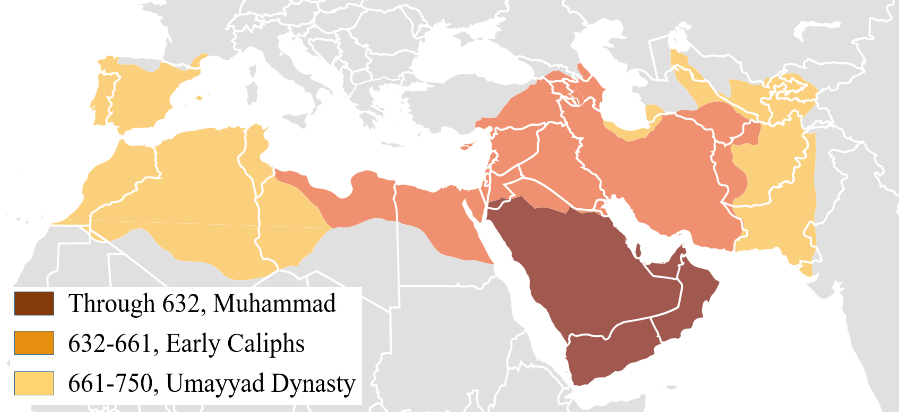
Map from http://academic.udayton.edu/williamschuerman/Growth_of_Islamic_Caliphate.jpg
Footnotes:
[1] Warraq, Ibn, Why I Am Not a Muslim, p. 108, Prometheus Books, 2003.
[2] Ibid, p. 70.
[3] Goldziher, Ignaz, Muslim Studies, Volume 2, p. 43, State University of New York Press Albany, 1971.
[4] Goldziher, Ignaz, Introduction to Islamic Theology and Law, p.43, Princeton University Press, 1981.
[5] Ibid, p. 44.
[6] Ye’or, Bat, The Decline of Eastern Christianity under Islam: From Jihad to Dhimmitude, p. 46, Associated University Presses, 1996.
[7] Ibid, p. 57.
[8] Warraq, Ibn, Why I Am Not a Muslim, p. 230, Prometheus Books, 2003.
[9] Ye’or, Bat, The Decline of Eastern Christianity under Islam: From Jihad to Dhimmitude, p. 72, Associated University Presses, 1996.