
Fifteenth in a Series
We now transition away from the previous section’s historically oriented material. We begin examining some of Islam’s tenets and beliefs, and how it implemented them into society over time. The goal is understanding those ideas enough to make comparisons with their Christian counterparts—where we can make one. No judgment; just information with the goal of understanding. I stated at this series beginning what matters most is understanding my own faith, and another faith sufficiently to determine whether something is similar or different. Then, if different, does the difference matter.
The next part of this series examines some of the big questions, such as; who is God, what is man, and what is the relationship between them. The answers lead us into areas concerning societal structures, such as; governance, law, rights, freedom, and justice—to name a few. This first post looks at God’s nature. A similar article about Allah’s nature follows this one, with some differences between them. Today will be a dive into philosophic thought, from about 1,800 years ago. It won’t be painful, but is necessary for the road ahead.
Why Does it Matter?
Let’s start with a question. Why does this matter? The answer is straight-forward. To succeed in the long-run, all societies must have an underlying moral basis. Our Founders understood this in establishing America’s framework; one based upon Judeo-Christian principles.
Most of this article’s material comes from A War for God,[1] focusing on the works of Clement of Alexandria. Clement lived in the late second and early third centuries. He was a pagan philosopher who converted to Christianity; his writing focused on man’s relationship with God. Clement’s works are among the oldest of the church fathers. Augustine cited his work in his The City of God. Finally, he lived over 300 years before Muhammad. Clement addressed the problem faced in both understanding God and responding to the pagan platonic thought prevalent during his lifetime.[2]
Clement’s Problem Description
Clement lays out the problem as follows.
“The professed aim of our philosophy … leads through Wisdom, … to the Rule of all, —a Being difficult to grasp and apprehend, ever receding and withdrawing from him who pursues. But He who is far off has … come very near … He is in essence remote … But He is very near in virtue of that power which holds all things in its embrace … For the power of God is always present, in contact with us, in the exercise of inspection, of beneficence, of instruction. … God is not to be known by human wisdom … For God is not in darkness or in place, but above both space and time, and qualities of objects.”[3]
Clement is laying out his balance between transcendence and immanence.[4] God is transcendent and therefore One. He has Being. We cannot come to know God through human wisdom, and is outside of time and space—a simple unity. It is His power which is immanent and appears to be a complex unity as there are different positive attributes associated with that power. So what does Clement say about God?
God is One
First, that “God is one.”[5] As our Creator is transcendent, He has been spoken of “in enigmas, and symbols, and allegories, and metaphors, and such like tropes.”[6] Clement noted, however, that most men think our Creator to be like themselves. They fail to notice that our Creator “has bestowed on us ten thousand things in which he does not share.”[7] These things include birth, food, growth, long life, and our bodies. We should interpret all such references as symbolic and not literal.
But that does not mean that we cannot have some understanding of Him. We know our Creator through a process of confession, contemplation, and analysis, stripping away “not what He is but what He is not.”[8] This stripping away includes all form, motion, position, place, throne, and notions of right hand or left. “The First Cause is not then in space, but above both space, and time, and name, and conception.”[9]
Reason Alone is Not Enough
This process indicates that “In reasoning, it is possible to divine respecting God”[10] by moving within the world of thought. However, reason alone is not enough. “Should one say that Knowledge is founded on demonstration by a process of reasoning, let him hear that first principles are incapable of demonstration; for they are known neither by art nor sagacity … Hence … the first cause of the universe can be apprehended by faith alone.”[11] We also must know Him by faith. The knowledge of our Creator comes not from man, but by His power through the Logos, for “the grace of knowledge is from Him by the Son.”[12]
Clement finds this line of thought difficult because it is hard to exhibit the absolutely first and oldest principle. We cannot express our Creator as He is not genus, difference, species, an individual, number, event, nor caused by an event. “No one can rightly express Him wholly. For on account of His greatness He is ranked as the All, and is the Father of the universe. Nor are any parts to be predicated of Him. For the One is indivisible; wherefore also it is infinite, not considered with reference to inscrutability, but with reference to its being without dimensions, and not having a limit. And therefore it is without form and name.”[13] Even though no one can fully or correctly express the Creator, He is not inscrutable.
So why do we use names to describe Him? “We speak not as supplying His name; but for want, we use good names, in order that the mind may have these as points of support, so as not to err in other respects. For each one by itself does not express God; but all together are indicative of the power of the Omnipotent.”[14] The names we do use are good and keep us from going further astray as we are limited in our ability to understand Him, and what we can understand of Him lies within the mind. “For the God of the universe, who is above all speech, all conception, all thought, can never be committed to writing, being inexpressible even by His own power.”[15]
God’s Nature
Clement asserts there is a Father and Son (Logos). Both are God, a unity. He also presents two different themes of the Father and the Son. One theme is the emphasis on the unity of the Father and the Son, as in the following passages.
- “The Son in the Father, and the Father in the Son.”[16]
- “Our Instructor is like His Father God … the Word who is God, who is in the Father … and with the form of God is God.”[17]
- “But nothing exists, the cause of whose existence is not supplied by God. Nothing, then, is hated by God, nor yet by the Word. For both are one—that is, God.”[18]
- “And His justice is shown to us by His own Word from there from above, whence the Father was. For before He became Creator He was God.”[19]
- “He Himself being one, the Son of the Father, who is truly one, the beginning and the end of time.”[20]
Unity and Distinction
The preceding thoughts all stress the Creator’s unity. There is only One Creator. Clement draws a contrasting theme indicating that there is a distinction between the Son and the Father. Yet, even within the distinction, the Son is still one with the Father—there is still unity. The distinctions Clement expresses are that the Son is (1) the Creator’s power, (2) the Creator’s image, but still one with Him, (3) the Creator of all creation, and (4) the key to what we can know about our Creator.
- “God then, being not a subject for demonstration, cannot be the object of science, but the Son is wisdom, and knowledge, and truth, and all else that has affinity thereto. He is also susceptible of demonstration and of description … And the Son is neither simply one thing as one thing, nor many things as parts, but one thing as all things; whence also He is all things. For He is the circle of all powers rolled and united into one unity.”[21]
- “But the nature of the Son, which is nearest to Him who is alone the Almighty One, is the most perfect, and most holy, and most potent, and most princely and most kingly and most beneficent. … For from His own point of view the Son of God is never displaced; not being divided, not severed, not passing from place to place, being always everywhere, and being contained nowhere, complete mind, the complete paternal light; all eyes, seeing all things, hearing all things, knowing all things, by His power scrutinizing the powers. … He, the paternal Word … For the Son is the power of God, as being the Father’s most ancient Word before the production of all things, and His Wisdom.”[22]
- “He, the Son, is,… the cause of all good things, being the first efficient cause of motion – a power incapable of being apprehended by sensation. … Being, then the Father’s power, He easily prevails in what He wishes, leaving not even the minutest point of His administration unattended to.”[23]
- “And as the Lord is above the whole world, yea, above the world of thought, so the name engraven on the plate has been regarded to signify … it is the name of God that is expressed; since as the Son sees the goodness of the Father, God the Saviour works, being called the first principle of all things which was imaged forth from the invisible God first, and before the ages, and which fashioned all things which came into being after itself.”[24]
- “And as the unoriginated Being is one, the Omnipotent God; one, too, is the First-begotten, ‘by whom all things were made, and without whom not one thing ever was made.’”[25]
- “‘Now the just shall live by faith,’ which is according to the covenant and the commandments; since these, which are two in name and time, given in accordance with the [divine] economy—being in power one—the old and the new, are dispensed through the Son by one God.”[26]
- “For the gates of the Word being intellectual, are opened by the key of faith. No one knows God but the Son … through whom alone God is beheld.”[27]
As we can describe the Son, He is immanent. The Father is transcendent as He is outside of human thought and inexpressible directly.
First Principle
But how is this possible? Clement cites both Father and Son as being the First Principle and Creator, but he says that they are First Principle and Creator in different senses of the word, similar to the four causes discussed in Aristotle’s Metaphysics.[28]
- “Wherefore the Word is called the Alpha and the Omega, of whom alone the end becomes the beginning, and ends again at the original beginning, without any break….
‘Now God, who is without beginning, is the perfect beginning of the universe, and the producer of the beginning. As, then He is being, He is the first principle of the department of action, as He is good, of morals; as He is mind, on the other hand, He is the first principle of reasoning and of judgment. Whence also he is Teacher, who is the only son of the Most High Father, the Instructor of men.”[29]
- “The timeless and unoriginated First Principle, and Beginning of existence – the Son – from whom we are to learn the remoter Cause, the Father, of the universe, the most ancient and the most beneficent of all.”[30]
From the above our Creator is the source of all existence, morality, and knowledge. The distinctions that Clement lays out are not always consistently maintained. This goes back to his statements about our inability to accurately name or write about our Creator. These only serve to act as “points of support” for our limitations.
Clement only refers to the Holy Spirit twice in his writings we have today. However, reference to God’s Spirit appears in the second verse of Genesis, the Ruwach Eloyihm. The Holy Spirit is the third person within the essence we call God.
Putting it Together
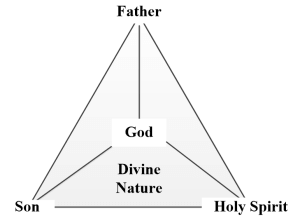
So we have a God who is One. He has Being, Essence, Nature. While He is One, He is a combination of transcendence and immanence. He has been described as a single essence containing three persons. We can diagram that relationship as follows.
God is our Creator, and He is Good. Clement notes that doing good and doing wrong are opposites, and they are not compatible. “To do wrong, then, is not good, for no one does wrong except for some other thing; and nothing that is necessary is voluntary. To do wrong, then is voluntary, so that it is not necessary. But the good differ especially from the bad in inclinations and good desires. For all depravity of soul is accompanied with want of restraint; and he who acts from passion, acts from want of restraint and from depravity.”[31] Doing wrong is voluntary and driven by internal factors.
In discussing good, Clement cites Plato saying there are two goods. “Further, Plato the philosopher says that the end is twofold: that which is communicable, and exists first in the ideal forms themselves, which he also calls ‘the good’; and that which partakes of it, and receives its likeness from it, as is the case in the men who appropriate virtue and true philosophy.”[32]
The Good
The first good is our Creator as follows:
“For assuredly He does not hate anything, and yet wish that which He hates to exist. Nor does He wish anything not to exist, and yet become the cause of existence to that which he wishes not to exist. Nor does He wish anything not to exist which yet exists. If, then, the Word hates anything, He does not wish it to exist. But nothing exists, that cause of whose existence is not supplied by God. Nothing, then, is hated by God, nor yet by the Word. For both are one—that is, God…. If then He hates none of the things which He has made, it follows that He loves them. Much more than the rest, and with reason, will He love man, the noblest of all objects created by Him, and a God-loving being. Therefore God is loving; consequently the Word is loving.
‘But he who loves anything wishes to do it good. And that which does good must be every way better than that which does not good. But nothing is better than the Good. The Good, then, does good. And God is admitted to be good. God therefore does good. And the Good, in virtue of its being good, does nothing else than do good. Consequently God does all good. And He does no good to man without caring for him, and He does not care for him without taking care of him. For that which does good purposely, is better than what does no good purposely. But nothing is better than God. And to do good purposely, is nothing else than to take care of man. God therefore cares for man, and takes care of him…. But the good is not said to be good, on account of its being possessed of virtue … but on account of its being in itself and by itself good.”[33] “For there is one good, the Father.”[34]
Implications
This has the following implications for His creation: “God is good on His own account, and just also on ours, and He is just because He is good. And His justice is shown to us by His own Word from there from above, when the Father was. For before He became Creator He was God; He was Good.”[35] Even before creation, our Creator was and has always been good. He is also just because He is good.
It is also because our Creator was good that creation was made. “For God, being good, on account of the principal part of the whole creation, seeing he wishes to save it, was induced to make the rest also; conferring on them at the beginning this first boon, that of existence. For that to be is far better than not to be, will be admitted by everyone. Then, according to the capabilities of their nature, each one was and is made, advancing to that which is better.”[36]
But our Creator is not only good in and of Himself, but his good is active in creation. In Clement’s writing, this active good is Providence. This is the second good Plato referenced. “For God is the cause of all good things; but of some primarily, as of the Old and the New Testament; and of others by consequence, as philosophy. Perchance, too, philosophy was given to the Greeks directly and primarily, till the Lord should call the Greeks.”[37]
Within Christianity, we have a God who is One—three persons in a single essence—and He is Good. He is good not only in Himself, but His good is active in creation – resulting in even our bad decisions being turned to His Good. This is Providence.
Points of Comparison
We can take the following ideas about God forward for comparisons.
- God is three persons in one being, nature, or essence.
- He is not inscrutable, but knowable by man.
- God is good; man’s turning away is evil’s source.
- He is consistent through His foreknowledge, which takes even our bad choices and turns them toward His good (Providence).
- God created everything that has ever been created; that Creation is based upon love.
- We can know Him, therefore we can have a relationship with God.
- That relationship is based upon both faith and reason.
- This relationship is open to all man.
- God is the Good, and that good is active within the world (Providence).
Footnotes:
[1] Wolf, Dan, pp. 113-8, A War for God, Living Rightly Publications, 2017.
[2] Wolf, Dan, pp. 49-86, The Light & The Rod: Why Biblical Governance Works, Living Rightly Publications, 2020.
[3] Rev. Alexander Roberts and James Donaldson, The Ante-Nicene Fathers, Fathers of the Second Century: Hermas, Tatian, Athenagora, Theophilus, and Clement of Alexandria (Entire), Vol. 2, p. 348, Wm. B Eerdmans Publishing Co., 1989. Stromata, II, II. Further references to this work will be Strom., followed by the book and chapter.
[4] Wolf, Dan, p. 82, A War for God, Living Rightly Publications, 2017.
“The second issue is the one of transcendence versus immanence. Is God transcendent, by which is meant remote from the world and beyond the reach of human knowledge? Or is He immanent: is He present in, and maybe even identical with, the world? In Middle Platonism, to which Clement and the other early church fathers were responding, the two issues were blended, with single unity being transcendent and complex unity being immanent. However, the blending of these two concepts varied according to each philosopher.”
[5] Rev. Alexander Roberts and James Donaldson, The Ante-Nicene Fathers, Fathers of the Second Century: Hermas, Tatian, Athenagora, Theophilus, and Clement of Alexandria (Entire), Vol. 2, p. 192, Wm. B Eerdmans Publishing Co., 1989. Protrepticus, Chapter VI. Further references to this work with use Prot. followed by the Chapter.
[6] Ibid, p. 449, Strom, V, IV. “All then, in a word, who have spoken of divine things, both Barbarian and Greeks, have veiled the first principles of things, and delivered the truth in enigmas, and symbols, and allegories, and metaphors, and such like tropes.”
[7] Ibid, p. 460, Strom, V, XI. “But the most of men, clothed with what is perishable, like cockles, and rolled all round in a ball in their excesses, like hedgehogs, entertain the same ideas of the blessed and incorruptible God as themselves. But it has escaped their notice, though they be near us, that God has bestowed on us ten thousand things in which he does not share: birth, being Himself unborn; food, He wanting nothing; and growth, He being always equal; and long life and immortality, He being immortal and incapable of growing old. Wherefore let no one imagine that hands, and feet, and mouth, and eyes, and going in and coming out, and resentments and threats, are said by the Hebrews to be attributes of God. By no means; but that certain of these appellations are used more sacredly in an allegorical sense.”
[8] Ibid, p. 461, Strom, V, XI. “We shall understand the mode of purification by confession, and that of contemplation by analysis, advancing by analysis to the first notion, beginning with the properties underlying it; abstracting from the body its physical properties, taking away the dimension of depth, then that of breadth, and then that of length. For the point which remains is a unit, so to speak, having position; from which if we abstract position, there is the conception of unity.
If, then, abstracting all that belongs to bodies and things called incorporeal, we cast ourselves into the greatness of Christ, and thence advance into immensity by holiness, we may reach somehow to the conception for the Almighty, knowing not what He is but what He is not. And form and motion, or standing, or a throne, or place, or right hand or left, are not at all to be conceived as belonging to the Father of the universe, although it is so written.”
[9] Ibid, p. 461, Strom, V, XI.
[10] Ibid, p. 462, Strom, V, XI. “In reasoning, it is possible to divine respecting God, if one attempt without any of the senses, by reason, to reach what is individual; and do not quit the sphere of existences, till, rising up to the things which transcend it, he apprehends by the intellect itself that which is good, moving in the very confines of the world of thought.”
[11] Ibid, p. 350, Strom, II, IV.
[12] Ibid, p. 461, Strom, V, XI.
[13] Ibid, p. 463-464, Strom, V, XII. “This discourse respecting God is most difficult to handle. For since the first principle of everything is difficult to find out, the absolutely first and oldest principle, which is the cause of all other things being and having been, is difficult to exhibit. For how can that be expressed which is neither genus, nor difference, nor species, nor individual, nor number; nay more, is neither an event, nor that to which an event happens? No one can rightly express Him wholly. For on account of His greatness he is ranked as the All, and is the Father of the universe. Nor are any parts to be predicated of Him.
For the One is indivisible; wherefore also it is infinite, not considered with reference to inscrutability, but with reference to its being without dimensions, and not having a limit. And therefore it is without form and name.”
[14] Ibid, p. 464, Strom, V, XII. “And if we name it, we do not do so properly, terming it either the One, or the Good, or Mind, or Absolute Being, or Father, or God, or Creator, or Lord. We speak not as supplying His name; but for want, we use good names, in order that the mind may have these as points of support, so as not to err in other respects. For each one by itself does not express God; but all together are indicative of the power of the Omnipotent. For predicates are expressed either from what belongs to things themselves, or from their mutual relation. But none of these are admissible in reference to God. Nor any more is He apprehended by the science of demonstration. For it depends on primary and better known principles. But there is nothing antecedent to the Unbegotten.”
[15] Ibid, p. 460, Strom, V, X.
[16] Rev. Alexander Roberts and James Donaldson, The Ante-Nicene Fathers, Fathers of the Second Century: Hermas, Tatian, Athenagora, Theophilus, and Clement of Alexandria (Entire), Vol. 2, p. 215, Wm. B Eerdmans Publishing Co., 1989. Paedogogus, I, V. Further references to this work will use Paed., followed by the book and chapter number.
[17] Ibid, pp. 209-210, Paed, I, II.
[18] Ibid, p. 225, Paed, I, VIII.
[19] Ibid, p. 232, Paed, I, IX.
[20] Ibid, p. 257, Paed, II, VIII.
[21] Ibid, p. 438, Strom, IV, XXV.
[22] Ibid, p. 524, Strom, VII, II.
[23] Ibid, p. 525, Strom, VII, II.
[24] Ibid, p. 453, Strom, V, VI.
[25] Ibid, p. 493, Strom, VI, VII.
[26] Ibid, p. 354, Strom, II, VI.
[27] Ibid, p. 174, Prot, I.
[28] Barnes, Jonathan, Ed., The Complete Works of Aristotle: The Revised Oxford Translation, Vol. II, p. 1600, Princeton University Press, 1995. Metaphysics, Book 5, 1013a.
[29] Rev. Alexander Roberts and James Donaldson, The Ante-Nicene Fathers, Fathers of the Second Century: Hermas, Tatian, Athenagora, Theophilus, and Clement of Alexandria (Entire), Vol. 2, p. 438, Wm. B Eerdmans Publishing Co., 1989. Strom, IV, XXV.
[30] Ibid, p. 523, Strom, VII, I.
[31] Ibid, p. 465, Strom, V, XIII.
[32] Ibid, p. 375, Strom, II, XXII.
[33] Ibid, p. 225, Paed, I, VIII.
[34] Ibid, p. 459, Strom, V, X.
[35] Ibid, p. 232, Strom, I, IX.
[36] Ibid, p. 516, Strom, VI, XVII.
[37] Ibid, p. 305, Strom, I, V.