
The Trifecta Playbook Is Coming for Every Bill, Every Election, Every State
By Jeff Bayard, Content Manager, Virginia Christian Alliance — A Pastoral Warning
Dear Christian:
Virginia’s redistricting amendment has been blocked. On April 22, Tazewell County Circuit Court Judge Jack Hurley issued a temporary injunction preventing certification of the April 21 results and described the votes as “ineffective” unless and until the Supreme Court of Virginia upholds the process used to place the amendment on the ballot. The state’s high court is scheduled to hear oral arguments on April 27.
That is good news. But it is not the whole story. And it is not yet a final ruling.
The trifecta that pushed this amendment through is still in power. The dark money pipeline that funded it — more than $62 million, the overwhelming majority from outside Virginia — is still open. The playbook they used is still on the table. And the next bill is already being written.
To every pastor, elder, and church leader in Virginia: this is your moment to decide.
Sign up at vachristian.org/email-list-signup/
The redistricting fight exposed something that should grieve every shepherd in this state. Approximately 1.2 million Christians attend church in Virginia every week, according to Pew Research data on religious attendance and Virginia’s population. The amendment passed by a margin in the tens of thousands of votes. The margin was sitting in the pews — and the pulpits stayed silent.
That silence cannot continue. What is coming from this trifecta — on guns, on gender, on parental rights, on school curriculum — will touch the lives of every family in your congregation. These are not political issues. They are biblical issues. And your people are looking to you for guidance that most of them are not receiving.
This is not a moment for the church to exhale and go back to the sidelines. This is the moment the church gets in the game. Not as a political action committee, no, but as the prophetic voice God ordained it to be.
The redistricting fight taught us what silence costs. The next fight will prove whether we learned anything.
Watch This: Nick Freitas and Christian Hines Break It Down
Former Virginia Delegate Nick Freitas and political analyst Christian Hines recorded the most important post-election analysis you will see on what just happened in Virginia. Before you read another word, watch this.
Freitas served ten years in the Virginia House of Delegates. He represented James Madison’s district. He holds one of the most conservative lifetime voting records in the history of the chamber. He is not guessing about what happened. He watched the machinery from the inside.
Here is what Freitas and Hines want you to understand:
What Every Virginian Needs to Take Away from This
1. This Was Not Redistricting. This Was a Playbook.
Freitas is blunt: “What you just saw happen in Virginia was not simply a question of a ballot referendum. What you saw was a very deliberate and organized approach in order to achieve something that is now going to essentially dictate probably the next 15 to 20 years for Virginia.”
Under the current map, Virginia sends six Democrats and five Republicans to Congress. Under the new map created by the amendment, nonpartisan and partisan analysts alike project Democrats could realistically win as many as ten of the eleven seats — turning a 6–5 split into a 10–1 delegation. That is not a tweak. It is a structural reset.
(Sources: VPAP redistricting analysis, vpap.org/redistricting/2026; NBC News results, April 21, 2026)
Democrats did not campaign on gerrymandering Virginia. They campaigned on affordability and kitchen table issues. Once in power, they pursued permanent structural changes to lock in control regardless of how Virginians vote in the future.
That is the template. Win on one message. Govern on another. Use temporary power to build permanent advantage.
2. Plaintiffs Argue Democrats Broke Virginia’s Constitution. A Judge Agreed.
Freitas and other plaintiffs contend that the amendment process violated Virginia’s constitutional requirements at multiple points. A circuit court judge found those arguments serious enough to issue an injunction blocking certification. The Supreme Court of Virginia has not yet ruled.
Former Attorney General Ken Cuccinelli outlined four distinct constitutional challenges in a post on X following the vote:
First: The amendment was introduced during a special session originally convened for budget purposes in 2024. Cuccinelli argues that expanding the session’s scope to include a constitutional amendment required a two-thirds vote that never occurred. Judge Hurley found this action “void, ab initio” — void from the beginning.
Second: Article XII, Section 1 of Virginia’s Constitution requires that after first passage, a proposed amendment be referred to the General Assembly after an intervening House of Delegates election. Here, first passage occurred during an election cycle — after over one million Virginians had already cast early ballots. Freitas: “Over a million Virginians had already voted in the intervening election. I’m sorry. That’s illegal.”
Third: Article XII, Section 1 requires that the amendment be submitted to voters “not sooner than ninety days after final passage.” The timeline from second passage on January 16 to the start of early voting on March 6 was 49 days — well short of the constitutional requirement.
Fourth: Article II, Section 6 requires that “every electoral district shall be composed of contiguous and compact territory.” Cuccinelli argues the proposed maps violate this requirement.
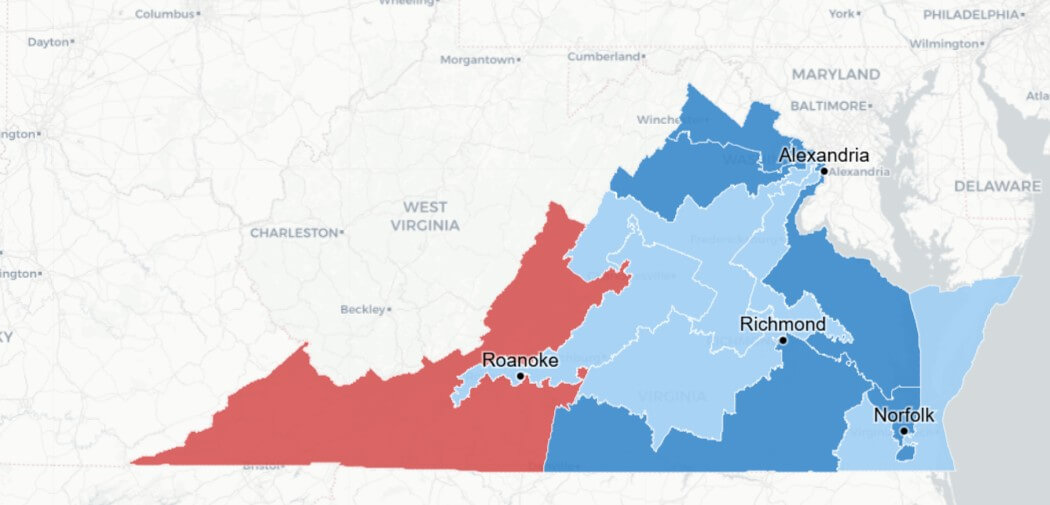
(Source: Ken Cuccinelli, X post, x.com/KenCuccinelli/status/2046763761264984137)
Judge Hurley has now ruled three times that serious constitutional violations occurred. The Virginia Attorney General has announced an immediate appeal. The Supreme Court’s ruling will determine whether the amendment stands or falls.
3. Fairfax County Splits Across Five Congressional Districts Under the New Map.
Under the proposed map, Fairfax County — a single, deep-blue county in Northern Virginia — is split across five of the state’s eleven congressional districts. Several of those districts stretch like long, jagged claws into the Shenandoah Valley and other rural regions.
Hines points out that Rockingham County, which voted 75–24 against the referendum, would be split three ways and submerged into a district anchored in Arlington. Freitas offers a sense of scale: “The distance between Arlington County and Stanton, Virginia in the Shenandoah Valley is a bigger distance than Arlington County and the state of New Jersey.”
In practical terms, voters in places like Rockingham or Augusta Counties would be represented by members whose political base and donor network sit in the Washington, D.C. suburbs — not in the communities that care about crop insurance, water rights, or diesel prices.
(Source: VPAP redistricting maps, vpap.org/redistricting/2026; Freitas video analysis)
4. More Than $62 Million from Outside Virginia Funded the “Yes” Campaign.
According to the Virginia Public Access Project, the redistricting referendum was the most expensive ballot measure in Virginia history — with more than $83 million raised by both sides through April 10. Roughly $62 million came from supporters of the amendment, much of it routed through House Majority Forward, a Washington, D.C.–based 501(c)(4) nonprofit that does not disclose its donors.
According to VPAP data as reported by WHSV, only about 3% of the pro-amendment donations came from Virginia donors. Approximately 88% came from Washington, D.C.
This was not Virginians deciding their own future. This was national political operatives using Virginia’s Constitution as a tool to flip the U.S. House — funded almost entirely by untraceable out-of-state money.
(Sources: VPAP, vpap.org/visuals/visual/the-most-expensive-referenda; VPAP finance reports, vpap.org/updates/4907; WHSV reporting on VPAP data, April 14, 2026)
5. The Maps Are Not the Worst Part. The Bureaucracy Is.
This is the warning most people are missing. Freitas reveals that while everyone focused on the maps, House Speaker Don Scott has been using the Secretary of the Commonwealth to staff the state bureaucracy and appoint boards of visitors at Virginia’s universities.
Freitas: “They are creating a permanent ruling class within corporate boards, boards of visitors at universities, the bureaucracy.”
This means control over education, regulation, enforcement, and audits — positions that outlast any single election cycle. Even if the courts overturn the maps, this bureaucratic entrenchment continues. The people making decisions about your children’s education, your business regulations, and your tax audits are being hand-picked right now.
6. The Model Is Being Exported.
Freitas’s clearest warning: “The model that was utilized in Virginia is coming to a state near you.”
Any state where Democrats win a trifecta — governor plus both chambers — is vulnerable to this exact sequence.
- Win on kitchen table issues.
- Use power for structural entrenchment.
- Spend national dark money to legitimize it.
- Dare the courts to stop you.
Virginia was the test case. Democratic strategist James Carville confirmed the national endgame on his “Politics War Room” podcast on April 16: if Democrats win the presidency and both houses of Congress, they should on day one make D.C. and Puerto Rico states and expand the Supreme Court to 13 justices. His words: “F them. Eat our dust. Don’t run on it. Don’t talk about it. Just do it.”
(Source: Fox News reporting on Carville’s “Politics War Room” podcast, April 17, 2026)
Freitas connects the dots: “If you thought it was bad before, just wait until you see what happens next.”
The Legal Fight: Cuccinelli and the Court Ruling Explained
Former Virginia Attorney General Ken Cuccinelli has been leading the legal challenge. The @VaChangeAgent account on X produced a detailed five-minute video explainer based on Cuccinelli’s work and the actual court documents from Tazewell County.
👉Judicial Injunction Against the 2026 Special Election Certification (Explanatory Video Summary)
The video below (under 5 minutes) was created based on the work of former Virginia AG @KenCuccinelli has been doing and uses the actual court documents from the Tazewell County (VA)… pic.twitter.com/CqceCgc6A7
— A Guy on X Striving to be the VA Change Agent (@VaChangeAgent) April 23, 2026
The courts may yet stop the maps. But even if they do, the template remains. The dark money pipeline remains. The trifecta remains. And the next bill is already being written.
What Is Coming Next — And Why the Church Cannot Stay Silent Again
The trifecta that pushed through the redistricting amendment is still in power. They control the Governor’s office, both chambers of the General Assembly, and the Attorney General’s office. The same machinery that was used for redistricting will be applied to every issue on their agenda.
Here is what is already in motion or coming:
Gun restrictions. Gun restrictions are not coming — they are here.
Governor Spanberger has already signed more than a dozen gun-related bills into law and acted on over two dozen gun-violence measures in total. Additional bills returned to the General Assembly for final action at the April 22 reconvened session, where lawmakers considered her amendments and vetoes.
The package includes a ban on unserialized “ghost guns,” new civil liability for negligent gun manufacturers and dealers, and expanded prohibitions for domestic abusers. A sweeping ban on the future sale of many semi-automatic firearms and magazines holding more than 15 rounds is now moving into place, following passage of HB 217/SB 749 and the governor’s announced support.
It also tightens safe-storage requirements in homes with minors and expands restrictions on carrying firearms in sensitive locations such as certain government buildings and public campuses.
Gun-rights groups including the NRA have condemned the legislation as blatant violations of law-abiding Virginians’ Second Amendment rights and are preparing legal challenges.
In total, Democrats pushed roughly 25 gun and public-safety bills through the General Assembly this session — the most sweeping overhaul of Virginia’s firearms laws in years.
Gender ideology and parental rights. The General Assembly has advanced a constitutional amendment for the November 2026 ballot that would repeal Virginia’s same-sex marriage ban and require the Commonwealth to recognize marriages “regardless of sex, gender, or race.”
Critics, including the Family Foundation of Virginia, warn that explicitly writing “gender” into the state’s marriage clause could effectively enshrine gender-identity ideology in Virginia’s highest law. They argue it could provide legal grounds for biological males in female athletic competitions and create new conflicts with religious liberty.
Lawmakers have also passed HB 6, the “Right to Contraception Act,” which broadly protects access to contraceptive drugs and devices. Pro-life and parental-rights advocates argue that its definition sweeps in some abortion-inducing drugs and lacks clear age or parental-consent limits — potentially allowing minors to obtain them without parental involvement.
In parallel, abortion-rights groups continue to push for a separate constitutional amendment to lock broad abortion access into the Virginia Constitution; opponents say such a measure would gut existing parental-consent protections if it reaches and passes on the statewide ballot.
School curriculum. During the 2026 session, Democrats again blocked Republican-backed legislation to add stronger “Victims of Communism Day” teaching requirements to public-school curricula — arguing that existing standards already address communism.
At the same time, they advanced their own preferred standards that lock in a specific framing of January 6 as a violent, anti-democratic attack and bar schools from teaching that it was a peaceful protest or justified by widespread election fraud.
Legislation sent to the Governor’s desk restricts schools from removing sexually explicit materials from their collections. It only requires parental notification when such material is formally assigned in class — not when it is simply available in classrooms or libraries.
Meanwhile, a controversial bill (HB 359) would have imposed new regulatory requirements on private schools participating in scholarship tax-credit programs — including mandates on curriculum, testing, and potentially religious instruction — though it ultimately did not advance this session.
Non-cooperation with ICE. This is no longer just a matter of local policy — it is now state policy.
In February, Governor Spanberger issued an executive directive ending all 287(g) agreements involving Virginia’s state law-enforcement agencies, rescinding former Governor Youngkin’s statewide ICE-cooperation framework.
She has also signed legislation (HB 836/SB 491) preventing schools from sharing student information with federal immigration authorities without a judicial warrant. Local school boards such as Charlottesville’s have adopted resolutions limiting cooperation with ICE.
Additional legislation advanced during the 2026 session would impose strict conditions on local ICE detention contracts and data-sharing. Critics say these measures will effectively wipe out the roughly two dozen remaining local 287(g)-style partnerships across the Commonwealth once fully implemented.
The practical effect: Virginia is moving toward a de facto sanctuary posture in everything but name.
Bureaucratic entrenchment. University boards, regulatory agencies, and state commissions are being stocked with political appointees who will remain in place long after the current legislature is gone.
Spanberger has already moved to reshape key university boards of visitors. At the University of Virginia alone, she appointed ten new members and requested resignations from Youngkin-era appointees — shifting long-term control over higher-education policy in a more progressive direction.
As Nick Freitas warns in his analysis, House Speaker Don Scott and the Secretary of the Commonwealth are using this appointment power to build what he calls “a permanent ruling class within corporate boards, boards of visitors at universities, and the bureaucracy.”
These appointees will oversee education, regulation, enforcement, and audits for years to come — long after any single election cycle has passed.
Every one of these issues is an issue where Scripture speaks clearly. Sanctity of life. Protection of children. Just governance. The proper limits of government authority. The defense of the vulnerable.
Every one of these is an issue where most Virginia churches will say nothing.
We saw what silence cost on April 21. Approximately 1.2 million Christians attend church weekly in Virginia. The amendment passed by a margin in the tens of thousands. The margin was sitting in the pews.
If the church stays silent on what is coming next, the same result will follow. Not once. Repeatedly. On every issue. For years.
What God’s Word Says to a People Under Threat
Nehemiah faced a situation that should sound familiar to every Virginian right now. The walls of Jerusalem were broken. The gates were burned. The people were vulnerable and demoralized. And enemies were circling, waiting to exploit the breach.
Nehemiah did not sit and wait for someone else to fix it. He assessed the damage, rallied the people, and organized them to rebuild — with a tool in one hand and a weapon in the other. Nehemiah 4:14 records what he told them: “Do not be afraid of them. Remember the Lord, who is great and awesome, and fight for your brothers, your sons, your daughters, your wives, and your homes.”
Notice what Nehemiah did not say. He did not say “the courts will handle it.” He did not say “let’s stay out of this — it’s too political.” He said remember God and fight. Both. At the same time. Faith and action. Trust in God and a sword on your hip.
Ezekiel 33:6 has not changed since our last article: “But if the watchman sees the sword coming and does not blow the trumpet, and the people are not warned… his blood I will require at the watchman’s hand.” The sword is not coming someday. It is here. The trifecta is in power. The bills are being written. The boards are being staffed. The watchman’s job is to blow the trumpet now — not after the damage is done.
Proverbs 27:12 says: “The prudent sees danger and hides himself, but the simple go on and suffer for it.” This is not a call to fear. It is a call to awareness. The prudent person sees what is coming and acts. The simple person ignores the warning and pays the price. Virginia’s Christians already paid the price once on April 21. The question is whether they will see the next threat coming or walk into it blind again.
What You Must Do Right Now
Watch the Freitas video above and share it. Send it to every Virginian you know. Post it on social media. Play it at your small group. This is the clearest analysis available of what just happened and what is coming next.
Pastors and elders: start teaching now. Do not wait for the next crisis to arrive before you decide whether Scripture applies to it. Open Romans 13, Deuteronomy 16, Proverbs 31, and Ezekiel 33 with your congregation. Teach the principles. Trust the Holy Spirit to apply them. Your people need a biblical framework for what is coming — and they need it before the next bill hits the floor, not after.
Follow the legislation. The General Assembly is still in session. Bills are still moving. Track what your delegates and senators are voting for at VPAP.org. Know their names. Know their records.
Prepare for the midterms. The 2026 congressional elections are coming. If the redistricting maps survive the courts, Democrats will use them to flip four congressional seats and potentially take the U.S. House. If the maps are overturned, the current fair maps stay in place and every seat is competitive. Either way, your engagement matters more now than at any point in the last decade.
Hold weak Republicans accountable. Freitas is direct: look at Club for Growth scores and American Conservative Union scores. If your Republican delegate or senator is in a safe R+10 district and scoring in the 70s, that is a problem. Support the good ones. Primary the weak ones. Sitting out is not an option.
Subscribe to Virginia Christian Alliance. We are going to cover every bill we can with our limited resources, every vote, and every issue where Scripture speaks and the church stays silent. We cover what others won’t.
Sign up at vachristian.org/email-list-signup/
This Is Not Over. Neither Are We.
Nick Freitas closed his analysis with this:
“Ladies and gentlemen, pray for Virginia and pray for our country because this is bad and it’s only the beginning. It doesn’t stop here. They are going to take this model and they are going to export it to as many states as they think they can get away with.”
He is right. And here is what he did not say, because it is not his lane to say it:
The church is the only institution that can stop this.
Not the courts. The courts are a backstop, not a solution. Not the Republican party. They have their own problems, as Freitas himself will tell you. The church. Millions of Christians in Virginia who sit under biblical teaching every Sunday and walk into the voting booth with no framework for applying it.
That changes when pastors decide it changes. That changes when elders decide it changes. That changes when you — the person reading this right now — decide that you will not be silent when the next bill comes.
God is sovereign over Virginia. He is sovereign over every trifecta, every dark money fund, and every bureaucratic appointment. The battle is real, but so is our God. He who sits in the heavens is not threatened by the schemes of men (Psalm 2:4).
Our calling is not to save the Commonwealth. Our calling is to be faithful. To speak truth. To blow the trumpet. To rebuild the wall with a tool in one hand and a sword in the other.
The template is set. The trifecta is in power. The next fight is already here.
The church does not go silent. Not ever.
Sources
All factual claims in this article are sourced from the following:
- Virginia Public Access Project (VPAP) — Redistricting analysis, spending data, finance reports, election results: vpap.org/redistricting/2026
- VPAP — Most Expensive Referenda visual: vpap.org/visuals/visual/the-most-expensive-referenda
- WHSV — VPAP finance data breakdown (3% VA / 88% D.C.): whsv.com, April 14, 2026
- Ken Cuccinelli — Four constitutional challenges: x.com/KenCuccinelli/status/2046763761264984137
- @VaChangeAgent — Judicial injunction explainer video: x.com/VaChangeAgent/status/2047128527737147487
- NBC News — Amendment results (51.5% yes, 48.5% no): nbcnews.com, April 21, 2026
- Breitbart — Judge Hurley injunction: breitbart.com, April 22, 2026
- 12 On Your Side — VA Supreme Court oral arguments April 27: 12onyourside.com, April 22, 2026
- Fox News — Carville “Politics War Room” podcast quotes: foxnews.com, April 17, 2026
- Cardinal News — Margin, spending, legal context: cardinalnews.org, April 21, 2026
- Ballotpedia — 2020 redistricting commission amendment (~65% approval): ballotpedia.org
- Pew Research Center — Religious attendance data: pewresearch.org, February 2026
- WVIR/29News — 62% of Virginians identify as Christian (Pew 2024): 29news.com, March 2025
- UVA Weldon Cooper Center — Virginia population 8.88 million: coopercenter.org, February 2026
- Nick Freitas / Christian Hines — Video analysis: youtube.com/watch?v=8BlJY3hA3Ks
- VPM News — Lawsuits FAQ: vpm.org, April 22, 2026
For a deeper exploration of this topic:
- “Your Vote Doesn’t Matter Anymore: How Virginia Democrats Are Rigging Elections for a Decade”
- “The Church That Stayed Silent: How Virginia’s Pulpits Failed Their Congregants on April 21”
- Coming Soon, after the Virginia Supreme Court Ruling: