Virginia Was Gerrymandered Because the Church Refused to Speak
By Jeff Bayard, Content Manager, Virginia Christian Alliance
Dear Christian:
On April 21, 2026, Virginia voters approved a constitutional amendment. It passed by roughly three points. That amendment hands the power to draw congressional districts back to the same politicians you voted to strip that power from in 2020.
The new map gives one party ten of eleven congressional seats. In a state nearly split down the middle politically.
I wrote about this before the vote. I laid out the constitutional violations. The rigged math. The ballot language designed to confuse. You can read that piece here: “Your Vote Doesn’t Matter Anymore: How Virginia Democrats Are Rigging Elections for a Decade.”
But this article is not about the politicians who did this.
Politicians pursued power. That is what politicians do when no one holds them accountable.
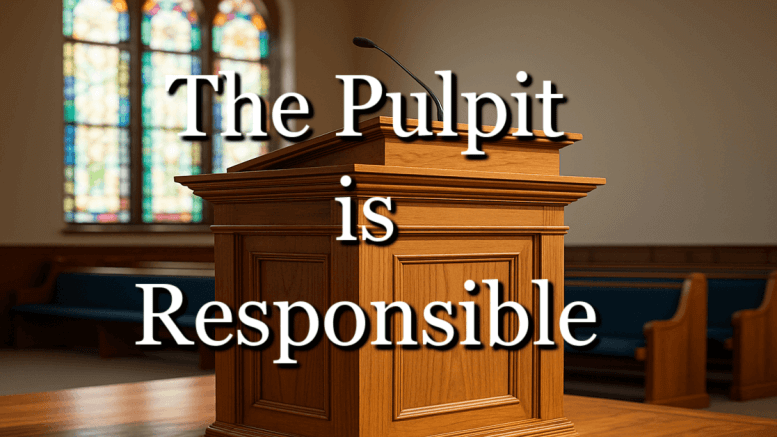
This is no longer about a redistricting amendment. It’s about the institution God ordained to be the conscience of a nation — and its refusal to speak.
The Margin Was Sitting in the Pews
Before we go any further, consider the math.
Virginia has approximately 8.88 million residents and 6.76 million adults. According to Pew Research’s 2024 Religious Landscape Study, 62% of Virginia residents identify as Christian. That’s roughly 4.19 million Christian adults in this state.
National data shows about 30% of adults who identify as Christian attend church weekly. Apply that to Virginia and you get approximately 1.26 million weekly churchgoing Christians.
The redistricting amendment passed by roughly three percentage points. In a low-turnout special election, that margin likely represents somewhere between 50,000 and 100,000 votes.
There are over 1.2 million Christians in Virginia who attend church every week.
The church did not lack the people to stop this. It lacked the voice.
The margin of defeat was sitting in the pews on Sunday morning. And nobody said a word.
A Silence That Cost Virginia Its Voice
Virginia has thousands of churches. Thousands of pastors. Hundreds of thousands of believers who sit under biblical teaching every Sunday.
On the most consequential vote in Virginia in years — a vote that any believer with a basic understanding of biblical justice would have recognized immediately — the vast majority of those pulpits said nothing.
Not a word about what was on the ballot. Not a word about what the amendment would do. Not a word about whether Scripture has anything to say about justice, representation, or the proper limits of governing authority.
Silence.
The result is exactly what you get when the church goes quiet while the state advances. The state wins unopposed.
What God’s Word Says About Silent Watchmen
God speaks directly to this in Ezekiel 33:6: “But if the watchman sees the sword coming and does not blow the trumpet, and the people are not warned, and the sword comes and takes any person from among them, he is taken away in his iniquity; but his blood I will require at the watchman’s hand.”
Read that carefully. God does not hold the watchman responsible for whether the people listen. He holds the watchman responsible for whether the watchman speaks. The failure is not in the outcome. The failure is in the silence.
Pastors and elders are watchmen. That is not a metaphor. It is a job description given by God. When something threatens the flock — spiritually, morally, or civically — the watchman blows the trumpet. Period.
Proverbs 31:8–9 commands: “Open your mouth for the mute, for the rights of all who are destitute. Open your mouth, judge righteously, defend the rights of the poor and needy.”
The people whose votes just became meaningless in nine of eleven districts — they are the voiceless now. Their representation has been stripped by mathematical design. The institution God ordained to speak for the voiceless chose not to speak.
James 4:17 makes the standard plain: “So whoever knows the right thing to do and fails to do it, for him it is sin.”
This is not a gray area. Rigging elections so outcomes are predetermined regardless of how people vote violates just governance. Scripture speaks to justice repeatedly and without ambiguity. The church knew what was at stake. The silence was a choice. And choices have consequences.
How the Church Lost Its Prophetic Voice
The church in America has retreated from civic engagement for decades. Virginia is no exception.
The retreat rests on a well-meaning but deeply flawed idea: the church should not be “political.”
But there is a critical difference between partisan and prophetic. A pastor who says “vote Republican” is being partisan. A pastor who teaches what Scripture says about justice, authority, and the proper limits of government — and trusts the congregation to apply it — is being prophetic.
The church has confused these two things for so long that most pastors now treat any civic issue as untouchable.
The result? Congregations walk into the voting booth with the same information as everyone else — campaign ads, social media, and ballot language crafted to obscure rather than clarify.
That is not neutrality. That is abandonment.
Hosea 4:6 warns: “My people are destroyed for lack of knowledge.” Not lack of intelligence. Not lack of good intentions. Lack of knowledge. And whose job is it to provide that knowledge? The shepherds. The teachers. The watchmen.
When the church does not teach, the culture fills the vacuum. Every single time.
What Virginia’s Churches Told Their People
Across Virginia, churches addressed the April 21 vote the same way. Here is a real example — a prayer request email sent to a Sunday school class the week before the election:
“Dear friends, PRAYERS FOR COMMONWEALTH. This coming Tuesday, April 21st, there is a very important election. Only one item is on the ballot: voting on drawing new voting districts. Please study the pros and cons and VOTE.”
Read that again. A constitutional amendment that would strip power from a bipartisan commission, hand it to one party, and redraw the map to predetermine outcomes for a decade — and the church’s message was: study the pros and cons.
No Scripture. No principles. No framework for evaluating what was on the ballot. Just: figure it out yourself.
That email was not unusual. It was typical. Churches across Virginia handled April 21 the same way — if they mentioned it at all.
Now imagine what that email could have looked like:
“Dear friends, this Tuesday Virginia votes on a constitutional amendment that would bypass the bipartisan redistricting commission voters approved in 2020 and give the General Assembly power to redraw congressional districts. Scripture calls us to pursue justice and oppose the perversion of it (Deuteronomy 16:19–20). It warns against rigged scales and false balances (Proverbs 11:1). Please pray, study this issue in light of God’s Word, and vote your conscience biblically.”
Same length. No candidate endorsement. No partisan language. Just Scripture applied to the moment.
That is the difference between neutrality and abandonment. One equips the congregation. The other leaves them to the campaign ads.
The church did not need to say “vote no.” The church needed to teach biblical principles of just governance and trust the people to apply them. In most Virginia churches, that never happened.
The pattern repeated across the commonwealth. Pastors stayed silent. Sunday school leaders deferred. Church emails — when they existed at all — said “study the pros and cons” without offering a single biblical principle to study them by.
The result was predictable. Congregations walked into the voting booth with no more biblical clarity than their unchurched neighbors. And an amendment that Scripture’s own principles expose as unjust passed by three points.
What Biblical Teaching on Civic Issues Actually Looks Like
Some pastors will say they have a legitimate concern. They do not want the pulpit to become a campaign platform. That concern deserves serious consideration — because they are right that the church is not a political action committee.
However, that concern fails when it becomes an excuse for silence on issues where Scripture speaks clearly.
Teaching biblically on civic issues does not mean endorsing candidates. It does not mean turning the sermon into a stump speech.
But let me be direct. When a ballot measure touches something Scripture speaks to clearly — the sanctity of life, biblical sexuality, or the perversion of justice — the church has every right and every obligation to put that information in front of the congregation.
A voter guide on abortion is not partisan. It is pastoral. A voter guide on an amendment that rigs elections and strips citizens of meaningful representation is not political activism. It is biblical faithfulness.
The church draws the line at endorsing candidates and parties. It does not draw the line at applying Scripture to the issues those candidates and parties are deciding.
It means doing what the church exists to do: teach the whole counsel of God and trust the Holy Spirit to apply it.
If a pastor teaches what Romans 13:1–4 says about governing authority — that government is ordained by God to serve the good, not to serve its own power — the congregation can evaluate for themselves whether bypassing a bipartisan commission to rig maps for one party serves the good.
If a pastor teaches Deuteronomy 16:19–20 — “You shall not pervert justice. You shall not show partiality… Justice, and only justice, you shall follow” — the congregation can evaluate whether a 10–1 map in a closely divided state represents justice.
If a pastor teaches Proverbs 11:1 — “A false balance is an abomination to the LORD, but a just weight is his delight” — the congregation can recognize rigged scales when they see them.
The pastor does not have to say “vote no.” The Scripture says it for him. He just has to be willing to open the text.
Hope, Action, and the Road Ahead
The amendment passed. The legal battles continue. The Virginia Supreme Court still has pending cases. Republican leaders have made clear the fight is not over in the courts. The outcome is not yet final.
But whether this amendment stands or falls, the deeper problem remains. The church in Virginia — and across America — has lost its prophetic voice on civic righteousness.
Until that voice is recovered, the state will continue to advance unopposed.
Here is what you can do.
Talk to your pastor. Not with anger. With grief. Share this article. Ask whether the church has a responsibility to teach biblical principles of governance. Ask what would have to be at stake for the pulpit to speak.
Start a study. In your small group or Sunday school, open the Scriptures on justice, government, and the Christian’s civic responsibility. Use Romans 13. Proverbs 31:8–9. Ezekiel 33. Deuteronomy 16. Let the text do the work.
Be the voice yourself. If the church will not teach, the laypeople must. Not in rebellion against the church. In faithfulness to the God who commands us to speak for the voiceless.
And remember this: God is sovereign over Virginia. He is sovereign over every map, every court, and every election. Our calling is not to win political battles. Our calling is to be faithful — to speak truth, pursue justice, and refuse the silence that lets injustice pass unchallenged.
The battle is real, but so is our God. He who sits in the heavens is not threatened by the schemes of men (Psalm 2:4). Our calling is not to save the republic. Our calling is to be the church.
And the church does not go silent when truth is at stake. Not ever.
For a deeper exploration of this topic, read the full constitutional analysis: “Your Vote Doesn’t Matter Anymore: How Virginia Democrats Are Rigging Elections for a Decade.”



Dunkirk 2.0 anyone? https://shut-upn-sing.com/2026/04/26/the-sunday-morning-tune-up-they-have-your-children/
Jeff Bayard, please post your article in Opinions or letters to the editors in Virginia papers! This is the truth and needs to be heard. I live in Luray, VA and don’t see anything like this in the news!
Are we allowed to post this other places?
Yes, please do.