

Forty-fifth in a series
We’ve reached the end, for now. I’ve taken some time reviewing European and American research into the history concurrent with the time of Islam’s development. It relies on period manuscripts, documents, and other writings to help understand how history unfolded. This work differs from that presented earlier. Those articles explored some of Islam’s claims about itself. This is more general and examines what may have happened during the period around its formation, and when that might have been. Does it answer everything? No, and the discovery is still ongoing. Teasing apart the history is an enormous task, covering multiple empires, languages, and schools of thought – along with archeological evidence from coins, inscriptions, buildings, and other artifacts.
So, while this doesn’t give us a full and complete picture, it does provide an interesting high-level glimpse into Christianity’s development, the rise and fall of empires, and Islam’s creation. Unlike the previous articles, this one is primarily formatted as lists, with some narrative where appropriate. I believe this will make the material easier to use, make comparisons, and determine where you might want more information about a topic.
A number of videos from this year’s NAPC and a number of others provided information for compiling this material.[1] A partial list is included in the footnotes. Finally, some information comes from previous research into this, and other, topics.
The Standard Islamic Narrative
The traditional standard narrative includes:
- Muhammad was born about 570 in Mecca,
- He began receiving revelations in 610,
- Immigrated with followers to Medina (Yathrib) in 622,
- He took Mecca in 629 or 630, and
- Died in 632.
- Muhammad was succeeded by four rulers from his inner circle, covering the years 632 – 661.
- At Muhammad’s death the Qur’an was not written down, but orally transmitted. Othman ordered the verses collected and written down in 652, and the Medinan codex was selected as the official writing. All others were ordered destroyed.
- According to tradition, Islam is fully formed as of 652.
- Those four rulers were succeeded by the Umayyad Dynasty, who ruled from Damascus between 661 and 750.
- They were succeeded by the Abbasid Dynasty, who ruled from Baghdad starting in 750 through about 1258, when the Mongols destroyed Baghdad, ending the dynasty.
Pre-Narrative History
By the middle of the third century, Christianity had spread from the area around Jerusalem west along parts of the North African coast, and to the north into Armenia and southeastern Europe. Christian majority areas included parts of modern Lebanon, Syria, Iraq, Jordan, Egypt, Turkey, Greece, and Italy. In addition, there were small communities throughout this area where the Christian population was the minority.
Aramaic was the primary language in and around the eastern Mediterranean. There were different forms or dialects in different areas. The west used Samaritan, Jewish Palestinian, Christian Palestinian, and Nabataean Aramaic. Those speaking the Palestinian dialect often wrote in Hebrew, while those using the Christian dialect used a form of Syriac. Nabataean speakers developed modern Arabic writing. Western Aramaic was influenced by the Greek language. The east primarily spoke Syriac, and it became the primary language of Christians in the near East, Mesopotamia, and Persia. Various Syriac writing styles developed in this part of the world, including those used by the Syriac Orthodox and Nestorians (Church of the East).
Pre-Nicene Christianity
A Trinitarian view of God formed officially within the Roman Empire, but this view was not accepted by everyone. Anti-Trinitarian, Nestorian, and Monophysite Christian forms also developed. We can get a view of this latter group’s beliefs from Paul of Samosata’s writings. He rejected the physical interpretation of the term “son of God.” He viewed the Logos as an instrument of God that inhabited men who lived good and holy lives. Implications from this line of thought include a rejection of both Jesus’ pre-existence and Mary’s giving birth to the Logos rather than a man. The connection between the Logos and Jesus was based upon Jesus’ obedience, rather than his nature.
Within Persia, Christianity began in the Aramaic speaking synagogues, and had a primarily Old Testament focus. It was closer to Palestinian Christianity rather than the Hellenistic form within the Roman Empire. Beginning in the second century, various types of gnostic thought also developed. These included, Basilidianism, Sethianism, and Valentinianism in the second century, and Manichaeism in third century Persia.
Timeline
Over the next three hundred years:
- 224: The Sassanian Empire became the dominant power within Persia after Ardashir I defeated Artabanus IV, the last Parthian king, at Hormozgan.
- 240 – 270: Under Sapor I, the Sassanids undertook mass deportations of Christians, many of whom were Aramaic Ishmaelites.
- 250: Roman Emperor Decius persecutes Christians. Many Syriac Christians fled into Persia.
- 325: Council of Nicaea – Arians and Anti-Trinitarians were cast out of the church
- 410: Council of Ctesiphon unifies the Church of the East (Nestorian) in what is now Iraq, Kuwait, Iran, and along the Silk Road. This led to the creation of the Persian Christian church, which adopted the Nicaean Trinitarian view of God. Persia’s rulers and military leaders were primarily Zoroastrian. They viewed the new Christians as a threat and began persecuting them.
- 431: Council of Ephesus condemned Nestorianism. Nestorian beliefs included Christ’s human and divine natures were distinct persons, and Mary was the mother of Christ, but not the mother of God. Greek was spoken in the East, and Latin now used in the West.
- 489: Byzantines closed the Nestorian school in Edessa. Nestorian teachers and students moved to Persia. Western Syria was primarily Monophysite, and the east Nestorian.
- 540: War began between Chosroes I and Justinian. Persia conducted mass deportations, and took the entire population of Antioch to the east. The Persian King had built cities that were empty, and needed a people to populate them.
Narrative Years History (570 – 632)
At this time, there is no historical evidence of a man named Muhammad, living in Mecca, and receiving the 114 Suras which would become the Qur’an by 652. Nor is there evidence yet of a city called Mecca in the western part of Arabia in the sixth century, or a written Qur’an.[2]
Within the Sassanid Empire, the Syrian Christians did not have to defend their theology. “Son of God” was a title, and not to be taken literally. The idea of the Trinity was rejected. Mahmed (MHMD) in Arabic was a title referring to the “anointed one” or “blessed one”. It was a Syriac title often used in referring to Jesus.
The Syriac focus was on living a good and holy life. The Logos emanated from God, much like the angels. The Aramaic Gospel in the second century combined the four Gospels we know today into one writing. It was used by eastern Christians until the 4th century. Much of the Aramaic writing was in the form of a lectionary, designed around specific readings for particular days of the calendar. It can also contain writing on how to live, similar to the book of Deuteronomy. This agrees with the research of Lüling and Luxenberg on the Qur’an’s Syriac source material.[3]
The Byzantine and Sassanid armies were roughly the same size. Both relied on mercenary Arab tribes to supplement their armies, who were Christian. The Byzantines hired the Ghassinid, who are primarily Monophysite. The Sassanid employed the Lakhmid, who were primarily Nestorian.
Timeline
- 600: The majority of the western Sassanid Empire was Christian, and many Christian communities were growing in the eastern part. Nestorian monks sat on the council of the Mongol Khans in the Far East. Christianity represented the majority of the population across parts of North Africa, much of the area of modern Egypt, Jordan, Syria, Lebanon, Iraq, Turkey, Armenia, Greece, and Eastern Europe.
- 602: The last war between the Byzantines (Maurice) and Sassanids (Chosroes II) began. Byzantine was on the verge of financial collapse. The Byzantine Governor of Mesopotamia rebelled and captured Edessa. Chosroes II invaded Byzantine territory. The Byzantine were also under pressure in the West at this time.
- Avar from the Russian Steppe were located near modern Hungary.
- The Byzantines were losing ground in Spain (Visigoth) and Italy (Lombard).
- Maurice sent his army to Pannonia in Eastern Europe to confront the Avar.
- 608 – 610: Byzantine civil war.
Period of Heraclius
- 610: Heraclius became the Byzantine Emperor. He turned things around by restructuring the administration and military, and began retaking territory in Italy and North Africa. The Avar allied themselves with the Sassanid. The Sassanids initially advanced against the Byzantine.
- 613: Sassanid took Syria.
- 614: Sassanid took Jerusalem.
- 615: Sassanid invaded Chalcedon and were situated across the strait from Constantinople.
- 618: Heraclius planned to abandon Constantinople.
- 619: Heraclius offered to become a client state. Chosroes II rejected the offer.
- 621: Sassanid took Alexandria and Egypt.
- 622: The Sassanid army was spread out over the conquered area. Chosroes II retreated from the occupied land to rebuild his army. The Arab mercenaries were not integrated into the Sassanid army. Heraclius concentrated his army and defeated the Sassanids. Much of the contested land fell under control of the Arab tribes.
- 628: The Avar and Sassanid joined forces to take Constantinople and were destroyed. The war ended. The Byzantine created client states under Arab control covering areas of Egypt, the Arabian Peninsula, Nabataea, Lebanon, Syria, Jerusalem, and Armenia. Much of this area was under Ghassinid control or influence. A four-year civil war within the Sassanid Empire began. This war ended in 632, and occurred where the Nestorian Lakhmid were located.
Post-Narrative History
Research suggests the original purpose of the Qur’an was to serve as a lectionary. This should come as no surprise given the research results of Lüling and Luxenberg, indicating significant parts of the Qur’an originated from Syriac sources, coming from homilies, hymns, and lectionaries.
During this period, we see the final fall of the Sassanid Empire. The Sassanian civil war ended with a grandson of Chosroes II, Yazdegerd III, recognized as the Shah of Iran. We also see the Arab realization that they do not need either the Sassanids nor the Byzantine. The year 622 marks the beginning of the Arab calendar. This is the same year the Arab tribes began gaining their independence from both the Byzantine and Sassanid people. This is also the year of the Arab migration from Mecca to Medina in the sirat. Coincidence? Maybe.
The Rashidun and Umayyad Caliphs
There is no evidence supporting the existence of the first four caliphs from Muhammad’s inner circle. The first caliph for which support exists is Mu’awiya, the first of the Umayyad caliphs. In an earlier article, we saw some of the coins and inscriptions from 661 to 680.[4] A few other things about Mu’awiya. His name is Aramaic, indicating he is likely an Ishmaelite Christian. During his rule in Damascus, we have the first references to the new Arab calendar. A king normally has a holy site they defend – a haram. The sanctuary bearing the head of John the Baptist was located in Damascus.
Mu’awiya’s goal was likely gaining authority over Christendom within the Arab held lands. The problem. The Church of the East was rejected by the West. Armenians, Syrian Jacobites (Syriac Orthodox Church), and Egyptian Copts practiced forms of Monophysitism. The Melkites were Greek Orthodox, and small communities of pre-Nicene Christians still existed throughout the land controlled by Arab tribes.
In 681, Abd al-Malik focused on consolidating what Mu’awiya began. He pushed the Arabization of his Empire, and used coins to communicate his religious ideas to his subjects. These ideas were also communicated through the inscriptions within the Dome of the Rock.
The Dome of the Rock
Abd al-Malik began the Arabization of Ishmaelite Christianity. The Dome of the Rock was built on the Temple Mount, in opposition to the Hagia Sophia in Constantinople. Abd al-Malik’s beliefs included a single community, unified under one new contract with God. The Dome was a monument to that contract. Jesus was the MHMD; the Dome, the place of crucifixion. It served as a symbolic tomb for Christ. The Dome itself has been destroyed eleven times. Only some of its inscriptions remain.
While Arabic was used to introduce these beliefs, the writings came largely from Aramaic (Syriac) and other sources. Those beliefs included Jesus being just a man—a good man, but just a man. The Dome inscriptions refer to Jesus as the “servant of God” and “Messiah”, but they also attack Jesus’ divinity and Christians as associators of Jesus with God. The inscriptions were all about Jesus and God. It appears they were intended to end fighting among the Arab tribes and end the Christological debate. Several Dome inscriptions are found in some form within today’s Qur’an.
Below are some images of these inscriptions, and their English translation.[5]
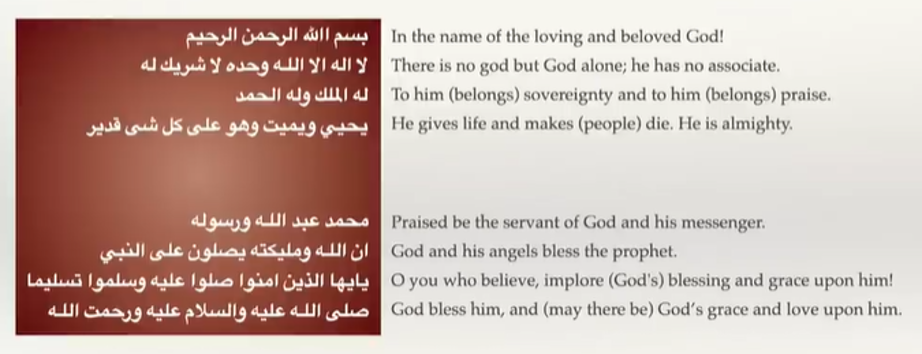
Inscription 2
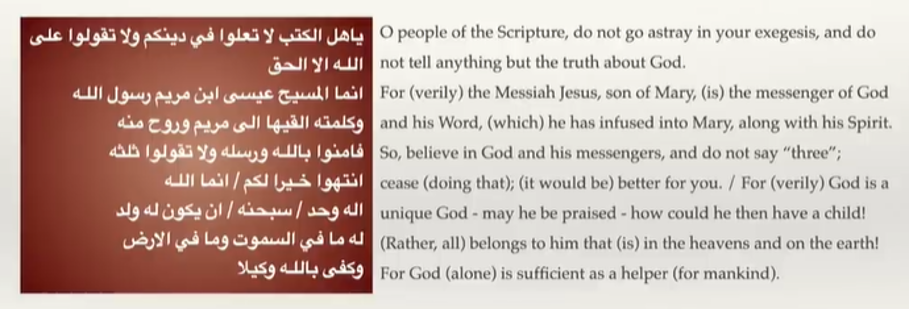
Inscription 3
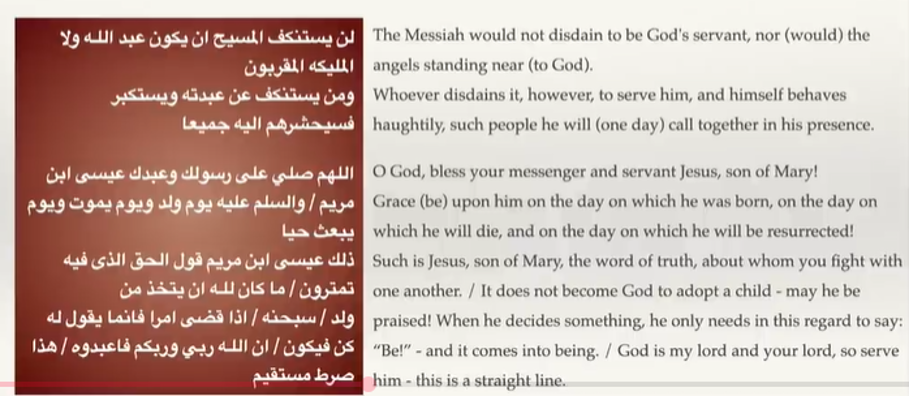
Inscription 4
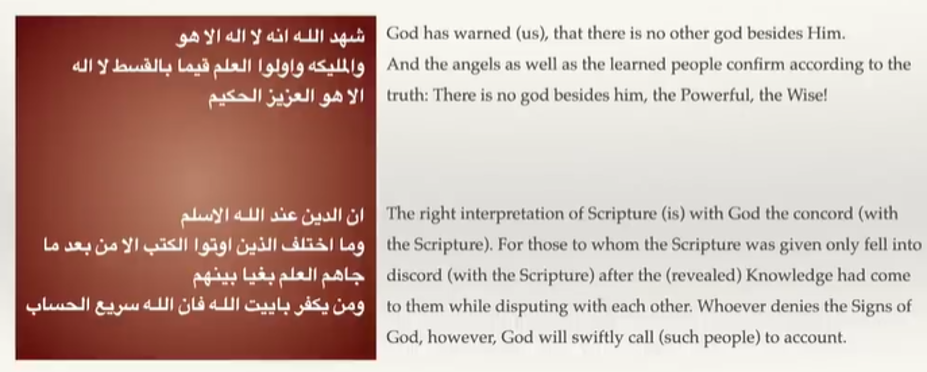
Inscription 5
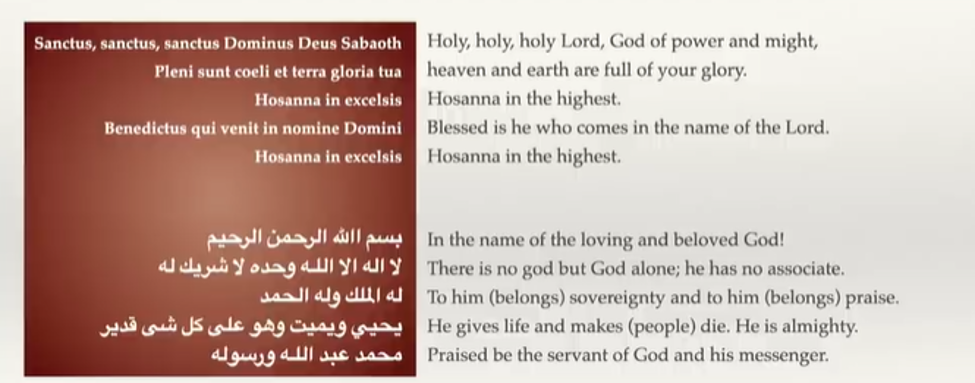
Under the Umayyad, there are no known references to Muhammad as a man, only a title for the servant of God. The references to Muhammad as a man appear to begin with the Abbasid Dynasty, who came after the Umayyad.
In the preceding, and following, timelines, note the events in the following years versus those in the standard Islamic narrative. Specifically, 610 (the year Muhammad received his first revelation), 622 (the migration to Medina), and 632 (the final year of the Sassanid civil war).
Timeline
- 634: Authority within the Sassanid Empire breaks down. Local rulers began minting their own coins. The two largest groups, the Parthians and Persians, began fighting each other. Local rulers also fought amongst each other and with the Empire’s king. Arab tribes began establishing independent Emirates.
- 641: Heraclius died. Arab allegiance to the Byzantines ended, and that Empire became the enemy.
- 651: The Sassanid Empire ended. The land fell into Arab tribal hands.
- 661: Mu’awiya was elected commander of the faithful (Amir al-Mu’min in).
- 672: Abd Allah ibn a–Zubayr was declared commander of the faithful, but his authority was limited to the former land of Persia.
- 674: Mu’awiya attacked Constantinople and failed.
- 681: Mu’awiya was deposed. He was succeeded by Abd al-Malik.
- 694: The Dome of the Rock was completed.
- 750: The Abbasid Dynasty began.
- 756: The tomb of the prophet was built in Medina. This was the last time MHMD appeared as a title.
- 825: The Regent al-Ma’mūn moved from Merv to Baghdad. The Chronicle of Seert was written during this period. It was an ecclesiastical history of the Church of the East, chronicling the history of the Nestorian Church and Sassanian Persia. There was no mention of a new religion.
- 833: The first mention of Muhammad as a prophet. This was the same time as tradition says Ibn Hisham wrote his sirat on the life of Muhammad.
- 850: Aramaic has almost disappeared, and was replaced by Arabic. The first true mosque with a qibla facing Mecca was built in Samarra, in modern Iraq.
Final Thoughts
I thought I knew something about Islam before reposting this series, but after the last few years, it appears that much we thought we knew about Islam’s early history is doubtful. This experience has taught me how little history we actually appear to know. In some ways, this series is only a small example. These events took place over one thousand years ago, but consider the billions of people who have been influenced and impacted by what’s been taught versus what appears to be closer to the truth. If lies enslave us, then the truth can set us free. Jesus is the Messiah, the anointed one. May God’s spirit rest upon you, and guide you to His truth.
Footnotes:
[1] Videos reviewed for this article include:
- Alexander, Thomas, Where Islam Came From, Pfander Films, https://www.youtube.com/watch?v=oZwRofAECVc&list=PLAf8GY8vQ8tg , Dec., 2021. Accessed Aug., 2026.
- Alexander, Thomas, How Islam Began Politically, Pfander Films, https://www.youtube.com/watch?v=Ztah_zC98YQ&list=PLAf8GY8vQ8tg&index=2 , Dec., 2021. Accessed Aug., 2026.
- Alexander, Thomas, Theological Influences on Islam, Pfander Films, https://www.youtube.com/watch?v=ku6sVS8F3CU&list=PLAf8GY8vQ8tg&index=3 , Jan., 2022. Accessed Aug., 2026.
- Alexander, Thomas, Why Did Islam Become Anti-Trinitarian, Pfander Films, https://www.youtube.com/watch?v=h35CiIp8Mf4&list=PLAf8GY8vQ8tg&index=4 , Jan., 2022. Accessed Sept., 2026.
- Alexander, Thomas, The Dome of the Rock: Islam’s First Home, Pfander Films, https://www.youtube.com/watch?v=GI7_8Ni6LHA&list=PLAf8GY8vQ8tg&index=5 , Jan., 2022. Accessed Sept., 2026.
- Alexander, Thomas, Muhammad Isn’t in the First Shahada, Pfander Films, https://www.youtube.com/watch?v=aA19k2GcBpY&list=PLAf8GY8vQ8tg&index=6 , Jan., 2022. Accessed Sept., 2026.
- Smith, Jay, Muhammad of Islam vs Muhammad of History, Pfander Center for Apologetics & Polemics, https://www.youtube.com/watch?v=1w9aAw09y9o , June, 2026. Accessed Aug., 2026.
- Janosik, Daniel, Dr., John of Damascus: The First Apologist to Muslims, Pfander Center for Apologetics & Polemics, https://www.youtube.com/watch?v=Xic5VWdD4gI&t=3s , June, 2026. Accessed Aug., 2026.
- Janosik, Daniel, Dr., Did Islam Originate from Anti-Trinitarian Christians?, Pfander Center for Apologetics & Polemics, https://www.youtube.com/watch?v=e9Ume0BYSfw&t=1185s , June, 2026. Accessed Aug., 2026.
[2] See, Wolf, Dan, Historical Critique – Part I, Virginia Christian Alliance, https://vachristian.org/historical-critique-part-i/ , July 8, 2026.
– Wolf, Dan, Historical Critique – Part II, Virginia Christian Alliance, https://vachristian.org/historical-critique-part-ii/ , July 13, 2026.
– Wolf, Dan, Historical Critique – Part III, Virginia Christian Alliance, https://vachristian.org/historical-critique-part-iii/ , July 15, 2026.
[3] Wolf, Dan, Historical Critique – Part III, Virginia Christian Alliance, https://vachristian.org/historical-critique-part-iii/ , July 15, 2026.
[4] Wolf, Dan, Historical Critique – Part II, Virginia Christian Alliance, https://vachristian.org/historical-critique-part-ii/ , July 13, 2026.
[5] Alexander, Thomas, The Dome of the Rock: Islam’s First Home, Pfander Films, https://www.youtube.com/watch?v=GI7_8Ni6LHA&list=PLAf8GY8vQ8tg&index=5 , Jan., 2022. Accessed Sept., 2026.