
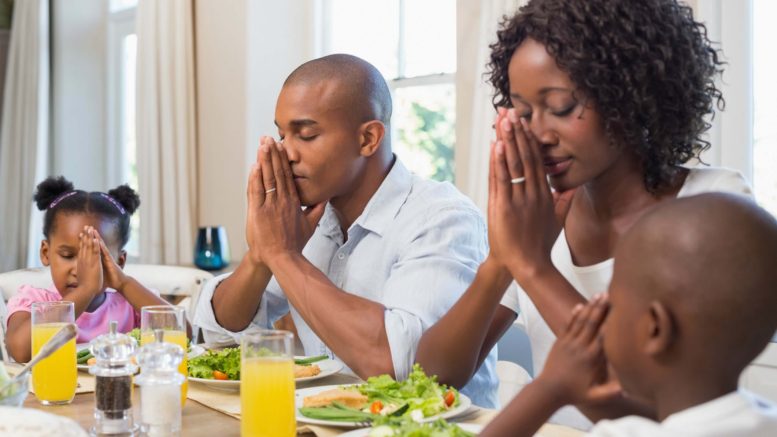
Dear Christian: this Thursday, millions of American families will gather around one table for one meal. For many homes, it will be the only family dinner of the year when every chair is filled. Before the turkey is carved, I want to hand you a question to carry to that table: What is being handed down there?
Moses answered that question long before there was a Thanksgiving. God told Israel to teach His words to their children “when you sit in your house.” The table was never just a place to eat. It was a classroom, a pulpit, and a witness stand all at once.
Before you read on, tell us: what did the table look like in the home where you grew up? Leave a comment below. And if you think I got something wrong, or you see it differently, say so. We welcome it.
What the Family Dinner Research Shows
Here is the good news. Researchers have studied the family table for decades, and the pattern is steady: families who eat together tend to do better.
In 2006, a team led by Jayne Fulkerson published a survey given to 99,462 students in grades 6 through 12, from 213 cities in 25 states. Teens who ate dinner with their families more often reported less substance use, less sexual activity, less depression and suicide risk, less violence, and fewer problems at school. Those links weakened but stayed significant after the researchers accounted for family factors.
A 2018 study in JAMA Network Open looked at more than 2,700 teens and young adults. More frequent family dinners were linked to modestly better eating habits, with more fruits and vegetables and less fast food. That held even in families that reported lower functioning.
Let Me Be Fair About the Numbers
Good research deserves honest handling. In 2012, sociologists Kelly Musick and Ann Meier followed nearly 18,000 teens in a national study and asked a harder question. Is it the meal itself, or the kind of family that makes time for the meal?
Their answer was humbling. Background factors and family relationship quality together accounted for 61% of the link with depression and 56% of the link with substance use. In addition, they found no direct carryover into young adulthood once earlier well-being was counted. Yet one link held up under their strictest test: when a teen’s family dinners increased, his depressive symptoms went down.
So I will not tell you that a plate of food works like medicine. Here is what the evidence supports: families who eat together do better. The meal alone may not be the cause. Still, a shared meal gives a family time to listen and talk, and that is exactly what Scripture would lead us to value.
And if your schedule makes dinner hard to arrange, take heart. Breakfast, a walk, or bedtime can make room for the same kind of conversation. Moses named the road and the bedside too. Shift workers and single parents, this is for you.
The Uninvited Guest at the Family Dinner
There is a new guest at most tables now, and it never says grace. It glows, it buzzes, and it pulls every eye in the room downward.
In a study published in 2018, researchers at the University of British Columbia described a simple experiment. More than 300 people went to a restaurant with friends or family. Some were told to keep their phones on the table. Others were told to put them away.
The diners with phones out enjoyed the meal less. They felt more distracted. To the researchers’ surprise, they were also slightly more bored, not less. The drop was small, about half a point on a seven-point scale, but the lesson is plain. A phone on the table takes something from the people around it.
VCA has warned before about how smartphones steal time from what is healthy. The dinner hour may be the most precious time they steal.
“When You Sit in Your House”
Notice the order. The words must be on your heart first, and only then taught to your children. Then Moses names four ordinary moments: sitting at home, walking, lying down, and rising. Not one of them is a church service. In God’s design, faith is handed down in the plain rhythms of a household.
The table sits at the center of those rhythms. The psalmist pictures the blessed home this way: “your children will be like olive shoots around your table” (Psalm 128:3). Olive shoots spring up around the old tree and draw from the same root. It is a picture of blessing, and a fitting picture of discipleship. It has always been the heart of VCA’s case for the God-ordained family.
We Cannot Hand Down What We Do Not Hold
Now the hard part. As a father of two and a grandfather of three, I include myself in it.
In 2022, George Barna’s Cultural Research Center at Arizona Christian University studied parents of children under 13. Two out of three (67%) called themselves Christian. Only 2% held a biblical worldview. As the report said plainly, parents “cannot pass on a worldview that they do not embrace.”
The latest numbers are no brighter. The center’s American Worldview Inventory 2026 found that just 4% of American adults hold a biblical worldview. The weakest area of all was the one this category is named for. Family and the value of life scored lowest, at 5%.
What about prayer at home? The American Bible Society’s State of the Bible 2026 found that only 29% of parents pray with their children daily or often. Thirty-five percent never do. Just 14% read the Bible with their children daily or often.
Our culture is a culture of chaos for the family, and our children are catechized every day by screens. As Max Lyons wrote here last December, children need truth, because words shape worldview. Where else will they hear those words spoken in love, if not at home?
Dear parent, dear grandparent: these numbers are not a reason for shame. They are a reason to sit down. The table is the easiest place in the whole week to begin again.
A Family Dinner Plan for Thanksgiving Week
So here is a simple plan for Thursday. It needs no seminary degree. It starts with a promise Asaph made long ago.
Asaph did not say, “We will hope they figure it out.” He said, “We will tell.” A child who hears his grandfather say, “God carried me through this year,” has heard a testimony no screen can match. That is how children come to know God by name: someone they love tells them what He has done.
- Phones in a basket. Set a basket on the counter. Every phone goes in before the blessing, including Grandpa’s. Including mine.
- One thing God has done. Go around the table. Invite each person to tell one thing God has done for them this year, and let anyone pass. Little ones can keep it simple. Let the oldest go last.
- Read Psalm 78:4 aloud. Let a child read it if one is able.
- Close in prayer. Thank the Lord for what was just said aloud.
Then keep the basket. Try it once a week after the holiday, and listen to what your table sounds like by Christmas.
The Guest Who Opens Eyes
There is one more guest worth inviting. On the first Easter evening, two weary disciples sat down to eat with a stranger in Emmaus. “When he was at table with them, he took the bread and blessed and broke it and gave it to them. And their eyes were opened, and they recognized him. And he vanished from their sight” (Luke 24:30–31).
A basket of phones cannot open a child’s eyes to Jesus. Only the Spirit who raised Christ from the dead can do that. But the Lord who made Himself known in the breaking of bread at Emmaus can still make Himself known at your table this Thursday, between the turkey and the pie, in the voice of someone your children love.
So set the table. Put the phones away. Tell the coming generation what He has done. Then trust Him with the rest.
Unless otherwise noted, Scripture quotations are from the English Standard Version (ESV).