
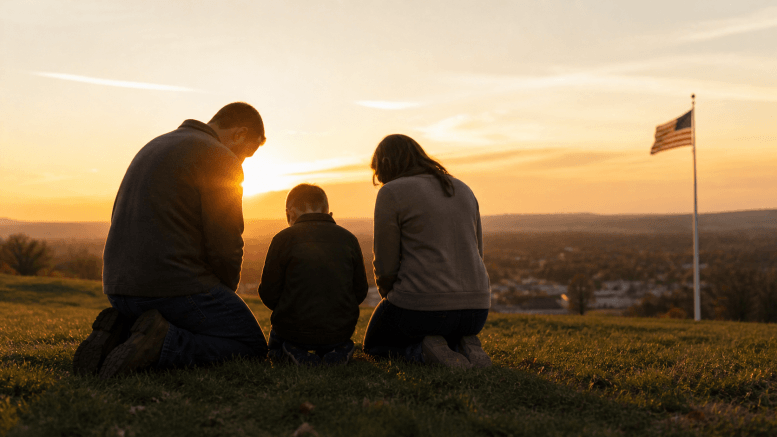
75 Years of Prayer. 250 Years of Providence. One God Who Still Hears.
Dear Christian:
This Thursday, May 7, two anniversaries collide — and most American Christians will let the moment pass without noticing.
Thursday marks the 75th annual National Day of Prayer. Just two months later, on July 4, our nation marks 250 years since the Declaration of Independence. A diamond jubilee of organized national prayer arrives in the same year as the semiquincentennial of our founding.
This is no longer about adding another event to the Christian calendar — it’s about whether the church in America will still fall on its knees before the God who raised this nation.
The National Day of Prayer Task Force chose this year’s theme with the convergence in plain sight: “Glorify God Among the Nations, Seeking Him in All Generations,” drawn from 1 Chronicles 16:24: “Tell of His glory among the nations, His wonderful deeds among all the peoples.”
The official 2026 theme artwork is Arnold Friberg’s painting The Prayer at Valley Forge — George Washington kneeling alone in the snow beside his horse, hat in hand, the Continental Army camped behind him in the worst winter of the Revolution. The image preaches before any sermon begins.
A Republic on Its Knees
Every American school child once knew the Valley Forge story. Two thousand of Washington’s eleven thousand soldiers died there in the winter of 1777-1778 — not in battle, but from cold, hunger, and disease. They wrapped bloody feet in rags. They ate bread made from flour and water and called it “fire cake.” The Continental Congress had no money to send.
And the commanding general knelt in the snow.
Whether or not every detail in the painting matches history — the often-cited eyewitness account comes from a Quaker named Isaac Potts, who said he stumbled upon Washington at prayer in the woods — the larger truth is beyond dispute. Washington publicly called the army to prayer and fasting. He issued general orders thanking Almighty God for the alliance with France. He attributed the survival of his army and the birth of the republic to “the interposition of Providence.”
Two and a half centuries later, the army of the Lord in this nation is also wintering. Not in snow, but in cultural cold. Christian conviction is mocked in the academy, ridiculed in entertainment, and increasingly criminalized in the public square. Pastors who preach the whole counsel of God are smeared as bigots. Children are taught that their bodies are mistakes and that their parents are the enemy.
And so the question for Thursday is the same question Washington faced in 1778: will the leaders kneel?
“Glorify God Among the Nations”
The theme verse comes from one of the most explosive moments in Israel’s history. King David has just brought the Ark of the Covenant — the visible sign of God’s presence — back to Jerusalem after decades of separation. The Ark had been captured by the Philistines, mishandled, and stored away. Israel had stumbled. Then God’s people repented, the Ark came home, and David broke into thunderous public worship.
His first command? Not silent meditation. Not private devotion. “Tell of His glory among the nations.”
Public. Outward. Loud.
This is not a season for whispered Christianity. The Apostle Peter writes that we are “a chosen race, a royal priesthood, a holy nation, a people for His own possession, that you may proclaim the excellencies of Him who called you out of darkness into His marvelous light” (1 Peter 2:9). The verb “proclaim” is not passive. It is a herald’s word — the kind of announcement made in a public square, not a closet.
When believers gather Thursday on courthouse lawns and Capitol grounds, that gathering is itself a proclamation. The watching nation sees the church remembering Whose the land truly is.
“Seeking Him in All Generations”
The second half of the theme cuts deeper than the first.
“In all generations.” That phrase is the harder battle, because the next generation is not automatically the believing generation. Judges 2:10 records the most chilling sentence in the Old Testament: “And there arose another generation after them who did not know the Lord or the work that He had done for Israel.”
One generation. That is all it took to lose the inheritance.
America’s first Great Awakening produced founding fathers who appealed to “the laws of nature and of nature’s God.” The second produced abolitionists who wielded Scripture against the slave trade. The Jesus Movement of the 1970s produced a generation of pastors and missionaries still fruitful today. Each awakening came when believers stopped assuming and started seeking.
Our grandchildren will inherit either a believing remnant or a generation that “did not know the Lord.” The difference is whether their grandparents knelt this Thursday.
What Washington Knew That We Have Forgotten
Read Washington’s General Orders from the Continental Army and one fact becomes impossible to ignore: the man called his soldiers to prayer constantly, by name, with no apology and no embarrassment.
In May 1778, after the alliance with France was confirmed, Washington ordered the entire army to a day of public thanksgiving and prayer. His order required chaplains to preach. It set aside time for “rejoicing.” It explicitly attributed the alliance to “the Divine Goodness” and called soldiers to acknowledge “the great hand of God” in their preservation. This was not chaplain-corps boilerplate. This was the commanding general writing in his own voice.
Two years earlier, on July 9, 1776 — five days after the Declaration was signed — Washington had ordered chaplains assigned to every regiment, and personally instructed each man to “live and act as becomes a Christian soldier.” When he took the presidential oath in 1789, by long-held tradition he added the words “so help me God” and bent to kiss the Bible. His first proclamation as President called the nation to a day of public thanksgiving to “that great and glorious Being, who is the beneficent Author of all the good that was, that is, or that will be.”
Modern Americans have been told for two generations that the founders were skeptical deists who wanted God walled off from public life. The actual record says otherwise. Washington — the indispensable man of the founding — did not separate his Christianity from his governance. He commanded both.
The question is not whether the founders prayed publicly. They did. The question is whether their descendants still will.
What 75 and 250 Mean Together
Skeptics will say a prayer rally cannot reverse the trajectory of a 250-year-old republic in moral free fall. They are partly right. Public prayer alone will not heal a nation that refuses to repent. No gathering on a Capitol lawn substitutes for the daily, on-our-knees crying out God requires of His people.
But here is what the cynics miss. The promise of 2 Chronicles 7:14 is still on the books:
“If My people, who are called by My name, will humble themselves and pray and seek My face and turn from their wicked ways, then I will hear from heaven, and I will forgive their sin and will heal their land.”
Notice who must move first. Not the Supreme Court. Not Congress. Not the academy. “My people.” God’s healing of any land begins with the humbling of the church inside that land.
The 75th National Day of Prayer falls in America’s 250th year for a reason. Washington knelt at Valley Forge and the Continental Army survived. The First Great Awakening preached the dignity of the human soul and the colonies declared independence. The God who answered then has not retired.
Just Days
You have just days. Not two months. Not two years. Just this week to rearrange your Thursday so that you are physically present somewhere — a Capitol lawn, a courthouse, a sanctuary, a park — calling on the name of the Lord with other believers.
A companion article with Central Virginia gathering locations and times is already on this site. Find one. Show up. Bring your Bible. Bring your children.
And as you kneel, remember the painting. Washington in the snow at the lowest point of the war that built this nation. He had no guarantee of victory. He had only a God who hears.
So do you.
“The Lord is not slow about His promise, as some count slowness, but is patient toward you, not wanting any to perish but for all to come to repentance” (2 Peter 3:9).
For the glory of God among the nations. For the seeking of God in all generations. For 250 more years if He tarries — and for the return of Christ if He does not.
Our hope is not in another century of American history, but in the Lord who holds history in His hands.
This Thursday. Will you kneel?