

Ninth in a series
The Abbasid Dynasty lasted from 750 until 1258. Many of Islam’s structures began to solidify during this period. The Qur’an, hadith, traditions (sunna), and schools of legal jurisprudence (Shri’a) all formed during this time. Governance structures also solidified under the Abbasid. These changes significantly impacted the peoples conquered by the early caliphs and Umayyad. Due to the nature and extent of the changes occurring during this period, we cover this dynasty over three articles. The first focuses on history. The next on religious doctrine development, and the final on the conquered peoples within the caliphate (the Dhimmi).
Thought of as Islam’s Golden Age, we should note there was much upheaval and infighting also occurring during this time. The changes within Islam during this period are both significant and complex. We cover the rise and fall of both the Fatamid and Seljuk Turk kingdoms within the Abbasid caliphate, and conclude with the crusades and Mongol invasion that ultimately ended Abbasid rule.
This is a good time to remind the reader once again the intent of this series is not to tell you what to think, but instead to simply present the facts, and provide you with references where you can find more information if you want it. It is also time to reiterate the subject of these articles is Islam’s ideas and not Muslims. These articles cover the further development of Islam’s tenets, and not its people. We are each defined by the choices we make, and those choices come from the ideas we choose to hold.
Power Shifts
The Abbasid overthrew the Umayyad in 750. They moved the caliphate’s capital to Baghdad where it came under greater Persian influence. This was not just a political revolution, but a religious one as well. The Abbasid viewed themselves not only as the caliphate’s rulers, but also as princes and kings of Islam. They more rigorously applied Islam’s principles, and were much less tolerant of other religions. They set about creating a theocratic state, based upon the Persian model “in which church and state are conjoined.”[1] For Sunni Islam (which the Abbasid represent),
“the caliph is there to guarantee the carrying out of Islamic obligations, to represent and embody in his person the duties of the Islamic community. ‘At the head of the Muslims … There must necessarily stand someone who sees to it that their laws are carried out, their statutes maintained, their borders defended, and their armies equipped, who makes sure that their obligatory taxes are collected, that men of violence, thieves, and highwaymen are suppressed, that services are held on Fridays and feast days, that minors (in need of a guardian) can be married, that the spoils of war are justly divided, and that similar legal obligations, which no single member of the community can take care of, are performed.’”[2]
Shia Persecution
The Abbasid traced their roots back to one of Mohammad’s uncles—Al-Abbas. They went out of their way in showing respect for the Umayyad they replaced. However, they viewed those following Muhammad’s cousin Ali (the Shi’a) as rivals; they, too, had a blood line claim to ruling the caliphate. During their rule the Abbasid persecuted the Shi’a.
From Goldziher, “Having plucked for themselves the fruit of Shi’a propaganda, the Abbasid had all the more reason to be on their guard against continued subversion by those who would not regard them, any more than the Umayyad, as the rightful successors of the Prophet. They strove therefore to deflect people from the veneration of Ali. Al-Mutawakkil razed the tomb of Husayn. People were not to recall at that sacred place that it was a son of Ali, and not a descendant of Abbas, who had shed his blood for the rights of the Prophet’s house … During Abbasid rule, some [Shi’a] ended their lives in prison, some on the scaffold, some by secretly administered poison.”[3]
Under the Abbasid, bureaucrats administered the empire. Viziers created decrees signed by the caliph. Hired provincials replaced the Arab army, including Turkish mercenaries (the Mamluks). Non-Muslim persecution within the empire increased. In 772, Jew and Christian hands were ordered stamped. Monasteries were sacked and burned, and many monks killed. Persecution became so severe that by the ninth century, many Christians fled to Constantinople and other Christian cities outside of Islam’s reach. We cover this aspect in a forthcoming article on Dhimmi treatment.
The Fatamid
However, not everyone readily accepted Abbasid rule. From about 909 – 1171 a Fatamid Dynasty arose within the caliphate. They took their name from one of Muhammad’s daughters, Fatima, from whom they claimed descent. Ali was Fatima’s husband—providing justification for the Abbasid concern about rivals also claiming descent from Muhammad. The Fatamid were Shi’a and their rise, in part, was a response to Abbasid Shia persecution. They viewed the Abbasid caliphs as usurpers and dedicated themselves to overthrowing the religious and political order they created. Fatamid rulers viewed themselves as spiritual leaders (imams). Initially, they established a firm base within Yemen. By 909 they were strong enough for their imam to come out of hiding and declare himself al-Mahdi (Divinely Guided One).
They established a base in modern Tunisia and spread through North Africa and into Sicily during the first half of the 10th century. At this time they added the third branch of missions (religion) to the military and political governance branches. While warring with Europe and facing internal divisions with the Berbers; the Fatamid turned eastward toward the Abbasid. In 969, after several unsuccessful years of campaigning, they broke through Abbasid defenses; taking portions of the Nile valley, Sinai Peninsula, Palestine, and southern Syria. At this time, they founded the city of Cairo. They moved as far east as Yemen, the Hijaz on the Arabian Peninsula, and into Anatolia (modern Turkey). They briefly occupied Baghdad in about 1057 after a dissident general in Iraq joined them. However, the Seljuq Turks drove them back a few years later. The map below shows the Fatamid dynasty at its height.
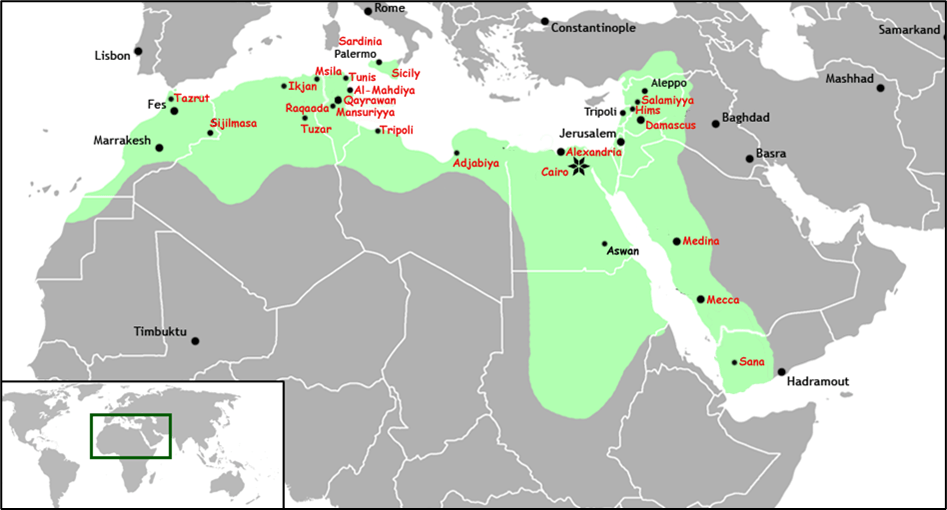
Figure 1: Fatamid Dynasty[4]
The Fatamid Collapse
However, Fatamid rule collapsed and they were gone in a little over a century. Several events conspired to their demise. First, their religious doctrine was unacceptable to the Sunni majority—the 11th and 12th century Sunni revival made that rejection a certainty. Also, the Crusades began in the 11th century, leaving no room for infighting amongst Muslim sects. Finally, the Fatamid dynasty’s later years were marked by fighting amongst Berber, Turkish, Sudanese, and Nubian troops. Plagues and famines during the final years exacerbated these conditions. Fatamid reign ended in 1171 when Saladin became Egypt’s ruler and once again established Sunni Islam there.
Seljuk Turks
The Mongol sweep across Asia drove the Seljuk Turks into southwestern Asia. The Seljuk were a warrior race, accepting Sunni Islam when they came in contact with the Abbasid. From Bat Ye’or;
“The Islamization of the Turks within the Muslim empire integrated new and unlimited forces. Uncouth and hardy, they had, since the ninth century, supplied contingents of slaves exclusively reserved for the Abbasid caliph’s guard and for military service. Thus, quite naturally, the ideology and tactics of jihad inflamed the warlike tendencies of the tribes, already roaming the Asiatic borders of the Greek and Armenian lands. They joined its ranks with the enthusiasm of neophytes and their ravages facilitated the Islamization and Turkification of Armenia, the Greek territories of Anatolia and the Balkans. Yet, it is also true that their depredations could not be controlled by the Muslim state and often harmed its economic interests.”[5]
The Turks swept westward, eventually taking control of the empire. They effectively ran the empire, with the Persians, after about 945. The Seljuk adopted the culture and language of their Persian instructors as they had no Islamic heritage or strong literary heritage of their own. This led to the Persian language’s adoption throughout the area that is now Iran.
The Seljuk Collapse
As mentioned above, the Seljuk drove the Fatamid from Baghdad, and were seen as restorers of Sunni unity within Islam. They continued pushing westward until they reached the Egyptian frontier. In the east, in 1071 the Seljuk defeated a Byzantine army at Manzikert (in Anatolia), capturing its emperor Romanus IV Diogenes. This opened the way for Turkish settlement in Anatolia. After settling into Anatolia, they became mercenaries, finding employment among rival Byzantine factions all vying for Constantinople’s throne. When the Crusades began, the Seljuk found themselves hemmed in by the Byzantine on the west and the crusaders on the east. Their practice of dividing provinces among all of a ruler’s sons led to internal power struggles and instability. They continued to weaken and by the time of the Mongol invasion, were no longer able to defend themselves. They disappeared as an autonomous power in the early 13th century.
The Seljuk left a significant imprint on Islam from both religious and political perspectives. They created a series of madrasahs providing uniform training for both administrators and religious scholars. Below is a map of the Seljuk Empire at its height (the inset) and the area under its control toward the end of its reign.
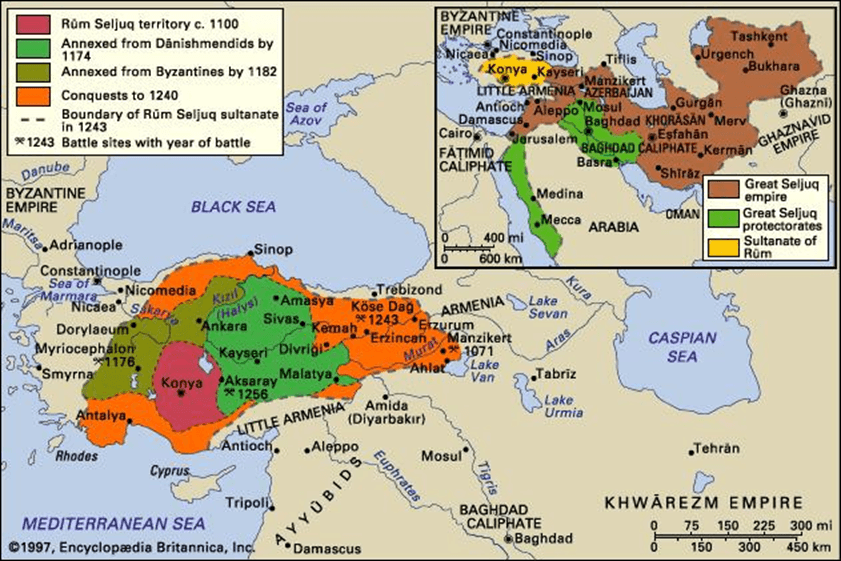
Figure 2: Seljuk Empire[6]
Byzantine Response
Abbasid advances put the Byzantines into a defensive posture. However, due to the caliphate’s non-Muslim persecution, the Byzantines switched from defense to offense. Beginning in 960, the Byzantine Emperor Nicephorus Phocas began retaking some territory from the Abbasid; reclaiming Crete, Cyprus, Cilicia, and portions of Syria—including Antioch. Losing lands considered part of dar al-Islam required Muslims waging war to reclaim them.
Forces came from all parts of the caliphate, but the Shia/Sunni split hampered the efforts. Basil II signed a ten year treaty with the Abbasid in 1001. However, the truce was not long-lived. In 1004 the sixth Abbasid caliph, Abu ‘Ali al-Mansur, rebelled violently against his mother and uncle’s Christian faith. Two of those uncles were Christian patriarchs. He ordered churches destroyed, crosses burned, and all church properties confiscated. It is estimated the caliph destroyed over 30,000 churches in the next 10 years, including the rebuilt Church of the Sepulcher in Jerusalem. He also implemented decrees intended to humiliate Jews and Christians, such as the wearing of extremely heavy crosses, and idols in the shape of calves for Jews. In 1021, this caliph mysteriously disappeared.
The Abbasid End – the Crusades, Mongols, and Mamluks
As noted above, the Seljuk Turks moved west into Persia and Asia Minor in the 11th century, fleeing the advancing Mongols of Genghis Khan. Beginning in 1070 they took portions of Asia Minor and retook Syria. They sacked Jerusalem, and established a sultanate in Nicaea. The Seljuk and Byzantine infighting reduced that Empire to an area a little larger than Greece. At this time emperor Alexius I Comnenus appealed to Rome for help.
The Crusades (1095 – 1250)
Christian pilgrimages to religious shrines housing various saint artifacts developed during the Middle Ages. There were many shrines throughout Europe and the Middle East, but three cities stood out in importance. These were Rome, Santiago de Compostela (Spain), and Jerusalem. Numerous charitable organizations developed throughout Europe supporting and protecting travelers on these journeys. These included hospitals, hospices, and bridge brotherhoods. By the High Middle Ages, every European town and most villages had at least one of these charitable organizations. Military orders also developed providing these services within Islam controlled areas. The military order’s role latter included negotiating and ransoming war captives during the crusades.[7]
Pope Urban II called for the First Crusade at the Council of Clermont in 1095. The crusades were a defensive war aimed at:
- Stemming Muslim aggression, as almost two thirds of what had been the lands of Christendom had by this time been conquered by the early caliphs, Umayyad, and Abbasid.
- Ending mistreatment of Christians living in Muslim lands (see the third article in this series on the treatment of Dhimmis).
- Ending harassment of Christian pilgrims traveling in the Holy Land.
The crusades achieved some short-lived success. The first crusade retook parts of Anatolia and Syria from the Seljuk, and Palestine—including Jerusalem—from the Fatamid. The seven crusades each had varying objectives and degrees of success. However, there was much mistrust between Byzantine and its western European allies, fueled in part by some Greek and Monophysite support given to Islamic forces. Also, many participants in the later crusades were third and fourth sons of nobles, without any wealth or land of their own. These looted and pillaged across Europe and Arabia in search of wealth both to and from the crusades.
The Mongols and Mamluks
As the crusades ended, the Mongols swept into western Asia. In 1253, Mögnke Khan assigned Hulagu Khan, Kublai Khan’s brother, the task of conquering what is now Iran, then an independent Islamic dynasty under control of the Khwarezm–who wrested control of that area from the Seljuks. Hulagu set out with an army of about 130,000, founding the Il-Khanid dynasty in 1256. The Il-Khan reunited the area under a single political authority’s rule. About this time, Hulagu Khan sent an emissary to the European powers offering help against the Abbasid. However, the Christians were too disorganized to come to any specific agreement.
Mongols destroyed Baghdad in 1258, ending the Abbasid dynasty. They then swept through Iraq and Syria toward Egypt. The Mamluks defeated them in Palestine in 1260. The Mamluks (derived from the Arabic word for slave) handed the Mongols their first known defeat in open combat. However, the Mamluk were neither Arab nor Egyptian. Saladin brought these Turkish and Circassian slave soldiers to Egypt a century earlier. Mamluk generals established their own sultanate upon the death of Al-Malik as-Salih Ayyub in 1249, ruling Egypt and portions of Syria from about 1250 to 1517. They were Sunni. We discuss the Mamluk latter, in conjunction with the Ottoman Empire.
As for the Mongols, by the end of the 13th century they lost all contact with their chieftains and embraced Islam. Their ruler Mahmud Ghazan embraced Sunni Islam, but his brother converted to Shia Islam early in the 14th century. This change gave rise to internal conflict within the Il-Khan ruled area, but was somewhat averted when a subsequent ruler converted back to Sunni Islam. Internal disputes continued and the Il-Khanid dynasty disappeared by the middle of the 14th century.
Footnotes:
[1] Goldziher, Ignaz, Introduction to Islamic Theology and Law, p. 46, Princeton University Press, 1981.
[2] Ibid, pp.182-3.
[3] Ibid, p. 137.
[4] Merchant, Jehangir A., Great Moments in Ismaili History: The Establishment of the Fatimid Caliphate, November 16, 2014, http://simerg.com/literary-readings/great-moments-in-ismaili-history-the-establishment-of-the-fatimid-caliphate/
[5] Ye’or, Bat, The Decline of Eastern Christianity under Islam, p. 52, Farleigh-Dickenson University Press, 2006.
[6] Britannica Editors. Fatimid dynasty. Encyclopedia Britannica, March 11, 2026. https://www.britannica.com/topic/Fatimid-dynasty http://www.britannica.com/topic/Fatimid-dynasty
[7] Wolf, Dan, Collectivism and Charity: The Great Deception, Living Rightly Publications, 2016.