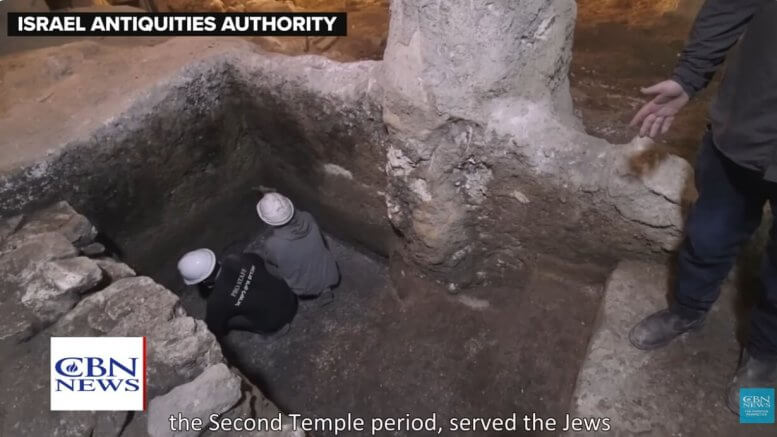
Ash. Stone. Water. History frozen in time.
What archaeologists just uncovered beneath the Western Wall doesn’t just confirm Scripture—it makes it tangible.
Archaeologists in Israel have unearthed something absolutely breathtaking beneath the Western Wall Plaza in Jerusalem. Hidden under layers of dirt and debris, they’ve discovered a ritual immersion pool–a mikvah–that served Jewish worshipers during the Second Temple period. But this isn’t just another archaeological site. Inside this ancient bath, researchers found the biological remnants of one of history’s most devastating events: the Roman destruction of Jerusalem in 70 AD.
For skeptics who claim the Bible is myth, this discovery is a problem. For believers who trust Scripture as history, it’s confirmation. Once again, archaeology doesn’t contradict the Bible–it validates it.
As Israeli tour guide Yoav Rotem puts it, this is an “Instagram moment”–a frozen snapshot in time where destruction and life collide, leaving no doubt about what happened nearly 2,000 years ago.
Watch the Full Discovery
Join CBN’s Raj Nair and Israeli tour guide Yoav Rotem as they explore this stunning find beneath Jerusalem–and explain why it matters for believers today.
Video courtesy of the Christian Broadcasting Network (CBN)
What Is a Mikvah–and Why Does It Matter?
Before we dive into the ash and stone, let’s understand what archaeologists actually found.
A mikvah is a ritual immersion pool used in Jewish tradition for ceremonial purification. In the days of the Second Temple, before entering the Temple Mount–the holiest site in Judaism–worshipers were required to be ritually pure. This wasn’t about physical cleanliness. It was about spiritual preparation to stand in the presence of God.
Mikvahs were strategically placed throughout Jerusalem, especially near major roads, public buildings, and residential areas. This particular mikvah sits just 200 feet from the Western Wall–the retaining wall of the Temple Mount built by King Herod the Great.
Here’s what makes this discovery extraordinary:
This wasn’t just a pool. It was active during the time of Jesus. When Christ walked through Jerusalem, preached in the Temple courts, and cleansed the Temple, Jewish pilgrims were using mikvahs like this one to prepare themselves spiritually.
As Yoav Rotem explains, “This ritual immersion pool, this mikvah, is in action during the time of Jesus. When Jesus goes into Jerusalem, this is happening.”
The Ash Layer: Biological Proof of Biblical History
What sets this mikvah apart from other archaeological finds is what was discovered inside it: a thick layer of ash and charred debris from the year 70 AD.
In that year, the Roman army–led by Titus–besieged Jerusalem, breached its walls, and burned the Second Temple to the ground. The Jewish historian Josephus recorded the horror in vivid detail. Jesus Himself prophesied this devastation in Matthew 24:2:
“Do you see all these things? Truly I say to you, not one stone here will be left upon another, which will not be torn down.”
The ash found in this mikvah isn’t symbolic. It’s not abstract. It’s the biological remnant of that destruction. When you touch it, you’re literally holding the physical evidence of one of the Bible’s most documented events.
As Raj Nair reflects, “When you feel the ash, you’re literally feeling the biological remnant of the Roman destruction of Jerusalem. It shows you that it’s not that far removed.”
This isn’t ancient myth. This isn’t folklore passed down through generations and embellished over time. This is history locked in stone.
Layers of Jewish History: A Timeline Beneath the Western Wall
The mikvah discovery is part of a larger excavation beneath the Western Wall Plaza that has been ongoing for over a decade. What archaeologists are uncovering is nothing short of stunning: layer upon layer upon layer of Jewish history in Jerusalem.
Here’s what they’ve found in the same excavation site:
- Remains of Jewish houses from the 8th century BC (the time of King Hezekiah)
- The mikvah from the Second Temple period (active before 70 AD)
- A synagogue from the 8th-9th centuries AD (after the Islamic conquest)
- Jewish workplaces and artifacts from the 12th-13th centuries AD (medieval Jewish presence)
Yoav Rotem describes it best: “What we’re seeing over there is a timeline of Jewish existence in Jerusalem. Jews are always there. They’re always attracted there. There is a strong connection between these people and the city, especially the Temple Mount. Every time there’s a destruction, the Jews will come back and rebuild again.”
This destroys the false narrative that Jews were expelled in 70 AD and didn’t return until 1948. Archaeology proves that Jews never left. They’ve been in Jerusalem for over 3,000 years continuously.
The Bible as History Book: Archaeology Never Contradicts Scripture
Here’s a truth that bears repeating: No archaeological discovery has ever disproven the Bible. Not one.
Critics have tried for centuries to dismiss biblical accounts as myth, exaggeration, or religious propaganda. But every time the spade hits the dirt in Israel, what emerges? Confirmation.
Archaeological confirmations of Scripture:
- The City of David (exactly where 2 Samuel says it was)
- The Pool of Siloam (where Jesus healed the blind man in John 9)
- The Pilgrimage Road (where Jesus and millions of pilgrims walked to the Temple)
- Hezekiah’s Tunnel (built exactly as 2 Chronicles 32:30 describes)
- The Tel Dan Stele (confirming the House of David)
- The Dead Sea Scrolls (proving the accuracy of Old Testament manuscripts)
- And now, this mikvah–frozen in the ash of 70 AD
The Bible isn’t just a spiritual text. It’s a historical document–and archaeology keeps proving it.
As Raj Nair observes, “We’re living in really beautiful, incredible prophetic times. God made certain promises to the Jewish people that were beyond reason, that were impossible–and yet He’s keeping those promises and He’s keeping those covenants.”
God’s Covenant Faithfulness on Display
There’s something deeply prophetic about this discovery.
For 2,000 years, the Jewish people were scattered across the globe. Empires rose and fell–Babylon, Rome, the Ottoman Turks, Nazi Germany. Each one tried to eradicate the Jewish people. Each one failed.
Meanwhile, the Jews preserved their identity, their faith, and their yearning to return to Jerusalem. Every Passover, they declared: “Next year in Jerusalem.”
In 1948, against all odds, Israel was reborn as a nation. In 1967, Jerusalem was reunited under Jewish control for the first time since 70 AD. Today, Jewish archaeologists are uncovering their own history beneath the city their ancestors never stopped loving.
This isn’t luck. This isn’t coincidence. This is covenant.
God promised Abraham in Genesis 12:7: “To your descendants I will give this land.”
God promised the Jewish people in Ezekiel 36:24: “I will take you from the nations, gather you from all the lands, and bring you into your own land.”
And He’s doing it–right before our eyes.
An “Instagram Moment” Locked in Time
Yoav Rotem uses a powerful phrase to describe this discovery: an “Instagram moment.”
What does he mean?
This isn’t a static artifact. It’s a frozen moment–a snapshot captured in ash and stone that preserves a single point in history with absolute clarity.
The Jews were using this mikvah. They were preparing to worship at the Temple. And then–destruction. Fire. Chaos. The Roman army tore through Jerusalem, burned the Temple, and left this mikvah buried under the debris of a shattered city.
But that moment didn’t disappear into myth or legend. It was locked beneath the ground, waiting to be uncovered so that 2,000 years later, we could stand in that exact spot and say: “This happened. Scripture is true. History is real.”
As Yoav says, “We’re seeing a moment in time where there’s no doubt about it. The destruction of the Second Temple combined with something that was alive–and this moment of destruction has been caught by ashes and been locked down there.”
The Apologetics Answer: Jews Are Indigenous to Judea
There’s a modern narrative that tries to rewrite history. It claims that Jews have no historical connection to the land of Israel, that they’re European colonizers who showed up in 1948 with no legitimate claim to Jerusalem or Judea.
Archaeology obliterates that lie.
As Raj Nair states plainly, “The idea that somehow the Jewish people are not indigenous to Judea is just unequivocally historical fallacy. It’s not even a debate.”
The evidence is overwhelming:
- 3,000 years of Jewish presence in Jerusalem
- Temples, synagogues, homes, mikvahs, coins, inscriptions
- Continuity through Babylonian exile, Roman occupation, Islamic rule, Crusader invasions, Ottoman control
- Return and restoration exactly as the prophets foretold
This mikvah is just one more piece of that unbroken chain. Jews didn’t vanish in 70 AD. They didn’t abandon their homeland. They were driven out, scattered, persecuted–but they never stopped being connected to this land.
And now, they’re home. Digging up their own history. Confirming their own Scriptures.
The Jewish Yearning: “Next Year in Jerusalem”
For centuries, Jewish families ended their Passover Seders with the same declaration: “Next year in Jerusalem.”
It was a prayer. A hope. A refusal to let go of the promise.
Even when Jerusalem was controlled by Romans, Byzantines, Muslims, Crusaders, Ottomans, and British–Jews never stopped longing for it. They prayed toward it three times a day. They wept over its destruction. They dreamed of its restoration.
As Yoav Rotem reflects, “Jews are always there. They’re always attracted there. There is a strong connection between these people and the city.”
That connection isn’t political. It’s not colonial. It’s covenantal.
God promised this land to Abraham, Isaac, and Jacob. He promised to bring the Jewish people back after exile. And every discovery like this mikvah is another fulfillment of that promise.
Come and See for Yourself
This mikvah isn’t open to the general public yet–it requires a special VIP tour to access. But the excavations beneath the Western Wall Plaza are ongoing, and more discoveries are being made every month.
For those who have the opportunity to visit Jerusalem, standing at the Western Wall and knowing what lies beneath is a powerful experience. You’re not just visiting a historic site. You’re standing on the physical proof of God’s faithfulness.
As Yoav urges, “Come see it with your own eyes. It’s exciting. We’re seeing destruction, but the destruction symbolizes life that were taken–and we’re seeing an Instagram moment, something where there’s no doubt about it.”
Scripture Conclusion
“The grass withers, the flower fades, but the word of our God stands forever.”
— Isaiah 40:8 (NKJV)
Key Takeaways
- A 2,000-year-old mikvah was discovered beneath the Western Wall Plaza in Jerusalem
- The mikvah contains ash from the Roman destruction of Jerusalem in 70 AD
- This biological evidence makes biblical history tangible–you can literally touch the remnants
- Archaeology has never contradicted the Bible–only confirmed it
- Layers of Jewish history (8th century BC to 13th century AD) prove continuous presence
- The narrative that Jews “appeared in 1948” is historically false
- God’s covenant promises to Israel are being fulfilled before our eyes
- The Bible is not just a spiritual text–it’s a historical document validated by the spade
Where to Learn More
Watch the Full Discovery:
Christian Broadcasting Network (CBN) – Buried Beneath Jerusalem: Ancient Mikvah Discovery
Explore Biblical Archaeology:
- Archaeology and the Birth of Christ: Top Ten Discoveries
- The Pilgrimage Road: Unearthing the Path Jesus Walked
- Cave Inscription Reveals Archaeological Evidence for Jesus
- Archaeology & Prophecy: The Unearthed Ruins of Sodom
By Jeff Bayard, Ghostwriter & Editorial Content Manager, Virginia Christian Alliance