They did not do it in the dark. They recorded every vote.
On Monday, the twenty-ninth of June, 2026, in the fifth plenary session of its 227th General Assembly, the Presbyterian Church (U.S.A.) did three things in the space of an afternoon. This was the PCUSA General Assembly’s LGBTQ vote. Each was debated. Each was voted. Each is now a matter of public record, in the denomination’s own words.
It approved, by a vote of 339 to 138, a new feature for the official system that matches pastors to congregations — a way for a church to signal, in the call process, its “openness and readiness to call an LGBTQIA+ pastor.”
It approved, by a vote of 419 to 54, a sweeping new study: a mandate to develop “theological, biblical and ethical frameworks addressing human sexuality, flourishing relationships, family and gender.”
And when a motion was offered to require that this study at least include “diverse theological views from across” the church — that is, to guarantee the historic Christian reading of Scripture a seat at the table — the Assembly refused it. The motion to keep the biblical view represented in the church’s own study of the Bible failed, 374 to 90.
We begin with the receipts because this is not a rumor, and it is not an alarm raised over what a church might someday do. It is what this church did this week, by its own hand, and wrote down.
The Plumb Line
There is a standard by which such acts are weighed. It is not ours. We did not set it, and we cannot move it.
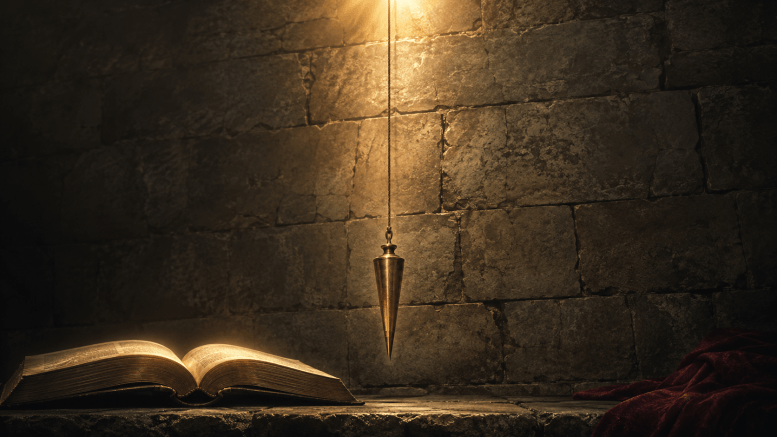
“Behold, the Lord was standing beside a wall built with a plumb line, with a plumb line in his hand. And the Lord said to me, ‘Amos, what do you see?’ And I said, ‘A plumb line.’ Then the Lord said, ‘Behold, I am setting a plumb line in the midst of my people Israel.’” — Amos 7:7–8 (ESV)
A plumb line is a weight on a string. It does not argue. It does not adjust itself to the wall. It hangs straight because the earth pulls it straight, and it shows, without malice and without exception, exactly how far a wall has leaned from true. The wall may have been built with great care. The stones may be beautiful. The builders may be sincere. The plumb line does not measure sincerity. It measures the lean.
This is the whole task of this series, and it is a narrow one. We are not here to measure hearts; we cannot see them, and their judgment belongs to God alone. We are here to hold documented acts beside the standard God set in His Word, and to say, plainly, what the line shows. Nothing more. But nothing less.
The Same Lie, One House Down
Readers of this series will recognize what they are looking at, because they have seen it before.
We spent four installments measuring the Episcopal Church against this same line — its canons rewritten, its marriage rite redefined, its own rolls testifying to the cost. When we finished, we said the story was not over, because the adversary of our souls is patient and thorough. He does not invent a new lie for each house on the street. He knocks on the next door with the one that already worked.
Here is the same lie, one house down. The Presbyterian Church (U.S.A.) does not have canons; it has a Book of Order. The word is different; the act is identical: a church editing its own rulebook to overrule the Book. For there is only one canon that finally matters. The word “canon” means a rule, a measuring reed, a standard — and that canon is the Scripture given by God. Every denomination in this series held that canon in its hands. Every one of them, reaching for the approval of the age, has quietly amended its lesser book to silence the greater one.
And when a church claims that the Spirit of God is now blessing what the Father created and the Son confirmed — male and female, one man and one woman, one flesh — it has not received some new word from the Spirit. The Spirit of God does not contradict the Word of God He Himself inspired. There is a spiritual reality beneath these votes, older and darker than any committee, and we will have more to say about it in an editorial to come. For now it is enough to mark it: this pattern is spiritual before it is institutional.
What the Record Shows About the PCUSA Vote
The feature approved 339 to 138 did not rise spontaneously from the floor, and it did not reach commissioners unaccompanied. The church maintains a permanent body, created by General Assembly mandate, whose standing work is to advise the Assembly on measures of exactly this kind — and this year’s own assembly program placed that committee before commissioners to guide them through the item. We will examine that committee, and the machinery around it, in the installment to come.
Here we note only what it means for the receipts. This was not a church caught off guard by the culture. This was a church that had built, staffed, and funded the means to move itself in one direction — and did.
That is what makes the vote of 374 to 90 the heaviest of the three. Offered the chance merely to seat the historic Christian reading of Scripture within its own study of Scripture, the Assembly declined by better than four to one. A church may drift. A church may be deceived. But a church that is handed the plumb line and votes, on the record, not to look at it — that church has told us something about itself, in its own voice, that we did not have to supply.
The Lampstand Is Not Yet Removed
We do not write this to gloat. There is no gloating in it. These are congregations with faithful men and women still in their pews, and there is no joy in watching a lampstand gutter.
But it is a lampstand we are watching — and that is the hope, because the lampstand is not yet removed. To the church at Ephesus, a church that had left its first love, the risen Christ, who walks among the lampstands and holds them in His hand, said this:
“Remember therefore from where you have fallen; repent, and do the works you did at first. If not, I will come to you and remove your lampstand from its place, unless you repent.” — Revelation 2:5 (ESV)
Read that again and notice the mercy in it. The warning is not the sentence; the warning is the door held open. Christ tells the falling church the truth precisely because there is still time to turn. The lampstand is removed by His hand alone, and only when the warning has been refused to the end. Ours is not that hand. We do not extinguish anyone’s lamp, and we do not pronounce it extinguished. We are watchmen, and the watchman’s task, when the appointed watchmen have gone silent, is simply to see the sword coming and to blow the trumpet. The blowing is itself an act of mercy.
So we sound it, without pleasure and without despair. The Presbyterian Church (U.S.A.) has, this week, leaned further from the line. The line has not moved. And the God who set it is sovereign still over every General Assembly and every human vote — able, even now, to grant repentance to a church, or to raise a more faithful one from the ground where an old one fell. We have already seen Him begin to do the latter. We will come to that, too.
The wall leans. The plumb line hangs straight.
No assembly has ever voted a church back to life, and no tally of hands has ever raised the dead. But the God who set the plumb line still stands over His house — and the wall He measures crooked, He is able to make straight.
Next in the series — Part Two: The Redline in the Book of Order. The words struck from the church’s own constitution, and the day it edited its book to overrule the Book.
— The Editorial Board, Virginia Christian Alliance
Unless otherwise noted, Scripture quotations are from the English Standard Version (ESV).